Review the 14-slide course on preparation boundaries, actionable gaps, scope and reporting questions, and an honest assessment handover.
Scott’s review pass complete. The PPTX contains the owner-recorded narration script in speaker notes. No audio or video has been produced. This page is noindex and outside the public catalog; it is not access-controlled.
Trainer edition 0.1.3+20261118T215034Z · Draft for review
RECORDING SCRIPT · NOT RECORDED AUDIO
Welcome to this ThrivePCI course on preparing for an assessment engagement. Our fictional organization, Lumen Courses, has a scheduled assessment and a collection of unresolved questions. Some belong to internal control owners, some need provider input and some require clarification from the appropriate reporting party. We will organize those questions without creating a readiness score or claiming the organization is ready. The goal is a clearer handover that distinguishes available evidence, open gaps and decisions still needed. This course does not determine scope, reporting eligibility, remediation acceptance or an assessment outcome. Those matters follow the relevant requirements, program instructions and engagement arrangements.
Distinguish preparation from assessment validation
Describe an actionable gap
Prepare a handover with visible dependencies
RECORDING SCRIPT · NOT RECORDED AUDIO
By the end, you should be able to explain which tasks prepare an organization for assessment and which activities belong to the assessment itself. You should be able to turn a vague issue into a gap with an owner, expected output and next review point. You will also assemble a practical handover covering known facts, evidence locations and unresolved decisions. We will use fictional records only. The handover format is a practitioner aid and does not replace the applicable report template, scoping confirmation or formal evidence requirements. A completed preparation checklist should support a discussion, not become an unsupported assertion that every requirement is satisfied.
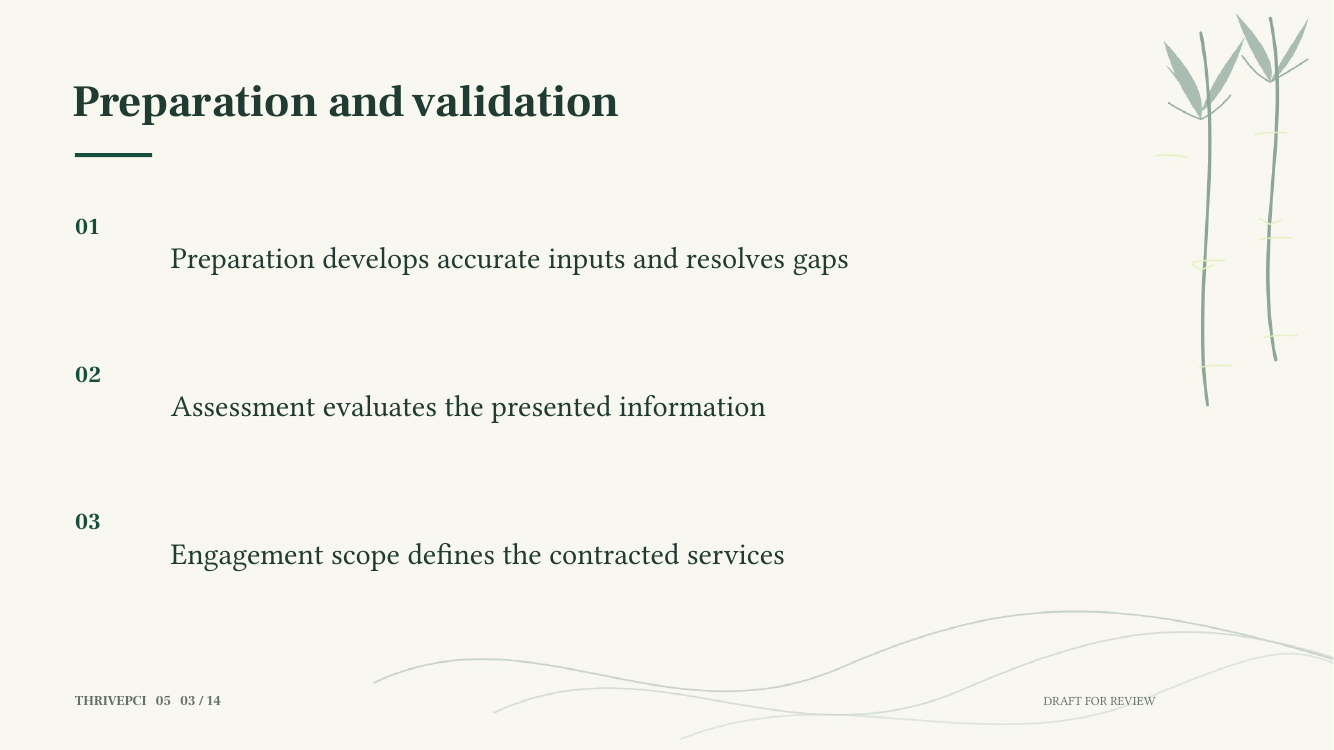
Preparation develops accurate inputs and resolves gaps
Assessment evaluates the presented information
Engagement scope defines the contracted services
RECORDING SCRIPT · NOT RECORDED AUDIO
Preparation can include understanding requirements, organizing records, investigating gaps and performing remediation. Assessment evaluates the presented environment and evidence using the applicable procedures. An organization may engage external help for preparation, but that role should be clear in the agreement. Do not assume the assessor is responsible for creating your scope narrative, building provider mappings or performing missing control activities. Equally, do not infer a universal rule about remediation rounds or engagement timing from this course. Those arrangements need the applicable program and contract context. Lumen’s program owner confirms the agreed services and directs preparation tasks to the appropriate internal or readiness owner.
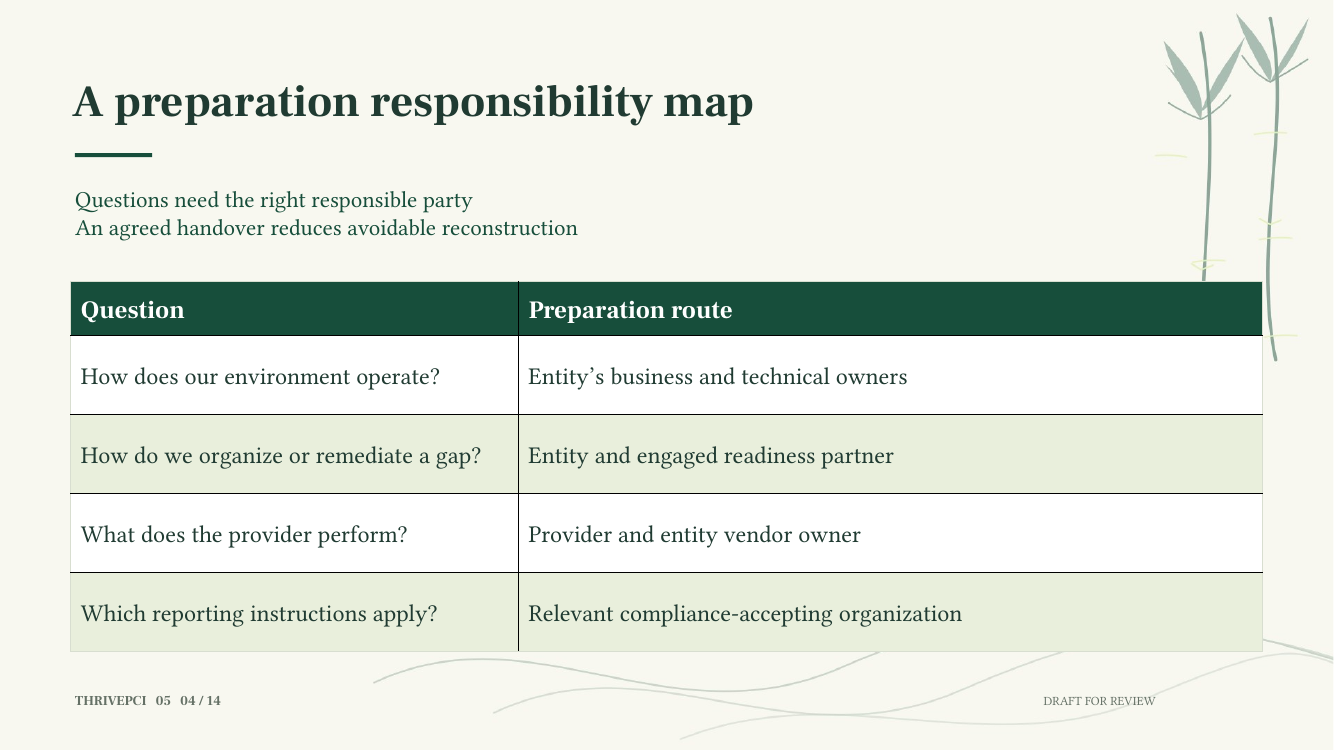
An agreed handover reduces avoidable reconstruction
Question
Preparation route
How does our environment operate?
Entity’s business and technical owners
How do we organize or remediate a gap?
Entity and engaged readiness partner
What does the provider perform?
Provider and entity vendor owner
Which reporting instructions apply?
Relevant compliance-accepting organization
RECORDING SCRIPT · NOT RECORDED AUDIO
This map shows who can help with different preparation questions. The organization describes its environment and substantiates its activities. A readiness partner can assist with preparation where engaged. A provider supplies relevant service and responsibility information. The assessor performs assessment validation within the engagement. The compliance-accepting organization supplies applicable reporting expectations. The precise arrangement may involve additional parties, so confirm rather than assume the roles. The map does not delegate the organization’s accountability to an outside helper. Its value is to route the question to someone who can provide the needed input and identify where formal clarification is still required.
Source note (not spoken): PCI DSS v4.0.1, section 11 and 12.8–12.9; practitioner role map
SLIDE 05 · content
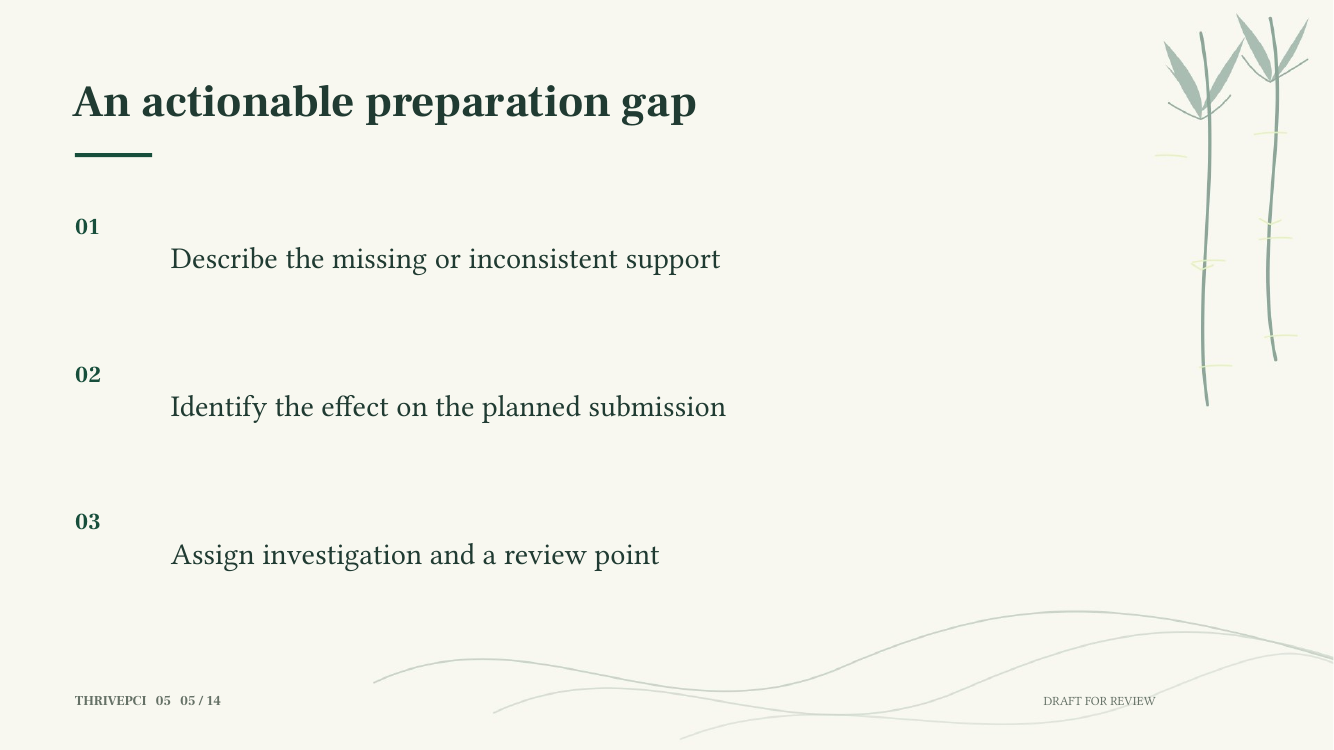
An actionable preparation gap
Describe the missing or inconsistent support
Identify the effect on the planned submission
Assign investigation and a review point
RECORDING SCRIPT · NOT RECORDED AUDIO
A gap should explain what is missing, inconsistent or unresolved. Lumen has a provider responsibility statement that does not match the current service arrangement. A useful gap note identifies that mismatch and the affected submission. It names the vendor owner who will obtain clarification and the review point when the team will revisit the answer. Avoid labeling a gap as resolved merely because someone uploaded another document. The new material needs review against the original question. Also distinguish the preparation team’s internal status from any assessment result. A team can track remediation progress while leaving the final evaluation to the appropriate assessor and process.
Source note (not spoken): PCI DSS v4.0.1, section 10 and 12.8.5; practitioner gap method
SLIDE 06 · content
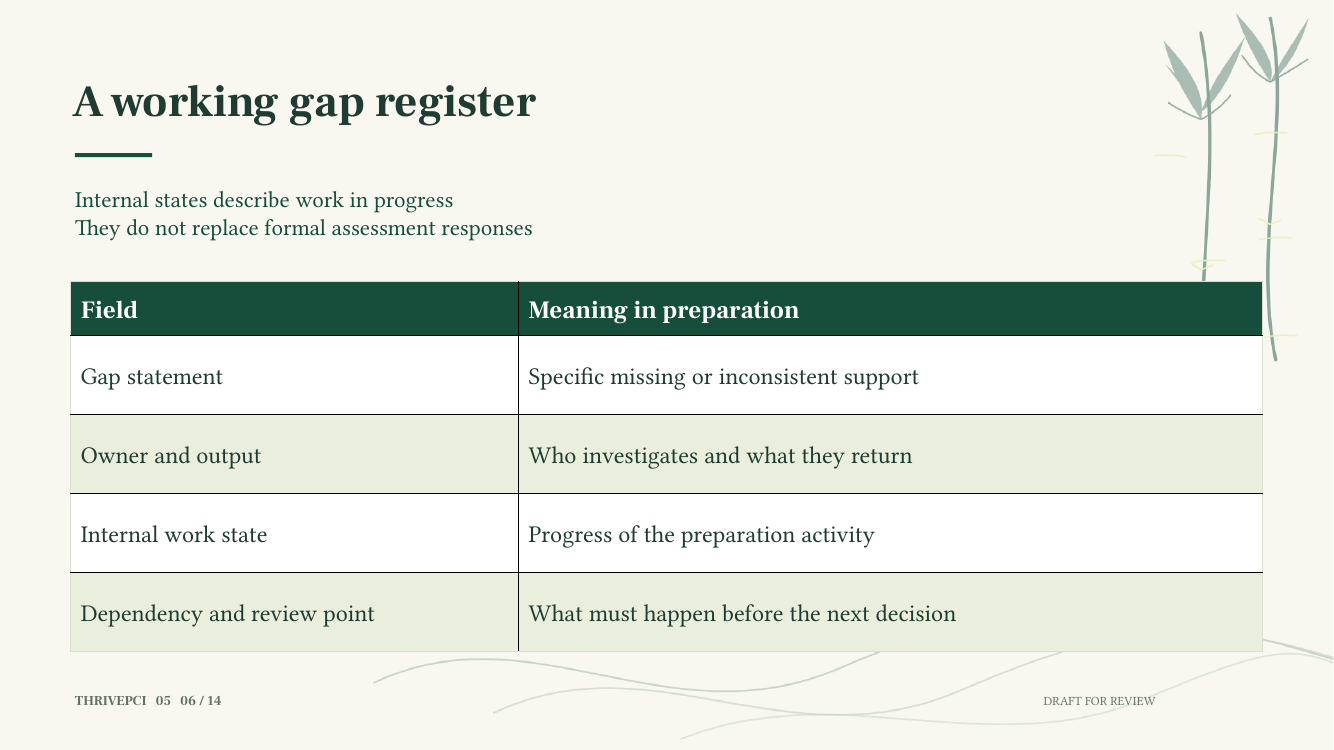
A working gap register
Internal states describe work in progress
They do not replace formal assessment responses
Field
Meaning in preparation
Gap statement
Specific missing or inconsistent support
Owner and output
Who investigates and what they return
Internal work state
Progress of the preparation activity
Dependency and review point
What must happen before the next decision
RECORDING SCRIPT · NOT RECORDED AUDIO
Lumen uses simple internal states such as identified, assigned, evidence received and ready for preparation review. These states describe the workstream, not the formal status of a PCI DSS requirement. A separate field records the owner, expected output and open dependency. When authentic new evidence arrives, the team checks whether it addresses the original issue and what still remains unresolved. It should not silently convert a platform completion or internal review into an assessor conclusion. The register is especially useful when several teams depend on one another. It shows why a handover may still be incomplete even when an individual owner has finished their assigned task.
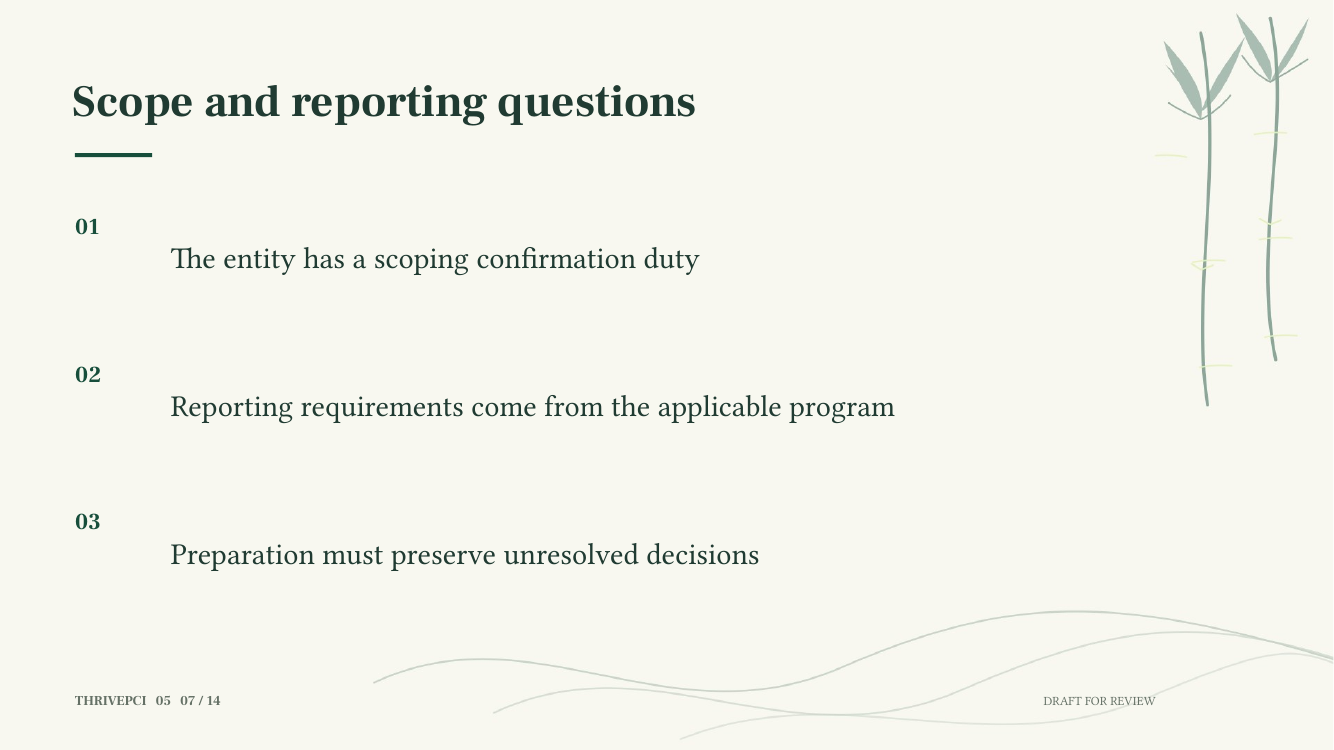
Reporting requirements come from the applicable program
Preparation must preserve unresolved decisions
RECORDING SCRIPT · NOT RECORDED AUDIO
Scope and reporting questions need particular care. PCI DSS requirement 12.5.2 calls for the entity to document and confirm scope at least once every twelve months and after significant changes to the in-scope environment. Service providers have an additional frequency requirement under 12.5.2.1. Reporting requirements and instructions come from the organizations that manage compliance programs, as explained in section eleven. Lumen should not choose a reporting path from a simplified course example or assume the assessor will define its environment for it. The organization prepares accurate information, obtains appropriate direction and preserves documented decisions. The assessor then validates scope within the assessment process.
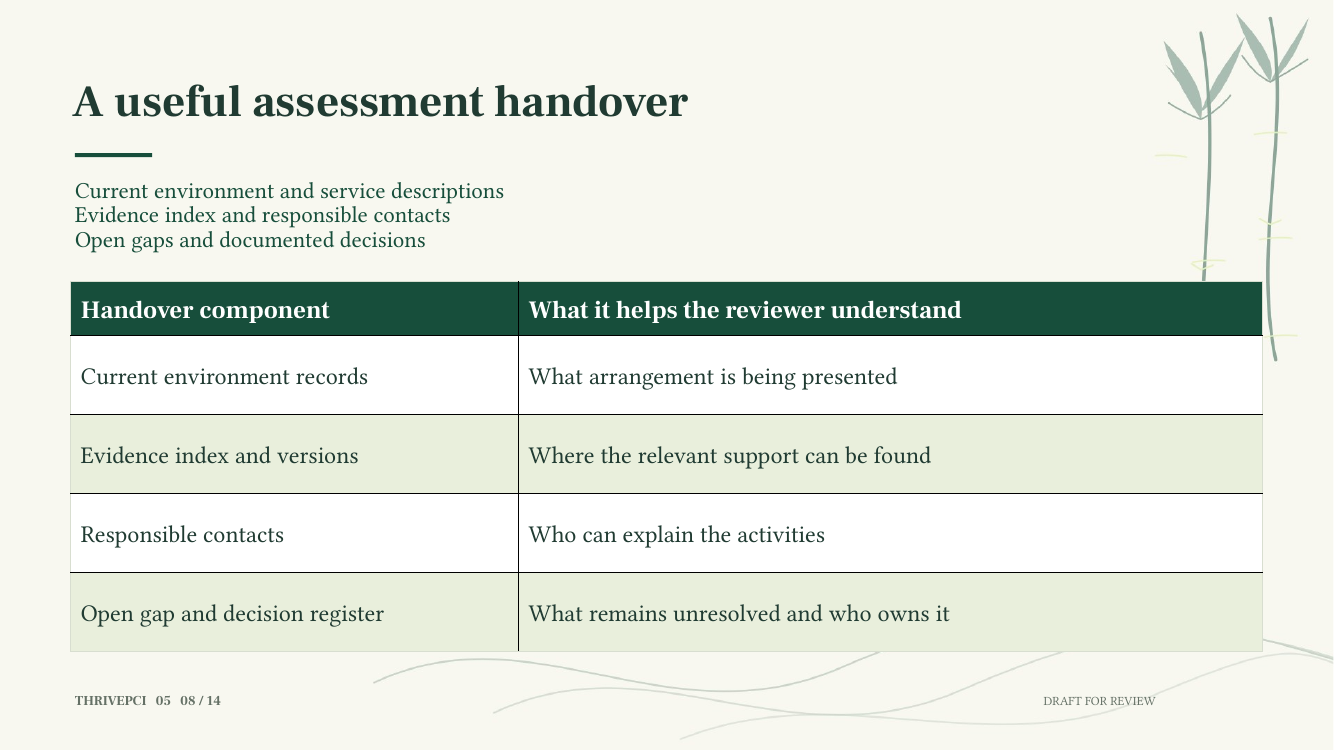
A handover should help the next party understand the current state without reconstructing it from scattered messages. Lumen includes current environment and service descriptions, relevant scope and reporting records, an evidence index and contacts who can explain the activities. It separates unresolved gaps from material the preparation team has reviewed. The package should also identify versions and coverage periods so older records are not mistaken for current support. This list is a practitioner organization aid. The applicable report template, testing procedures and engagement requests still determine the actual information needed. Use the approved evidence channel and avoid duplicating confidential material into unnecessary locations.
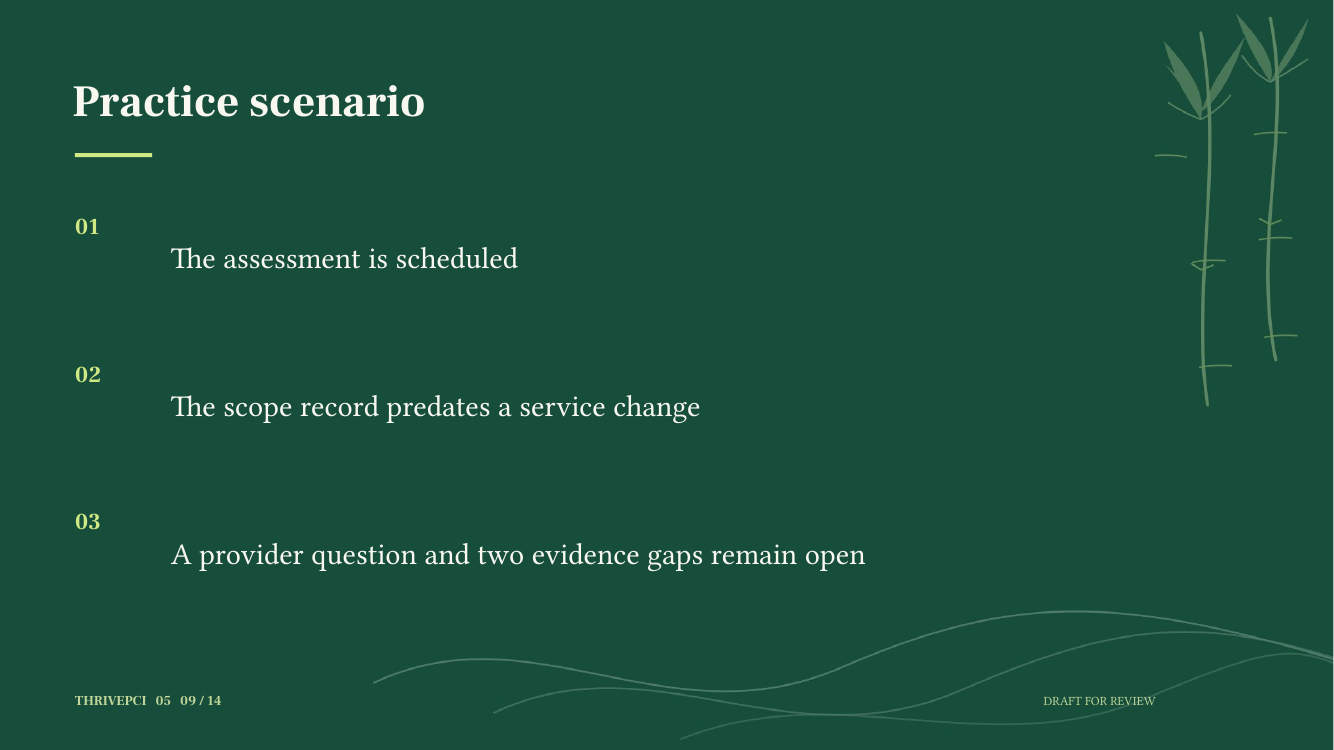
A provider question and two evidence gaps remain open
RECORDING SCRIPT · NOT RECORDED AUDIO
Pause and organize Lumen’s fictional situation. The assessment is scheduled. The scope record predates a service change, a provider responsibility question remains open and two submissions lack the requested supporting material. The program lead wants to mark preparation complete to meet the internal calendar. Write a handover note that states what is available and what remains unresolved. Assign the next action for each gap. Do not declare the organization ready or unready for assessment based on this course. Your task is an accurate preparation account that lets the responsible parties understand the changed facts, dependencies and limits of the available information.
Source note (not spoken): Practitioner exercise based on PCI DSS v4.0.1, 12.5.2 and 12.8.5
SLIDE 10 · content
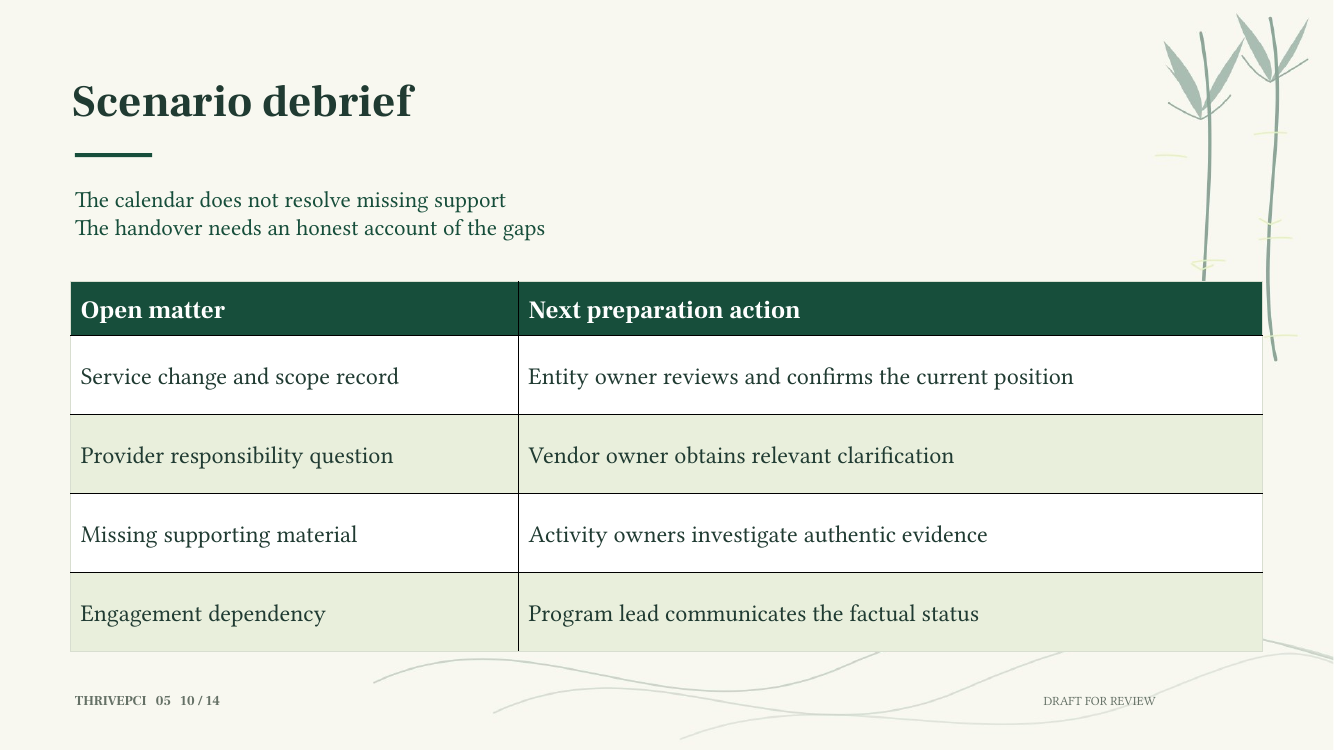
Scenario debrief
The calendar does not resolve missing support
The handover needs an honest account of the gaps
Open matter
Next preparation action
Service change and scope record
Entity owner reviews and confirms the current position
Provider responsibility question
Vendor owner obtains relevant clarification
Missing supporting material
Activity owners investigate authentic evidence
Engagement dependency
Program lead communicates the factual status
RECORDING SCRIPT · NOT RECORDED AUDIO
The handover should identify the service change and route the scope record to the entity’s responsible owner for appropriate review and confirmation. It should identify the provider question, its owner and the expected service-specific response. Each evidence gap needs a specific request for authentic supporting material or an accurate explanation of the limitation. The program lead can communicate the current state and dependencies to the relevant engagement contacts. Scheduling and any remediation arrangements must follow the actual engagement and program context. The key lesson is that an internal deadline cannot make an unresolved question disappear. A transparent handover is more useful than a complete-looking dashboard with unsupported assumptions.
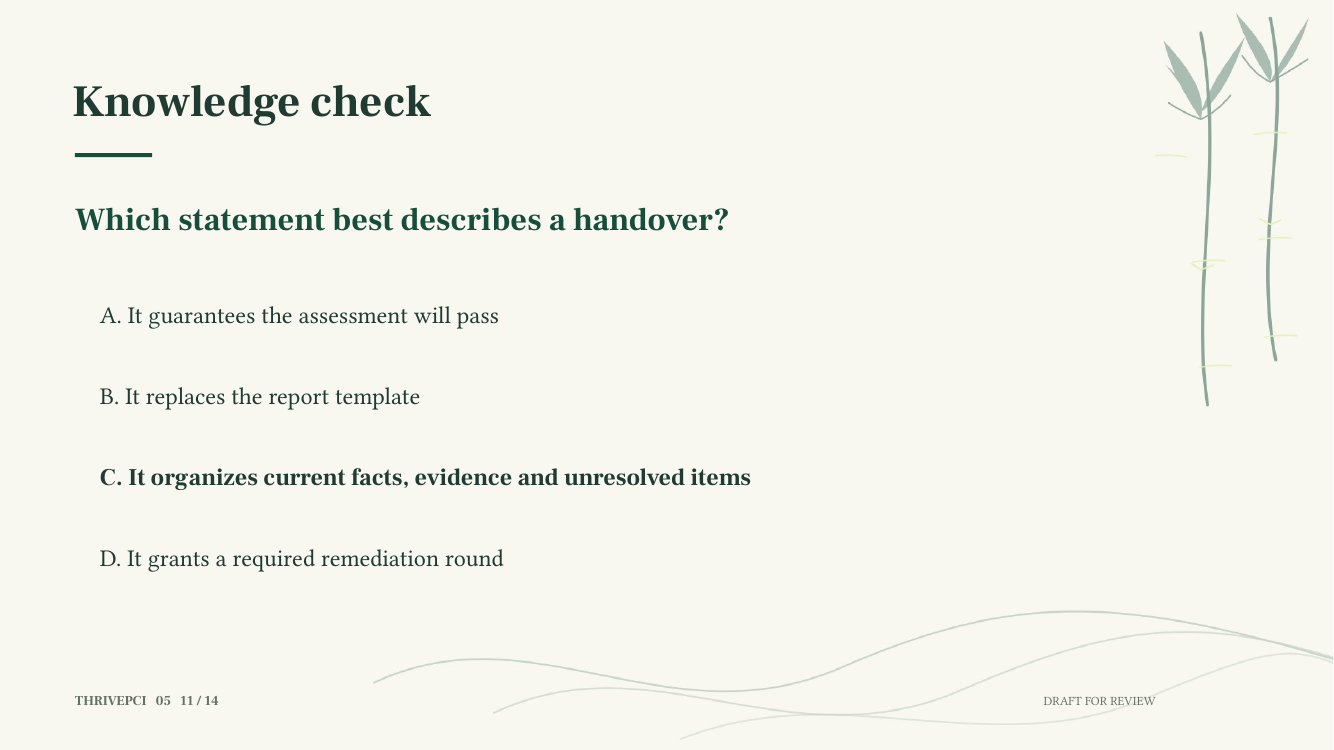
C. It organizes current facts, evidence and unresolved items
D. It grants a required remediation round
RECORDING SCRIPT · NOT RECORDED AUDIO
Choose the statement that best describes the handover we have built. A says it guarantees a successful assessment. B says it replaces the formal report template. C says it organizes current facts, evidence and unresolved items. D says it grants a required remediation round. Pause and choose the supported answer. Consider the boundary between a practitioner preparation tool and a formal program or engagement requirement. A useful handover can make work easier to understand, but it cannot create authority or contractual rights. Explaining that limit helps the organization plan support and communicate accurately with its readiness and assessment partners.
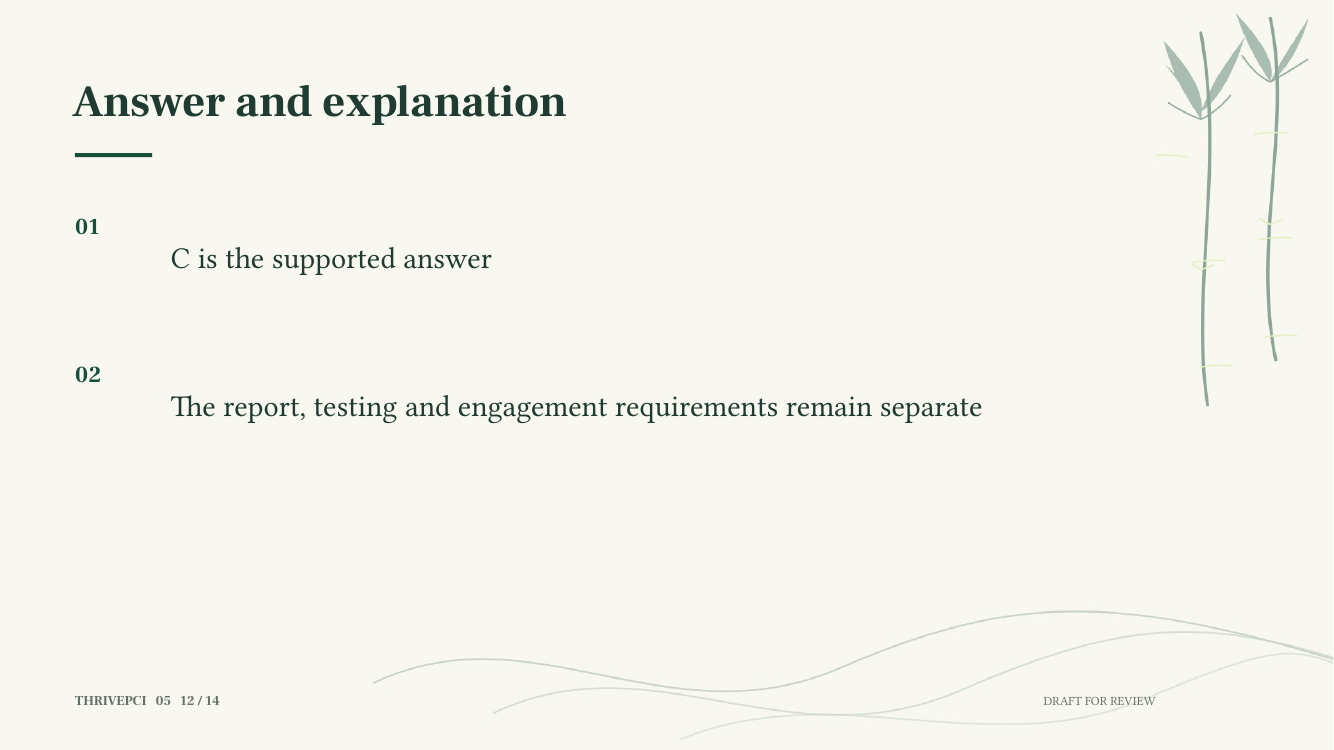
The report, testing and engagement requirements remain separate
RECORDING SCRIPT · NOT RECORDED AUDIO
C is correct. The handover organizes what the organization can substantiate and makes unresolved items visible. It supports the assessment process without replacing its required documentation or testing. It also does not promise a result or a universal remediation entitlement. Those questions need the actual standard, program instructions and engagement terms. Lumen benefits because its teams can see which record is current, where support is located and who owns each next action. This does not eliminate difficult findings. It reduces avoidable confusion and helps ensure that the presented information accurately reflects the organization’s activities and known limitations.
Prepare a short handover brief for a fictional or redacted environment. Describe the current arrangement and the versions of the relevant records. Link the evidence index and identify people who can explain the activities. List open gaps with their owners, expected outputs and dependencies. Distinguish documented decisions from questions still under review. Compare the brief with the applicable report template and actual engagement requests before treating it as a complete submission. Use the readiness partner for preparation support where engaged, and preserve the assessor’s validation role. The objective is an accurate handover, not an internal claim that all requirements are satisfied.
Our reference baseline is PCI DSS version 4.0.1. The introductory sections address scope, assessment practices, testing and reporting context. Requirements 12.5.2 and 12.5.2.1 support the scoping discussion, while 12.8.5 supports provider responsibility correlation. Read the exact applicability and frequency details in the standard. The gap register and handover brief are practitioner methods, not mandatory Council templates. This course does not select a reporting path, determine final scope, decide compliance or establish a contractual remediation process. It remains a review draft for education. Apply current authoritative instructions and the appropriate responsible parties’ documented decisions to an actual engagement.
This course does not determine scope, reporting eligibility, remediation acceptance, compliance, or an assessment outcome. Apply the authoritative standard and engagement instructions to the actual circumstances.