A 14-slide working course on aligning the service consumed, provider coverage, responsibility information, and customer-retained work.
Scott’s review pass complete. The PPTX contains the owner-recorded narration script in speaker notes. No audio or video has been produced. This page is unlisted and noindex; it is not access-controlled and is not in the public training catalog.
Consumed services, responsibility mapping and retained work
Trainer edition 0.1.1 · Draft for review
Recording script: Welcome to this ThrivePCI course on third-party service provider responsibilities. Our fictional organization, Summit Classes, uses several external services. The program owner has a provider’s Attestation of Compliance but does not know whether it covers the specific service the business consumes or how responsibilities divide. We will work through a service-first preparation method. The goal is to make reliance on a provider explainable, including the work that remains with the organization. This course does not validate a real provider, establish scope or decide whether a requirement is met. Use current, service-specific records and the appropriate responsible parties when applying the approach.
SLIDE 02 · REVIEW COPY
Learning objectives
Identify the service actually consumed
Correlate provider coverage and responsibility information
Record retained work and unresolved questions
Recording script: By the end, you should be able to describe the specific service an organization consumes, identify relevant provider documentation and explain why a supplier name alone is insufficient context. You should be able to prepare a requirement-level responsibility map where relevant and identify supporting evidence for retained or shared work. You will also practice writing a provider question that can produce a useful answer. Our mapping format is a practitioner aid. The actual requirements and service arrangements govern what must be maintained and validated. Do not upload real provider contracts or client evidence into a public training environment. We will work entirely with fictional descriptions.
SLIDE 03 · REVIEW COPY
The consumed service
Provider name and service coverage are different facts
The deployed arrangement needs a current description
Responsibility analysis starts with the actual service
Recording script: Summit Classes uses a fictional provider called CedarCloud. CedarCloud offers hosting, managed infrastructure and optional security services. A document naming CedarCloud does not automatically tell Summit which activities its own contract and deployment include. The preparation team records the service name, covered environment, service configuration and the provider documents that relate to it. This avoids relying on a broad vendor label. The team also identifies any uncertainty about the provider’s role. A service description is an input to responsibility analysis, not a conclusion that the provider performs every PCI DSS activity. Keep the analysis aligned with the actual consumed service and the applicable documents.
SLIDE 04 · REVIEW COPY
A provider evidence packet
Each document answers a different question
Coverage needs correlation to the consumed service
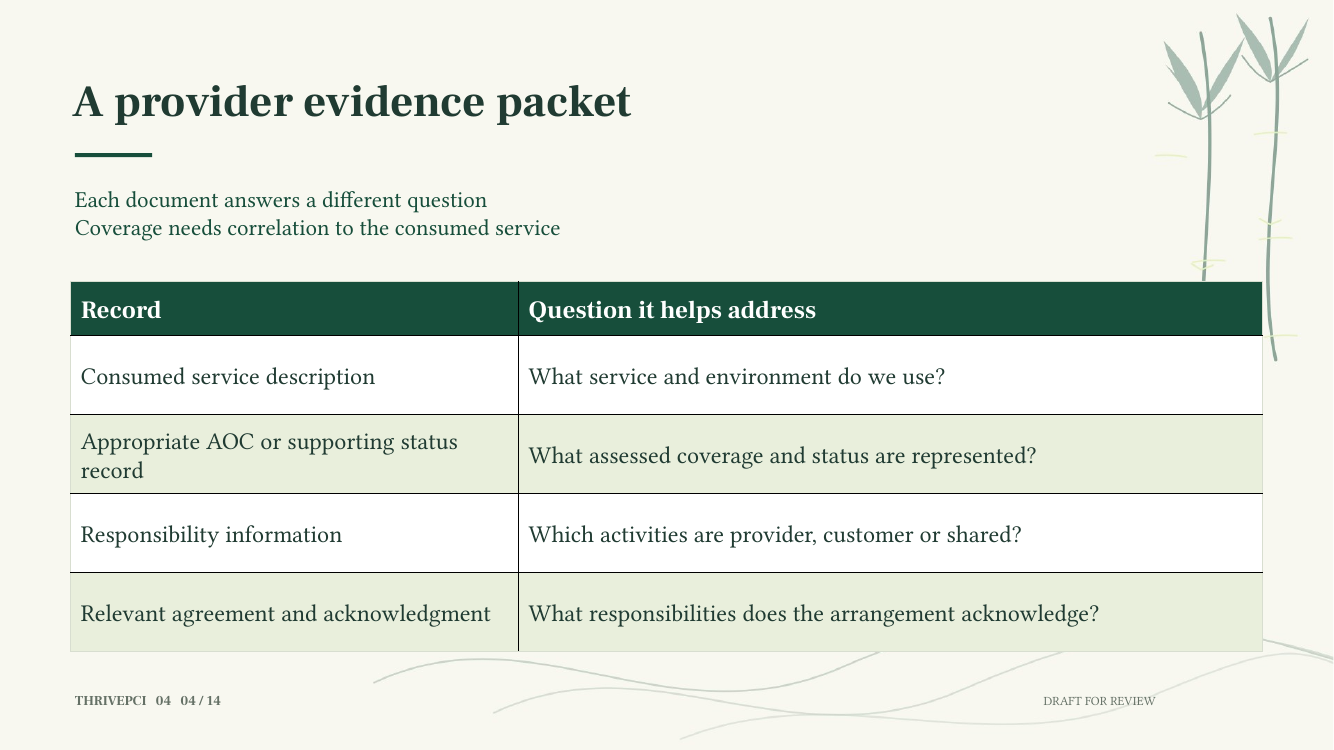
Recording script: The packet shown here organizes several types of information. A service description helps establish what is consumed. An appropriate Attestation of Compliance can support understanding of assessed service coverage and status. Responsibility information helps identify provider, customer and shared activities. Relevant agreement terms address the service arrangement and applicable acknowledgment. These records serve different purposes, and one should not be assumed to replace another. Requirement 12.8.2 addresses written agreements with applicable provider acknowledgment. Requirement 12.8.4 addresses monitoring provider compliance status. Requirement 12.8.5 addresses responsibility information. The team needs to read the actual documents and resolve mismatches rather than treating a packet as complete because all filenames exist.
SLIDE 05 · REVIEW COPY
Provider, customer and shared work
12.8.5 calls for responsibility information
12.9.2 is an additional requirement for service providers
Customers retain and evidence their assigned work
Recording script: Requirement 12.8.5 calls for the entity to maintain information about which PCI DSS requirements each third-party service provider, or TPSP, manages, which the entity manages, and which are shared. A requirement-level map helps, but where a requirement contains relevant sub-requirements or distinct activities, record enough detail to explain the division. Requirement 12.9.2 is an additional requirement for service providers only. Upon customer request, a TPSP supports requests for compliance-status and responsibility information under Requirements 12.8.4 and 12.8.5. The responsibility-information provision applies to services the TPSP provides that meet a PCI DSS requirement on the customer’s behalf or can impact the security of the customer’s cardholder data or sensitive authentication data. The customer still maintains its required information and evidence for retained work. Do not infer responsibility from a provider name, a broad attestation, or a shared label alone.
SLIDE 06 · REVIEW COPY
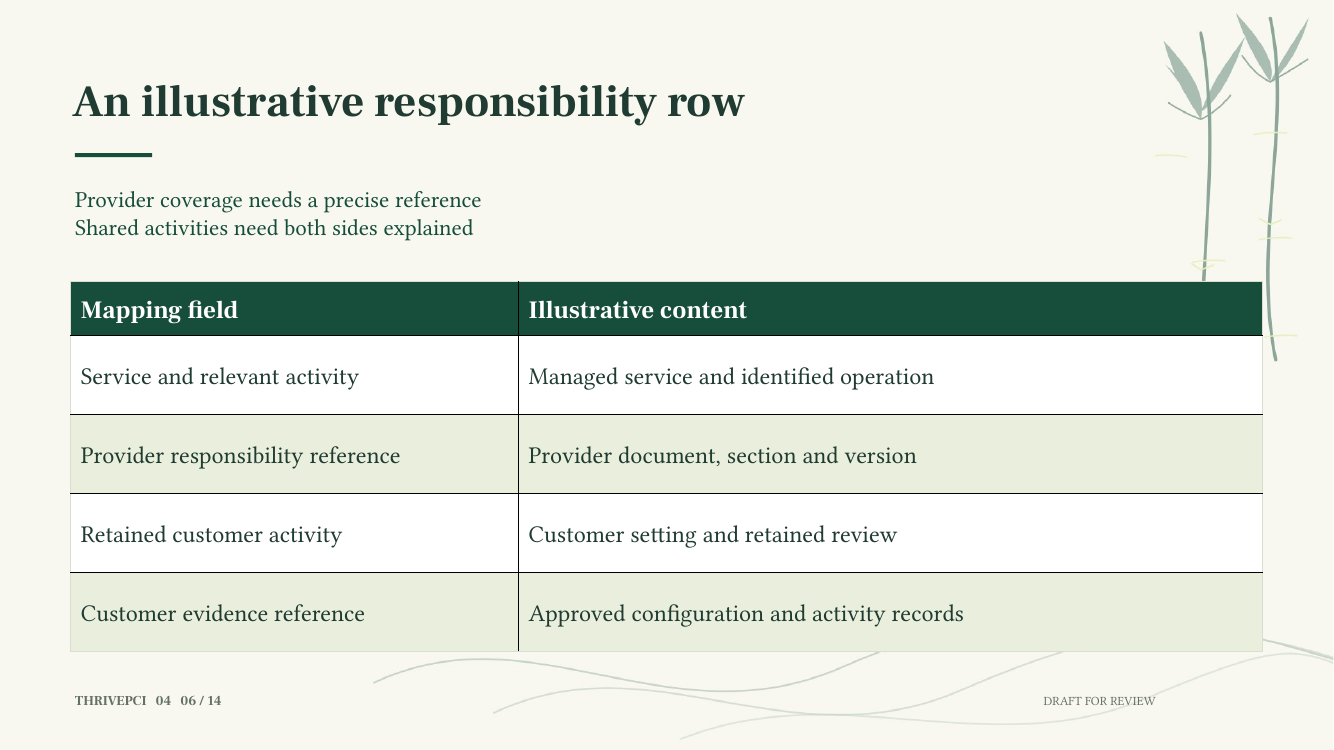
An illustrative responsibility row
Provider coverage needs a precise reference
Shared activities need both sides explained
Recording script: This fictional row describes a managed security service. The provider operates one activity identified in its responsibility information, while Summit configures an agreed customer-side setting and performs its retained review. The row includes a provider-document reference and a separate customer-evidence reference. We are not asserting that this example satisfies a particular numbered requirement. Its purpose is to demonstrate the information needed to investigate a shared arrangement. If a provider document is silent or conflicts with the agreement, record that gap and ask a specific question. Do not allocate responsibility by assumption or treat a blank cell as evidence that no one needs to perform the activity.
SLIDE 07 · REVIEW COPY
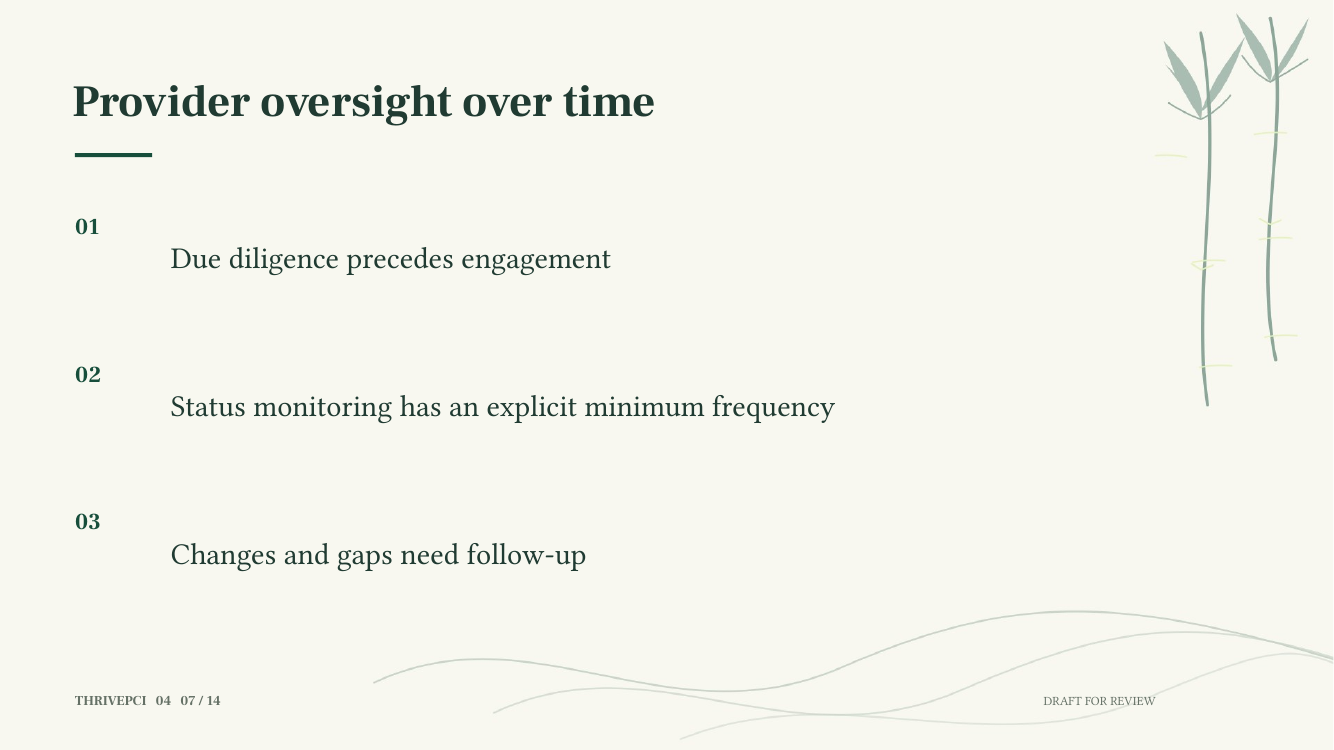
Provider oversight over time
Due diligence precedes engagement
Status monitoring has an explicit minimum frequency
Changes and gaps need follow-up
Recording script: Provider oversight continues after onboarding. Requirement 12.8.3 addresses due diligence before engagement, and requirement 12.8.4 calls for monitoring the provider’s PCI DSS compliance status at least once every twelve months. That minimum does not mean a team should ignore a known service change or a gap between the consumed service and the available coverage. Summit keeps service ownership and open questions visible. The organization must work with the provider where it relies on the provider for applicable requirements. If the provider does not meet those applicable requirements, the standard’s applicability guidance explains the effect on the entity’s status. The actual determination needs appropriate evidence and assessment review.
SLIDE 08 · REVIEW COPY
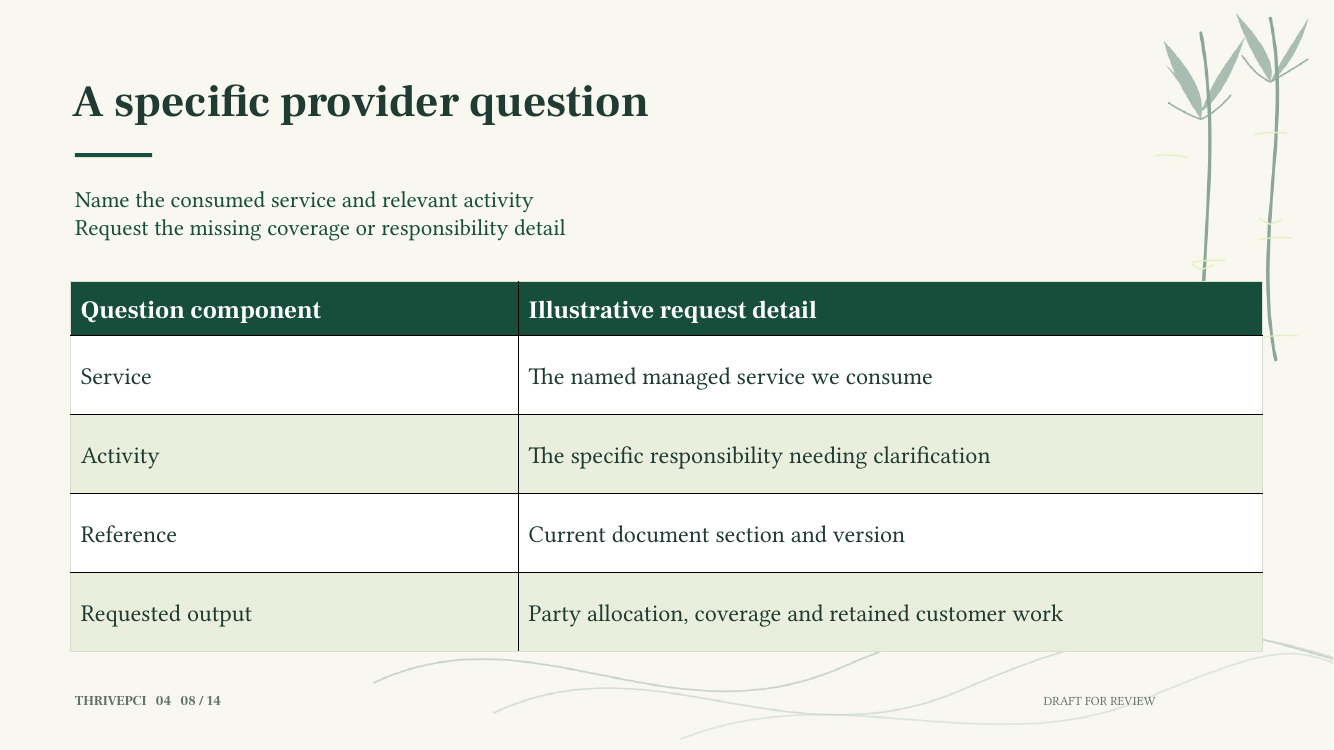
A specific provider question
Name the consumed service and relevant activity
Request the missing coverage or responsibility detail
Recording script: A useful request to CedarCloud identifies the consumed service and the document section that caused uncertainty. It asks which party performs the relevant activity, what the provider’s supporting coverage includes and what Summit must retain. It can also ask for the current responsibility information and relevant status documentation. A generic message asking whether the vendor is PCI compliant may produce a broad response that does not resolve Summit’s actual question. Keep the request proportionate and use the agreed business channel. A response still needs review against the service arrangement. Provider support helps preparation, but the customer must understand and substantiate its retained work.
SLIDE 09 · REVIEW COPY
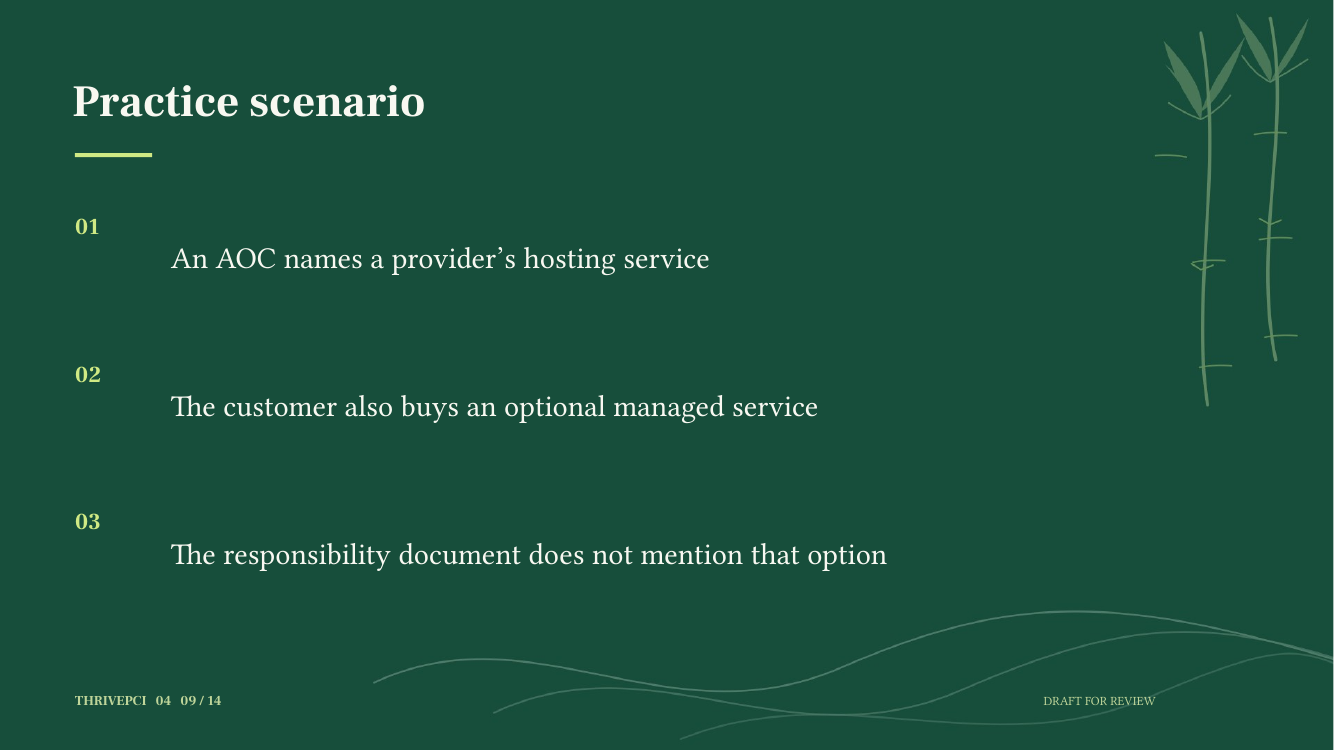
Practice scenario
An AOC names a provider’s hosting service
The customer also buys an optional managed service
The responsibility document does not mention that option
Recording script: Pause and consider Summit’s fictional service arrangement. The available AOC names a hosting service. Summit also purchases an optional managed service, but the supplied responsibility information does not mention that option. The team plans to mark all relevant work as provider-managed. Write the preparation gap and a concise provider question. Identify who at Summit should own the follow-up. Avoid declaring the optional service covered, uncovered or compliant based only on this scenario. We do not have enough information. The exercise is to notice the mismatch and obtain the exact service and responsibility detail needed for a defensible analysis.
SLIDE 10 · REVIEW COPY
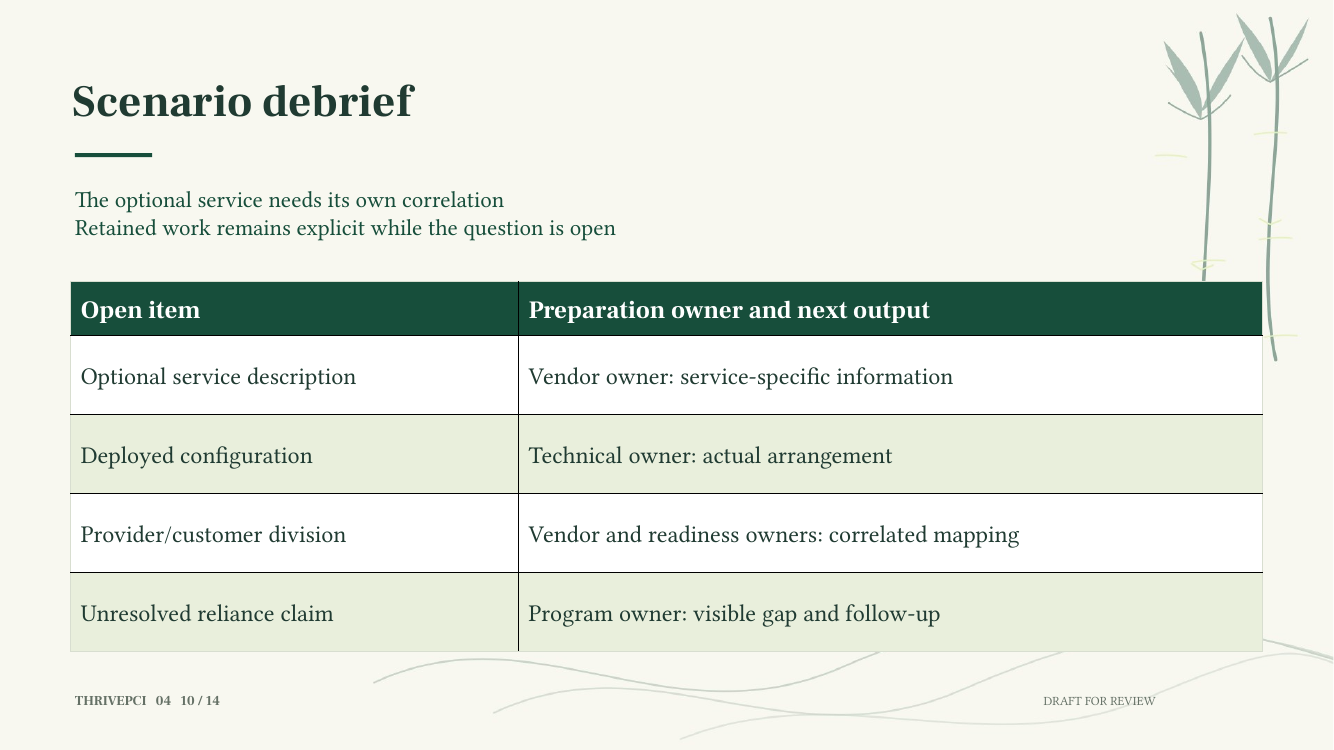
Scenario debrief
The optional service needs its own correlation
Retained work remains explicit while the question is open
Recording script: A useful gap note identifies that the supplied coverage and responsibility documents do not yet explain the optional managed service. The vendor owner asks CedarCloud for current service-specific coverage and responsibility information, including what Summit must configure or perform. The program owner keeps the affected reliance claim unresolved until the relevant information is reviewed. The technical owner helps describe the actual deployed arrangement. No one should silently treat a broad hosting statement as proof of an optional service’s responsibilities. The final assessment treatment depends on the actual documents and evidence. Our debrief improves the preparation inputs without pretending to make that determination.
SLIDE 11 · REVIEW COPY
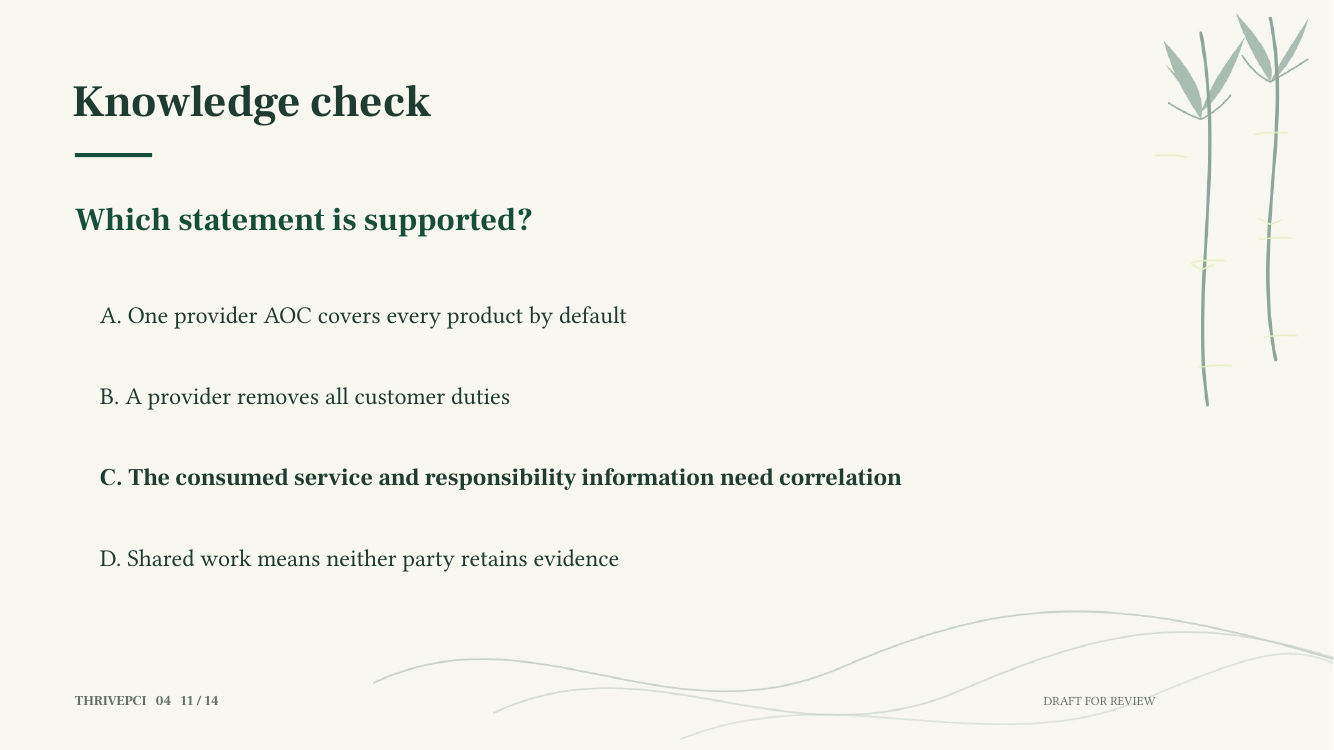
Knowledge check
Which statement is supported?
A. One provider AOC covers every product by default
B. A provider removes all customer duties
C. The consumed service and responsibility information need correlation
D. Shared work means neither party retains evidence
Recording script: Choose the statement supported by our provider preparation method. A assumes that any AOC naming the provider covers every product. B removes every customer duty. C asks the team to correlate the consumed service with coverage and responsibility information. D suggests that shared responsibility eliminates evidence needs. Pause and explain why your selected answer fits the actual requirements. If the service or document is ambiguous, your next action should make that ambiguity visible. A responsible preparation team does not fill the gap with confidence alone. It obtains current information and explains the retained activities with their supporting material.
SLIDE 12 · REVIEW COPY
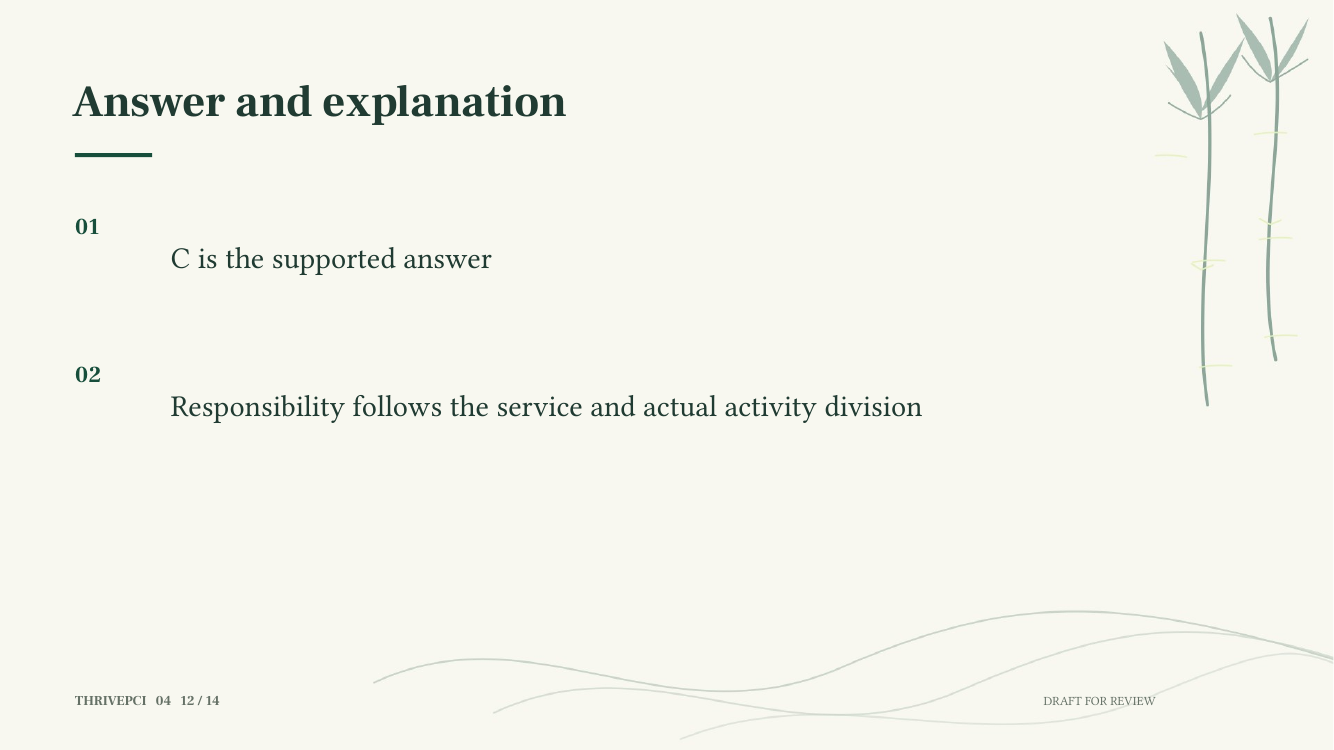
Answer and explanation
C is the supported answer
Responsibility follows the service and actual activity division
Recording script: C is correct. A useful provider analysis begins with the consumed service and then connects its coverage and responsibility information. The customer needs to understand its own activities and any shared work. A broad provider name, certification badge or folder of documents does not replace that analysis. Shared responsibility also means the parties’ contributions need explanation, not that evidence disappears. Keep the provider’s formal support duties distinct from the customer’s preparation tasks. The customer can request relevant information, but it must still maintain the required responsibility information and work through gaps. The actual compliance conclusion remains an assessment matter based on appropriate evidence.
SLIDE 13 · REVIEW COPY
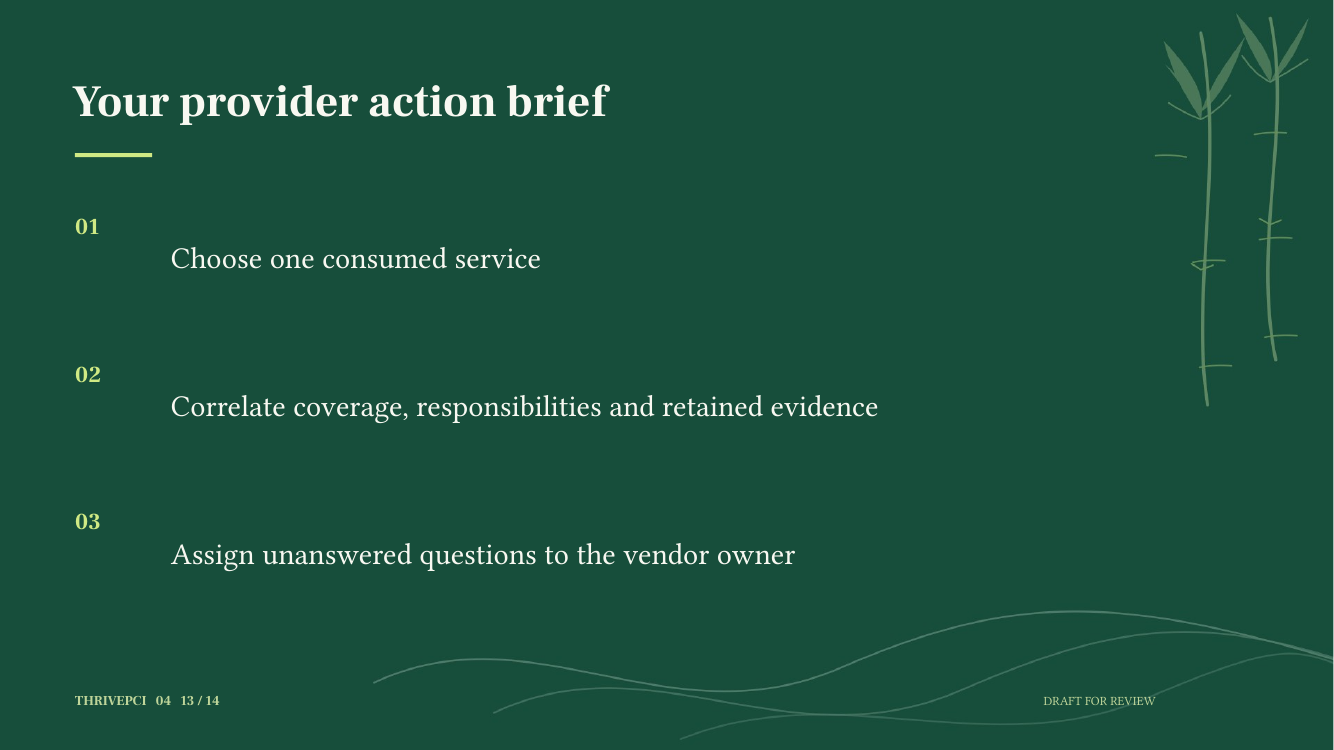
Your provider action brief
Choose one consumed service
Correlate coverage, responsibilities and retained evidence
Assign unanswered questions to the vendor owner
Recording script: Choose one fictional or redacted service arrangement. Record the provider and exact service consumed. Identify the current coverage or status records and responsibility information. For one relevant activity, explain the provider’s contribution, the retained or shared customer work and where the supporting customer evidence sits. If you cannot correlate a document to the service, record a specific question and its owner. This action brief is a practitioner preparation aid, not a replacement for the organization’s full third-party service provider records. Use approved channels for real documents and preserve the distinction between a proposed reliance claim and an assessed conclusion.
SLIDE 14 · REVIEW COPY
Sources and course boundary
PCI DSS v4.0.1: third-party provider management
12.8.5: requirements managed by each party or shared
12.9.2: service-provider support for customer requests
Recording script: The supplied authoritative baseline is PCI DSS version 4.0.1. Requirements 12.8.1 through 12.8.5 address the entity’s third-party service provider management responsibilities. Requirement 12.8.4 sets a minimum annual monitoring frequency for each TPSP’s PCI DSS compliance status. Requirement 12.8.5 requires maintained information about which requirements are managed by each TPSP, by the entity, or shared. Requirement 12.9.2 is an additional service-provider requirement: upon customer request, the TPSP supports requests for the status and responsibility information described by 12.8.4 and 12.8.5. Responsibility information relates to services that meet PCI DSS requirements on the customer’s behalf or can impact the security of the customer’s cardholder data or sensitive authentication data. Apply the exact text, applicability notes, and testing procedures. Our service packet, mapping row, and provider question are practitioner aids. The fictional examples do not determine a real provider’s compliance. This draft is education, not an official PCI SSC position or a compliance guarantee.