Connect a specific activity claim to relevant supporting material, surface mismatches, and prepare an evidence index another person can use.
Scott’s review pass complete. The narration is a script for the owner to record. No audio, video, or timed captions have been produced. This remains an unlisted draft outside the catalog and is not a released course.
Practice stating what happened, for which system and period, and how supporting material relates to the activity being explained. Then identify gaps and prepare a concise evidence index.
Planning estimate: approximately 7 minutes. Actual runtime will be known only after recording.
THE RECORDING SCRIPT
Fourteen slides. One clear story.
Spoken copy follows the slide sequence. Confirm the exact PCI DSS v4.0.1 source wording on slide 14 before recording.
SLIDE 01 · OWNER RECORDING SCRIPT
Evidence That Explains the Work
Welcome to Evidence That Explains the Work. A clear preparation package connects a specific activity claim to material that helps explain what happened. We will look at how to describe the claim, identify relevant support, and make gaps visible. We will use fictional examples only. This course helps you prepare and communicate; it does not decide scope, determine whether a requirement is satisfied, or replace an assessor's evaluation.
SLIDE 02 · OWNER RECORDING SCRIPT
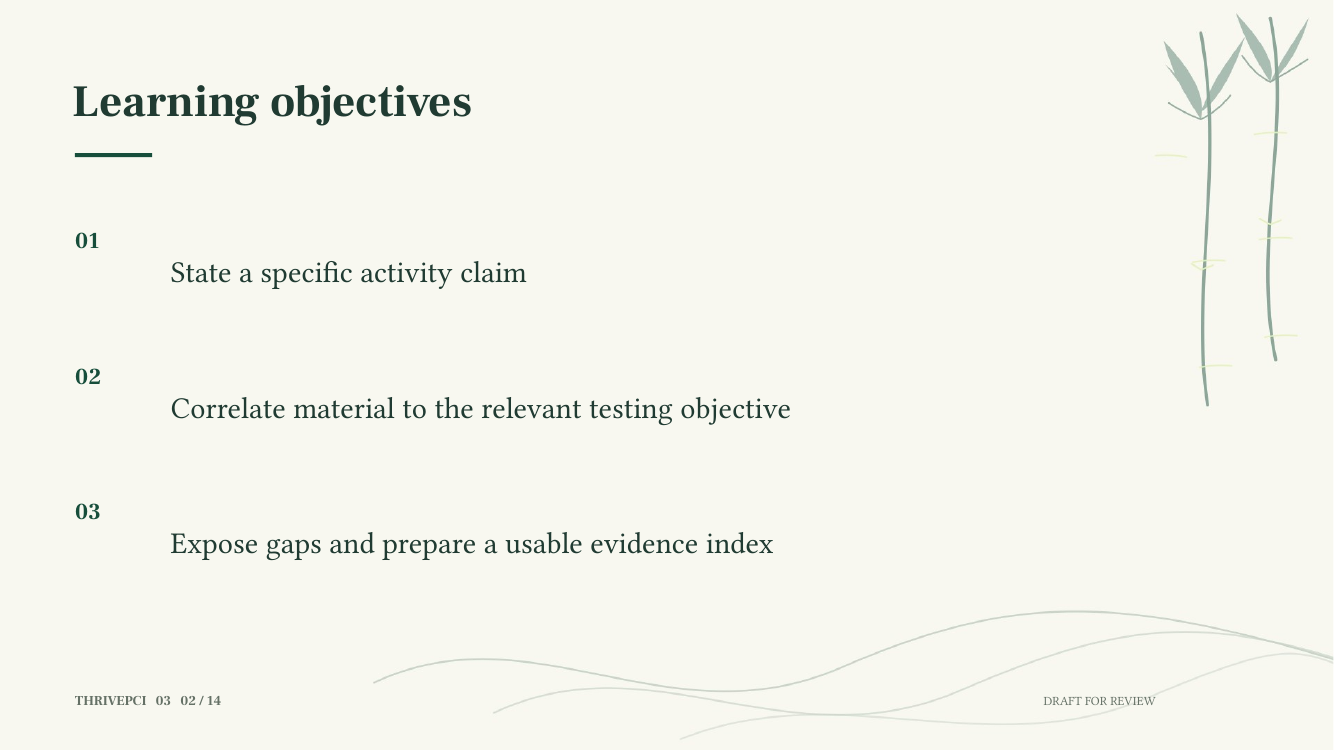
Learning objectives
By the end, you should be able to state a specific activity claim, correlate material to the relevant testing objective, and expose gaps in a concise evidence index. Think of an ordinary, non-sensitive process as we go. Do not copy cardholder data, credentials, client evidence, or confidential records into practice notes.
SLIDE 03 · OWNER RECORDING SCRIPT
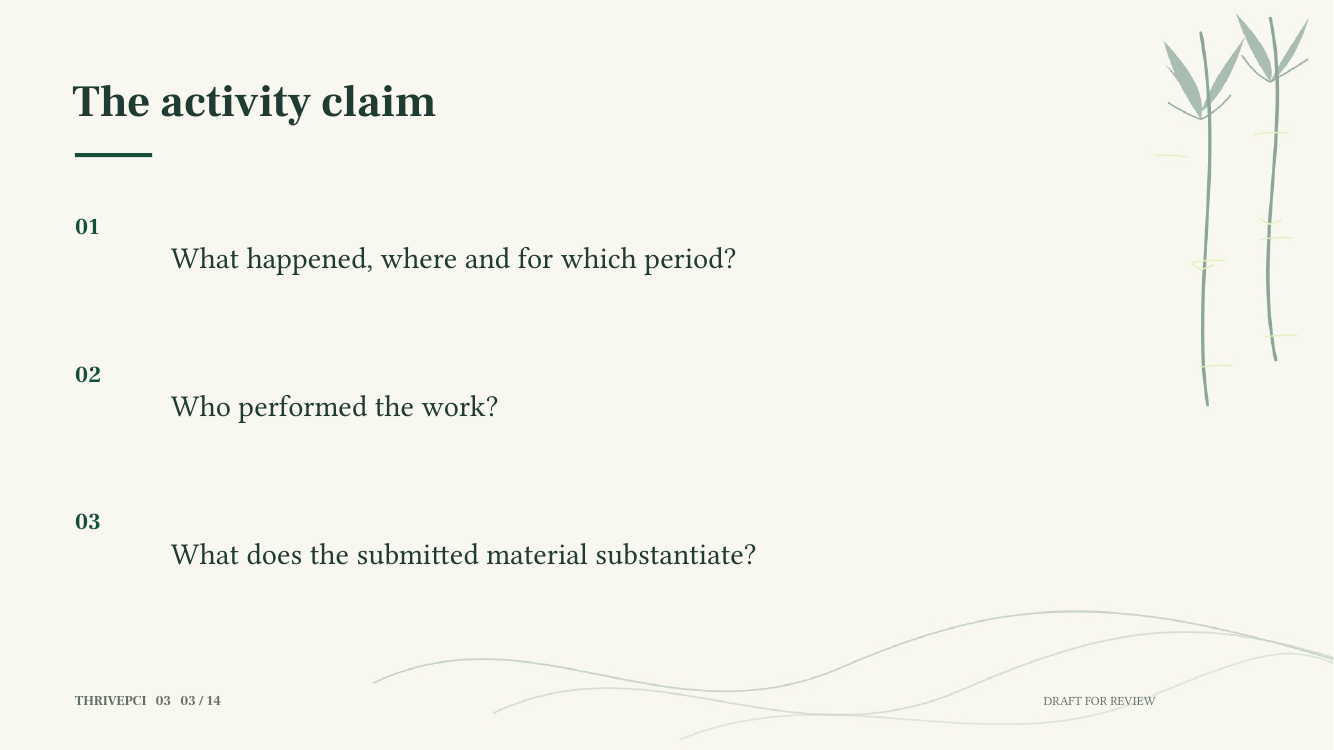
The activity claim
Before collecting files, state the claim you want the material to support. What activity occurred? Which system, service, or population did it cover? For what period? Who performed or reviewed the activity? Then ask what the submitted material actually substantiates. These questions keep a broad statement from outrunning the available support. A well-written claim is still a claim to evaluate, not a compliance conclusion.
SLIDE 04 · OWNER RECORDING SCRIPT
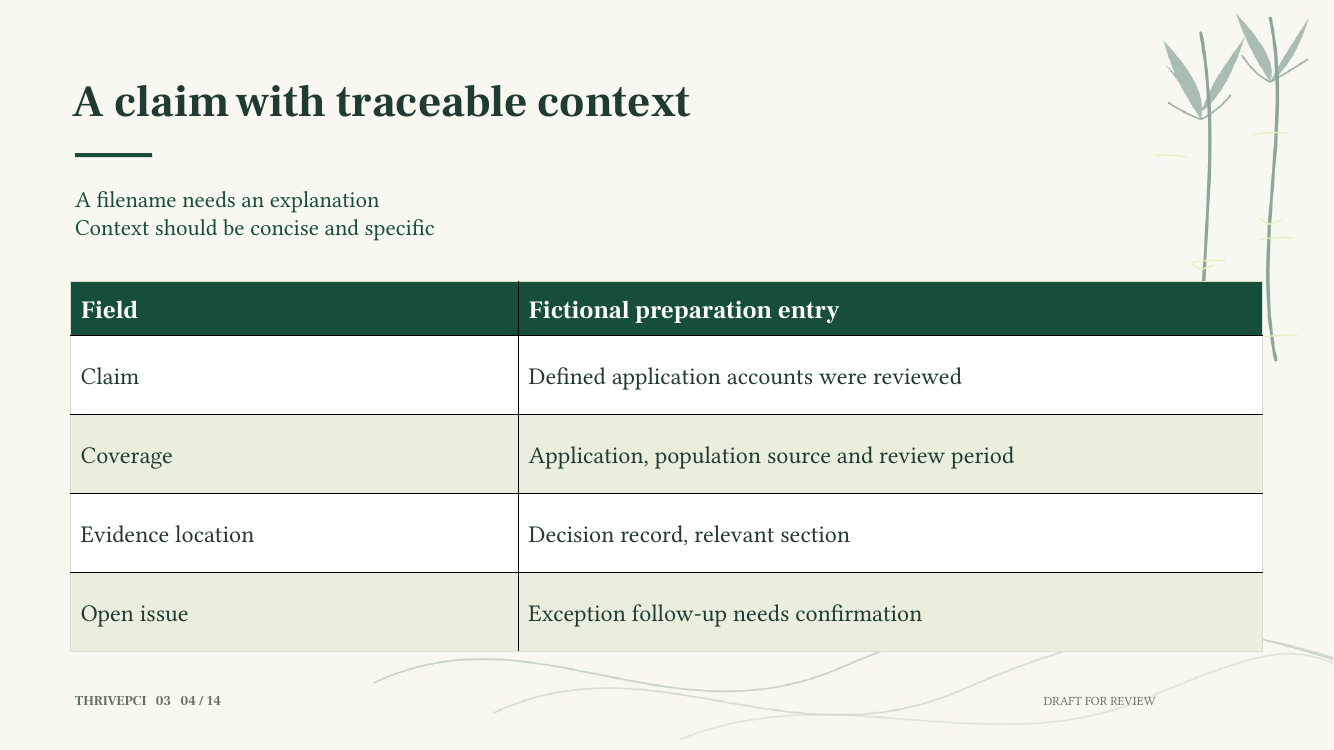
A claim with traceable context
This fictional preparation entry says that defined application accounts were reviewed. It names the application, population source, review period, and location of the decision record. It also keeps an open issue visible: exception follow-up needs confirmation. That context helps a reviewer understand why the record was selected and where the supporting detail may be found. A filename alone does not explain coverage, decision authority, or limitations.
SLIDE 05 · OWNER RECORDING SCRIPT
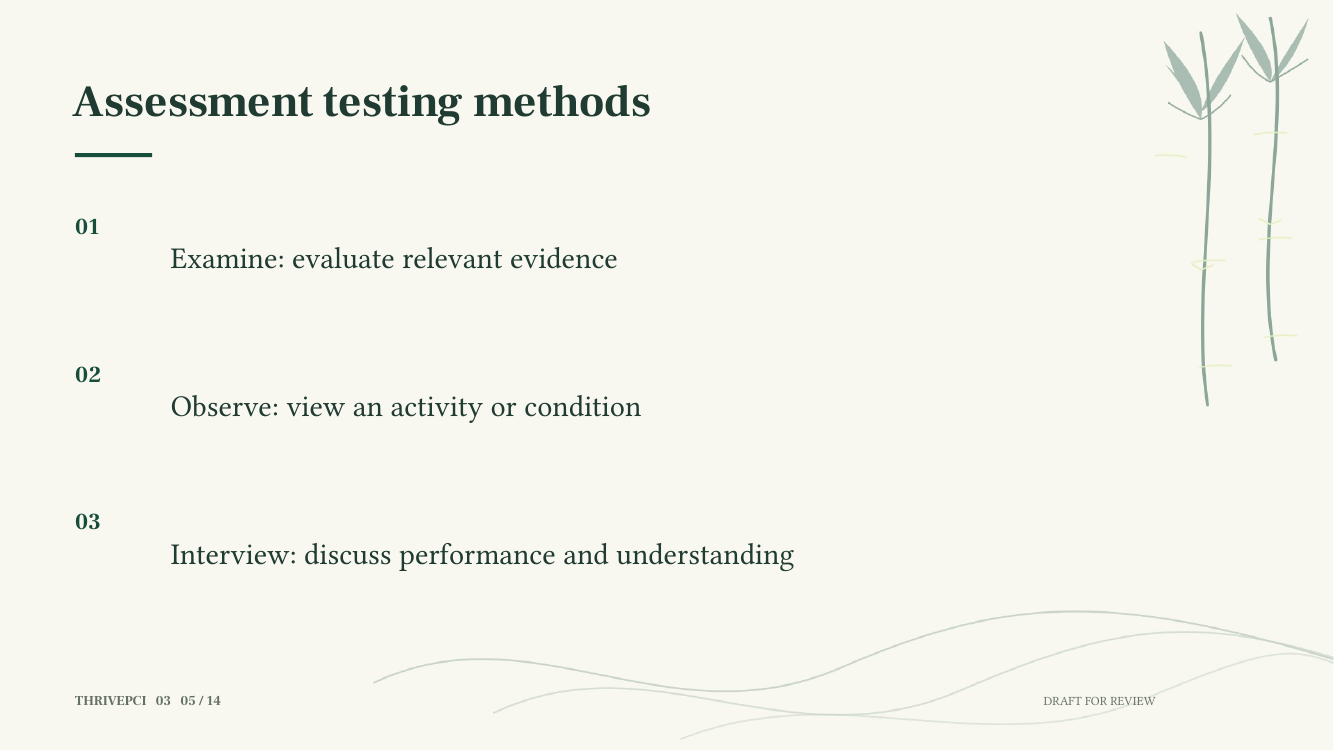
Assessment testing methods
The course groups testing methods as examine, observe, and interview. Examination evaluates relevant evidence. Observation involves viewing an activity or condition. Interview involves discussion about performance and understanding. A particular testing procedure may call for one or more methods and may have more specific instructions. The entity's preparation package should not claim that one method, document, or platform status proves more than the applicable procedure supports.
SLIDE 06 · OWNER RECORDING SCRIPT
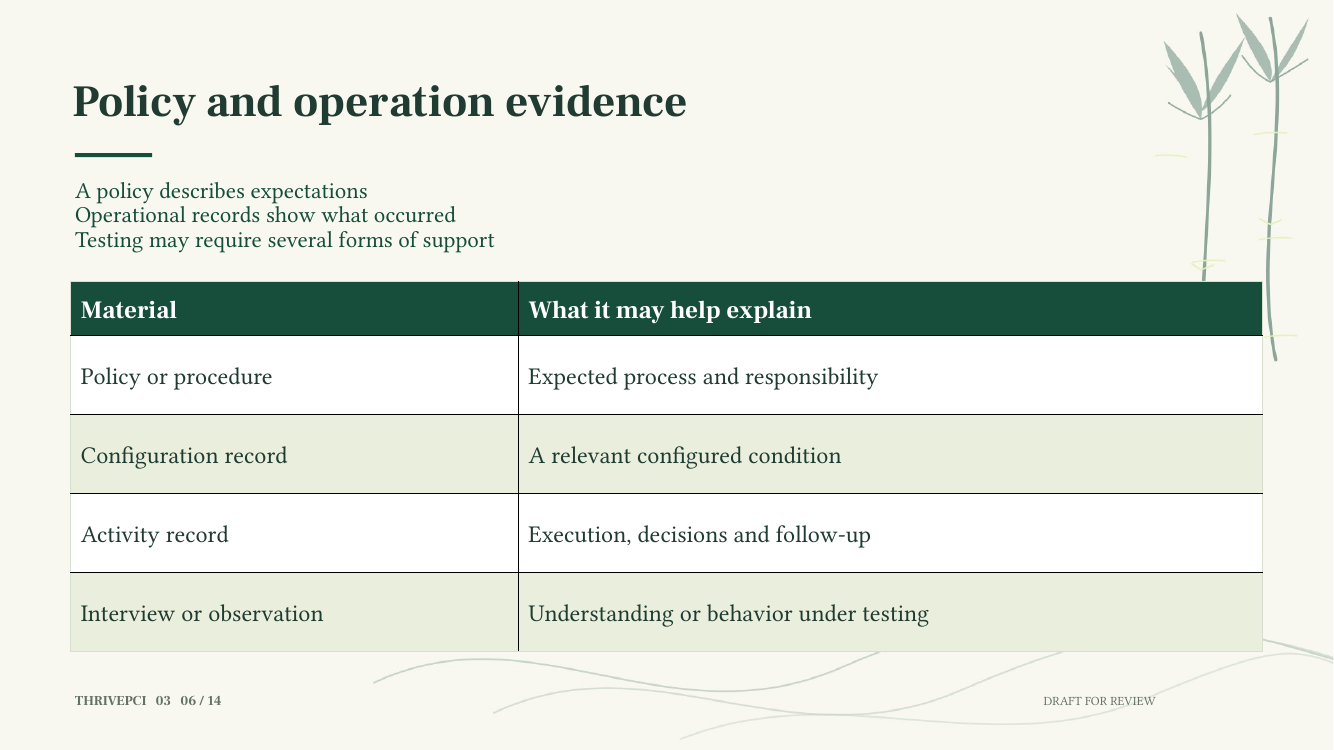
Policy and operation evidence
A policy or procedure can explain expected process and responsibility. A configuration record can show a relevant configured condition. An activity record can show execution, decisions, and follow-up. Interview or observation can help explain understanding or behavior during testing. These materials can answer different questions. Whether a specific type of evidence is sufficient depends on the applicable requirement and testing procedure. Use the table as an organizing aid, not a substitute for those instructions.
SLIDE 07 · OWNER RECORDING SCRIPT
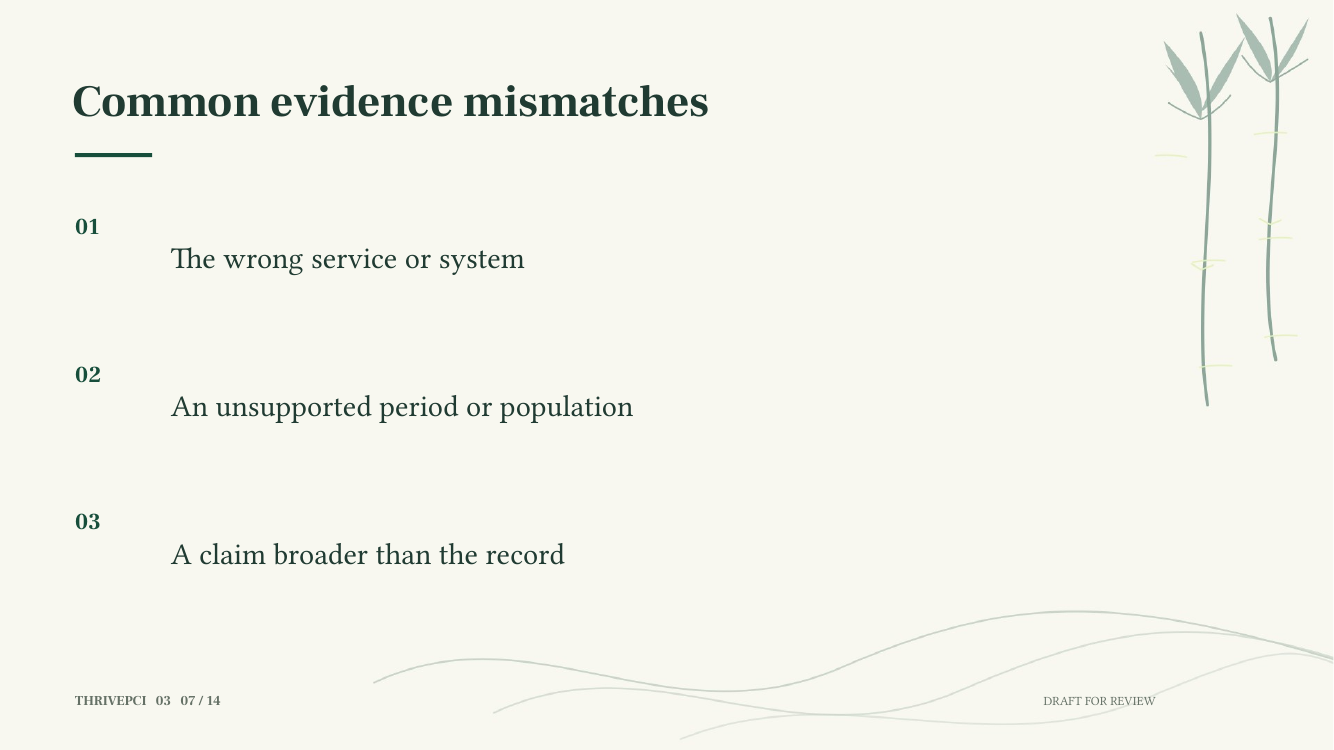
Common evidence mismatches
Three common mismatches deserve a closer look. The file may concern the wrong service or system. Its period or population may not match the claim. Or the claim may be broader than what the record shows. If any of those applies, narrow the claim, find appropriate support, or document the gap and use the approved escalation process. Do not edit a record to make it appear to support a different activity.
SLIDE 08 · OWNER RECORDING SCRIPT
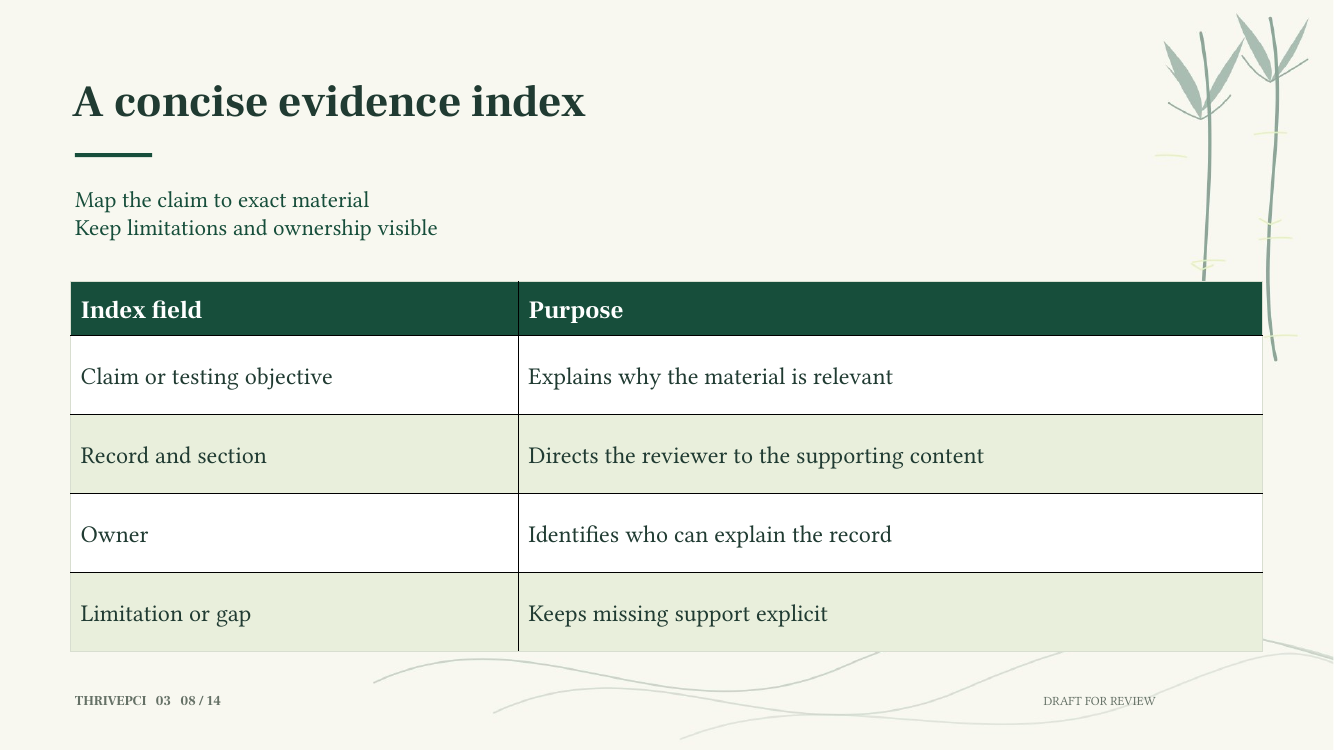
A concise evidence index
An evidence index can link a claim or testing objective to an exact record and section, identify an owner who can explain the material, and state a limitation or gap. The index is a navigation aid. It should help people find and interpret authentic source records without implying that the index itself proves the activity. Keep the index concise, current, and free of sensitive information that is not needed for navigation.
SLIDE 09 · OWNER RECORDING SCRIPT
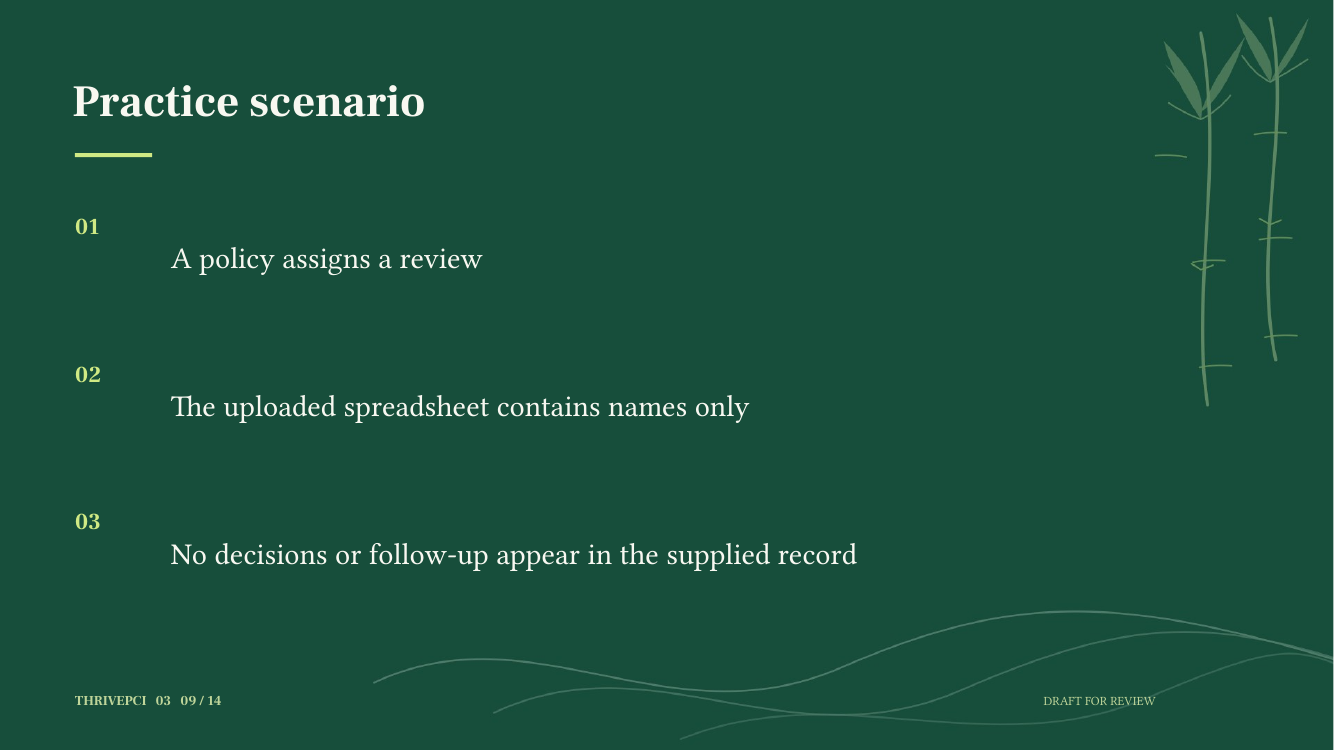
Practice scenario
Consider this fictional scenario. A policy assigns a review. The uploaded spreadsheet contains names only. No decisions or follow-up appear in the supplied record. Pause and ask what the spreadsheet establishes, what it does not establish, and what authentic material or explanation might clarify the activity. Do not assume that the review failed or passed from a file name or a list of people.
SLIDE 10 · OWNER RECORDING SCRIPT
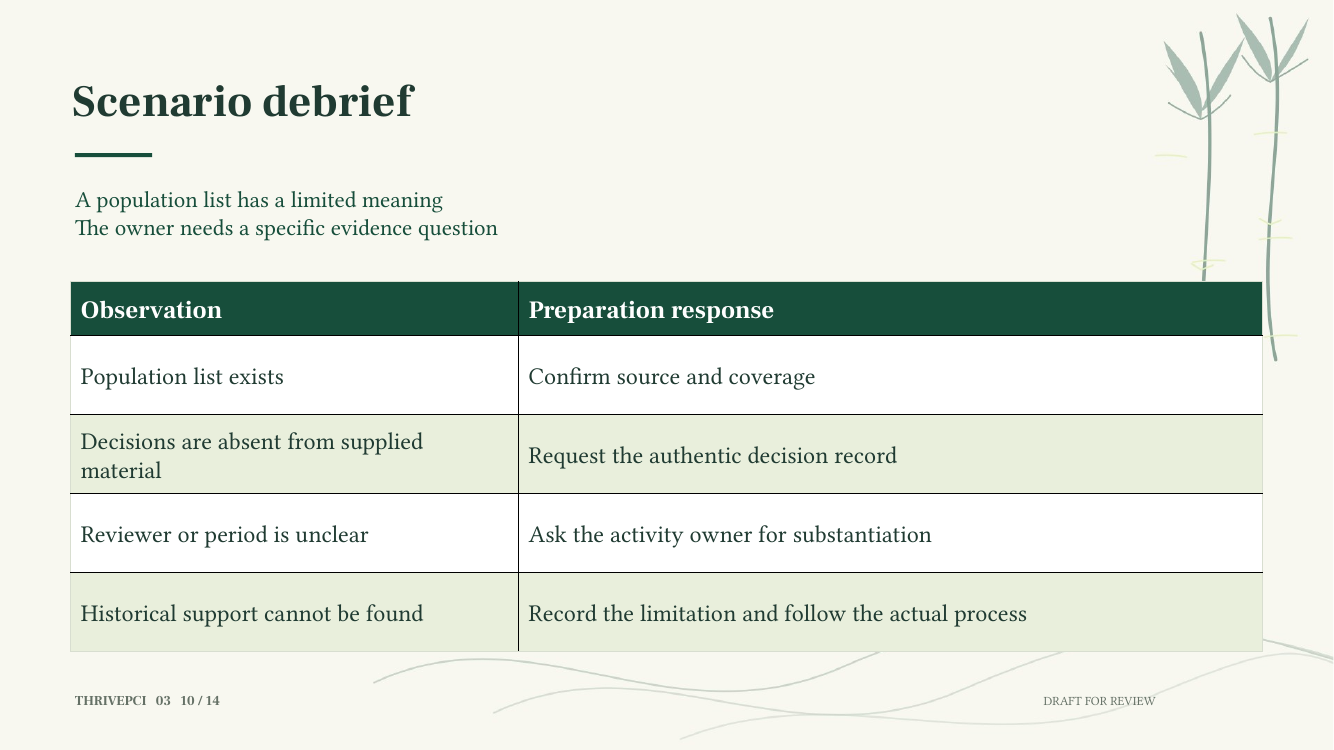
Scenario debrief
A population list may help identify who or what was in a review, but it may not show the review decisions, reviewer, period, or resulting follow-up. The preparation owner can ask a specific question: where is the authentic decision record, who can explain it, and what exceptions remain open? If historical support cannot be found, record the limitation accurately and follow the organization's actual process. Do not reconstruct evidence after the fact.
SLIDE 11 · OWNER RECORDING SCRIPT
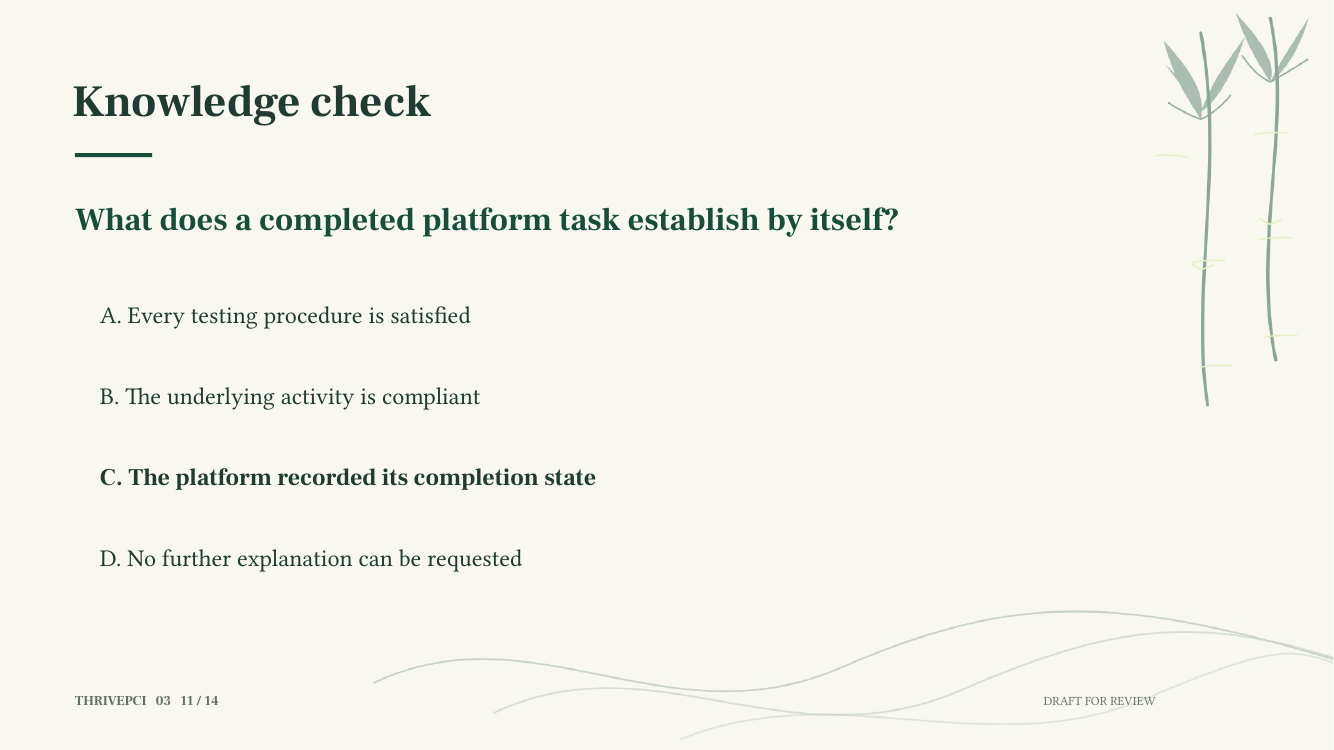
Knowledge check
What does a completed platform task establish by itself? Option A says every testing procedure is satisfied. Option B says the underlying activity is compliant. Option C says the platform recorded its completion state. Option D says no further explanation can be requested. Choose the conclusion that stays within what the platform status alone tells you.
SLIDE 12 · OWNER RECORDING SCRIPT
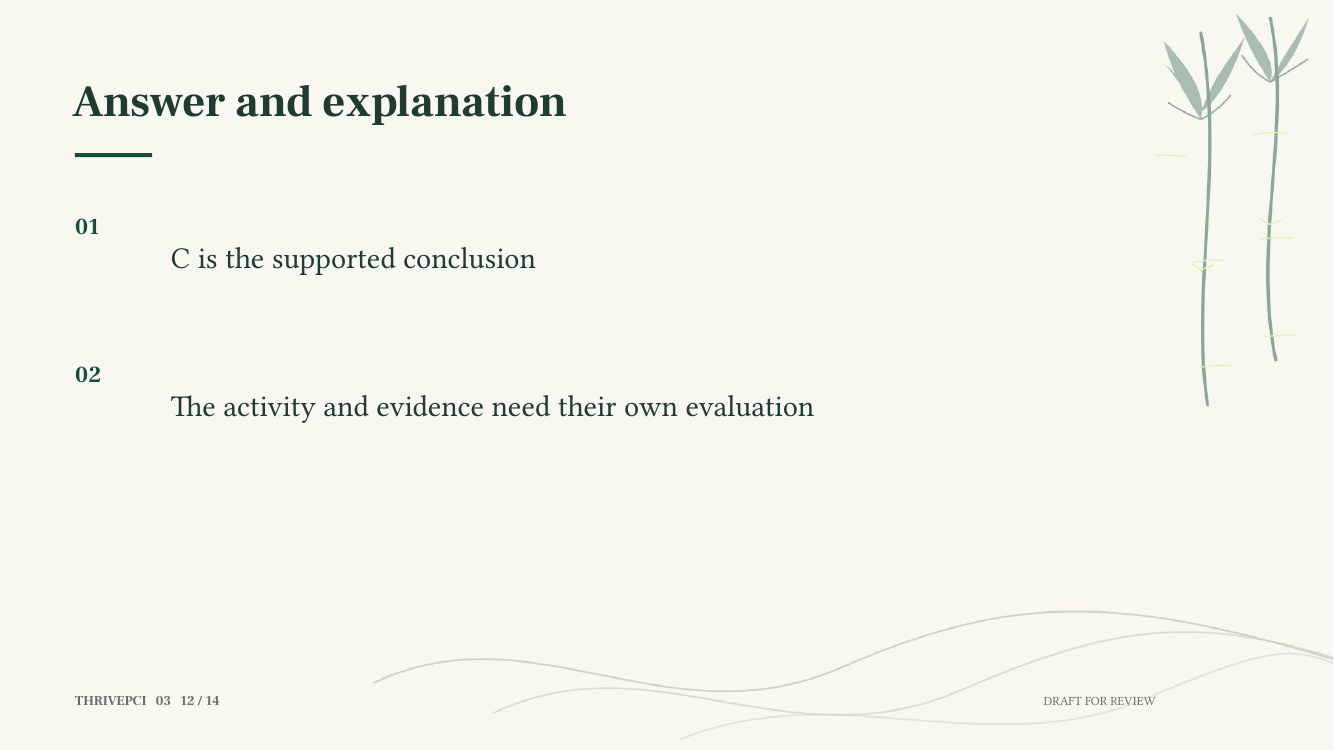
Answer and explanation
Option C is the supported conclusion: the platform recorded its completion state. That status does not, by itself, establish what activity occurred, which population it covered, what decisions were made, or whether the applicable testing procedure is satisfied. The activity and its evidence need their own evaluation. Use the relevant procedure and the authentic supporting material to guide the next question.
SLIDE 13 · OWNER RECORDING SCRIPT
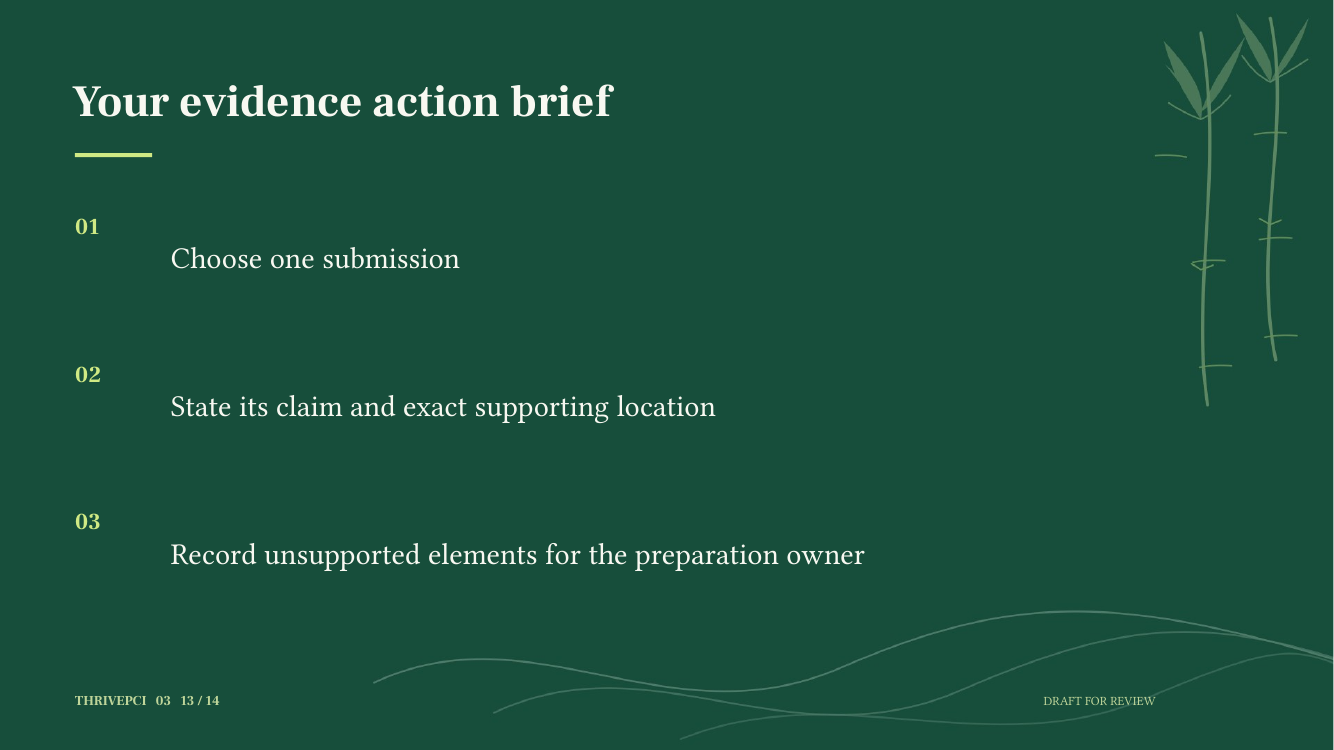
Your evidence action brief
Choose one generic submission. State the claim it is intended to support and give the exact supporting location. List the relevant period and population, identify an owner who can explain the record, and note any unsupported elements for the preparation owner. Keep the exercise sanitized. Follow your organization's approved handling, retention, and access processes for actual records.
SLIDE 14 · OWNER RECORDING SCRIPT
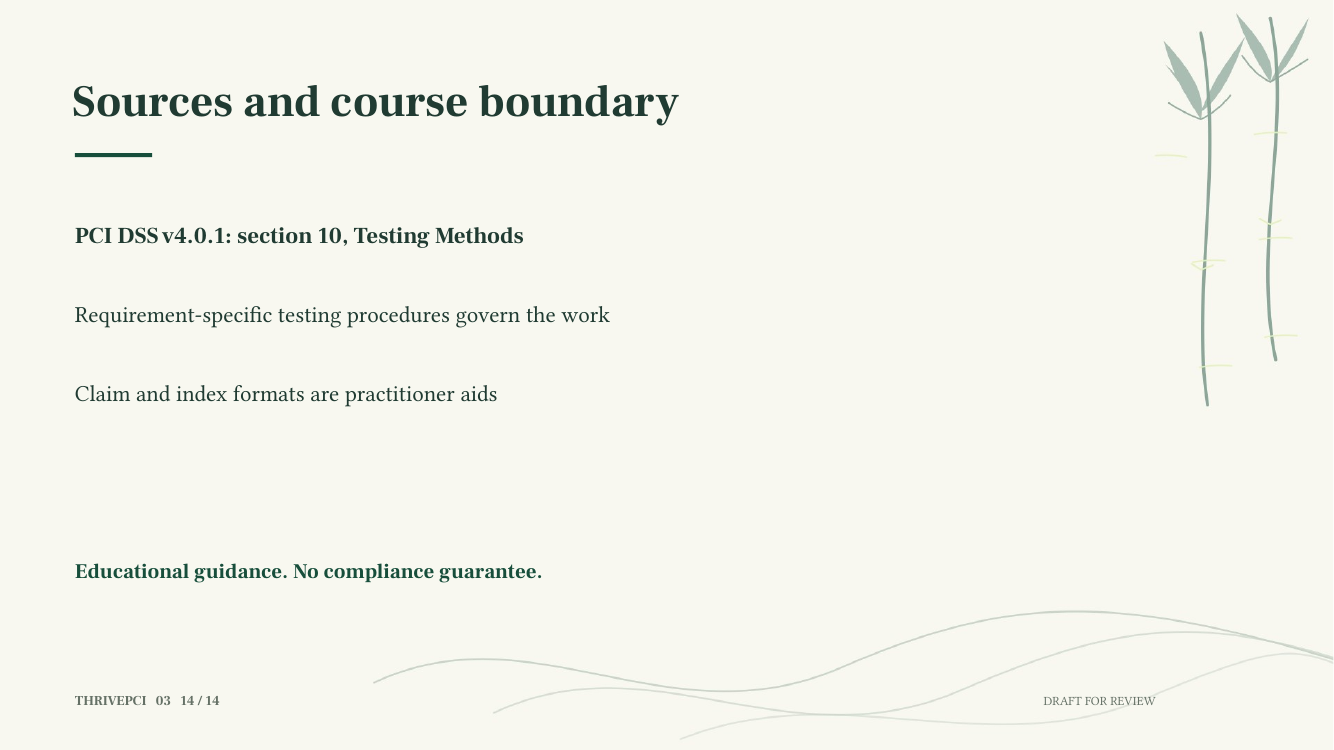
Sources and course boundary
This course points to PCI DSS version 4.0.1 and its testing-method material, along with requirement-specific testing procedures. Confirm the exact section title and reference wording against the supplied authoritative DOCX before recording. The claim and index formats are practitioner teaching aids. This course is educational guidance. It does not establish scope, determine compliance, or guarantee an assessment result.
COURSE BOUNDARY
Useful evidence practice, with limits clear.
The course does not determine scope, applicability, compliance, or assessment outcomes. Scott has completed the review pass for the current version; keep the source map with the course if it changes.