Turn a PCI DSS scope model into diagrams, registers, and testable questions.
Scott’s review pass complete. This is an independent practitioner teaching model, not PCI SSC terminology. Keep its source boundaries clear in future revisions. This page is noindex, not private or access-controlled. Speaker notes contain owner recording copy; no audio/video has been produced.
ThrivePCI course 07 · trainer edition · draft for review
Read owner recording script
RECORDING SCRIPT · NOT RECORDED AUDIO
Welcome to Six Zones, Four Boundaries. In this course, we will use one fictional payment environment to practice turning a scope discussion into diagrams, flow records, and segmentation questions. The zones are a teaching model, not terminology published by PCI SSC. The examples are not a substitute for PCI DSS, the applicable validation program, or an assessor’s evaluation. We will keep those distinctions visible as we work. You will leave with a repeatable way to ask what a system does, how it connects, and what evidence supports the answer.
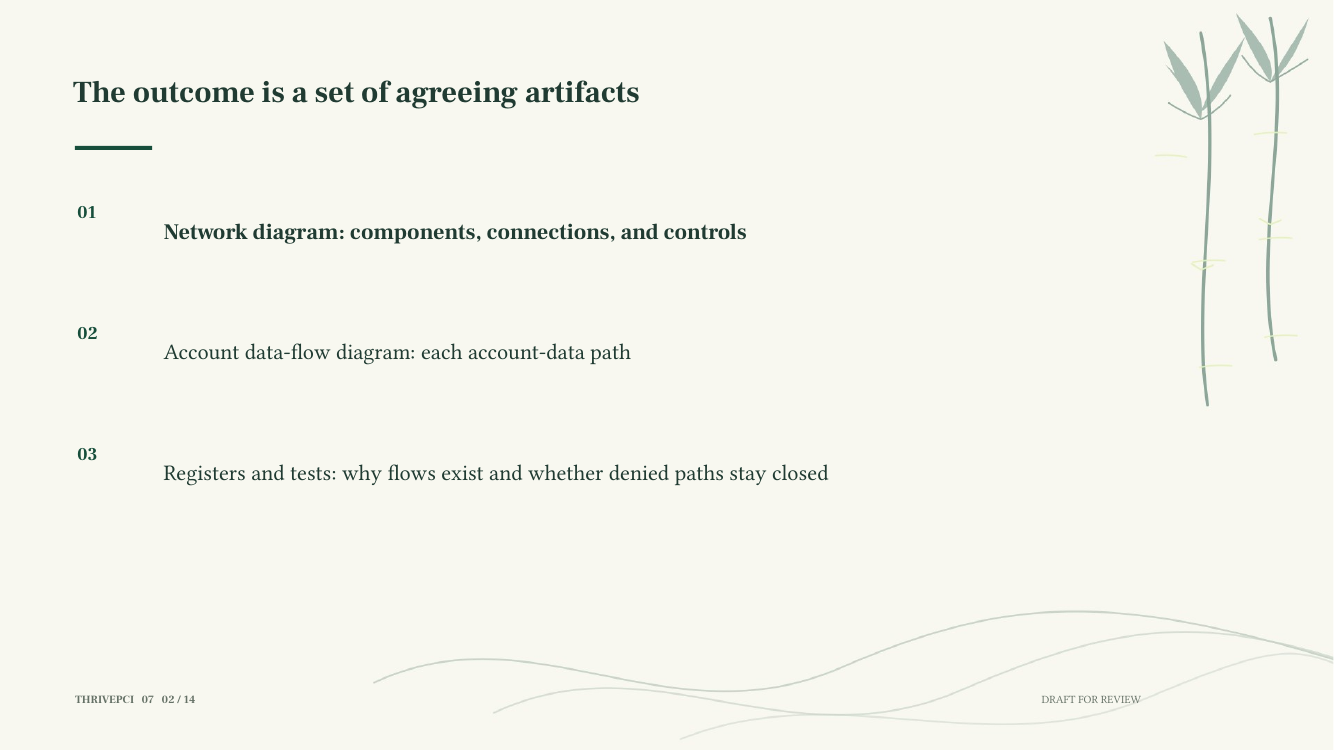
Network diagram: components, connections, and controls
Account data-flow diagram: each account-data path
Registers and tests: why flows exist and whether denied paths stay closed
Read owner recording script
RECORDING SCRIPT · NOT RECORDED AUDIO
The aim is not to make a diagram look complete. It is to make several artifacts agree. Requirement 1.2.3 addresses the network diagram. Requirement 1.2.4 addresses the account-data-flow diagram. Requirements 1.2.5 and 1.2.7 cover records about services and ports, and review of network security control configurations. Requirements 11.4.5 and 11.4.6 address segmentation penetration testing for their respective applicability. The registers and visual model in this course are practitioner tools that can help organize those inputs. They do not establish that an entity has met a requirement.
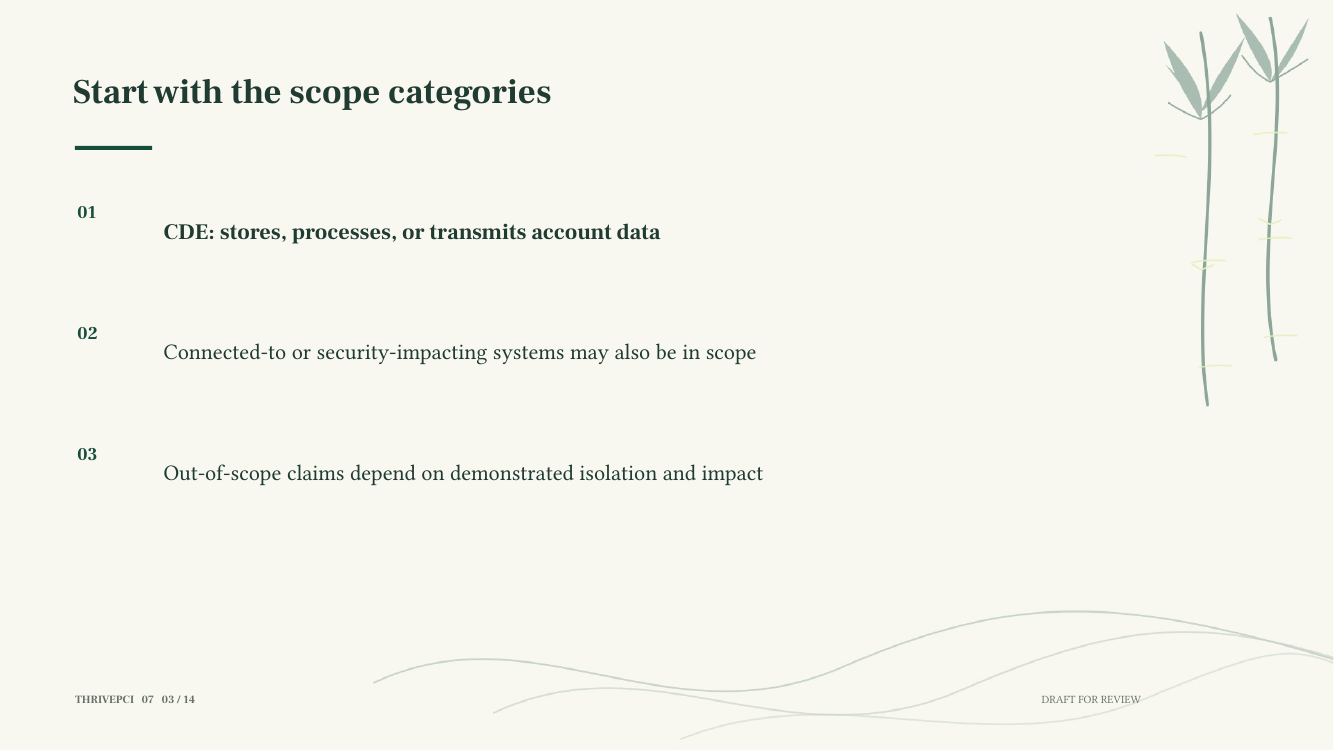
Connected-to or security-impacting systems may also be in scope
Out-of-scope claims depend on demonstrated isolation and impact
Read owner recording script
RECORDING SCRIPT · NOT RECORDED AUDIO
Before drawing walls, identify the scope categories. The cardholder data environment includes system components that store, process, or transmit cardholder data or sensitive authentication data, and connected components as defined by the standard. Other components may be in scope because they can impact the security of the CDE. A component is not out of scope just because it does not store card numbers or sits on a different subnet. The exact scope analysis belongs to the assessed entity and assessor using the standard’s definitions and the actual environment. Our zones help make those questions visible; they do not answer them automatically.
Source note (not spoken): PCI DSS v4.0.1, Scope of PCI DSS Requirements, pp. 9–12
SLIDE 04
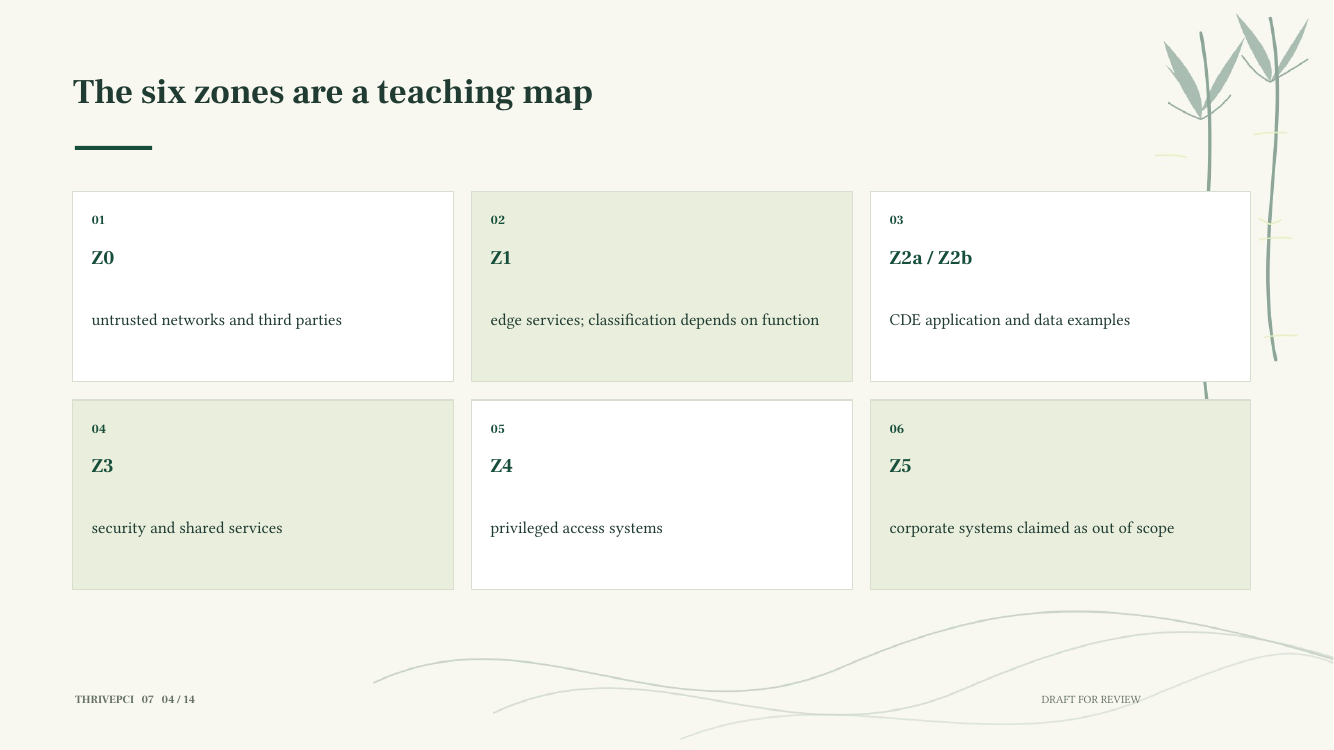
The six zones are a teaching map
Z0 · untrusted networks and third parties
Z1 · edge services; classification depends on function
Z2a / Z2b · CDE application and data examples
Z3 · security and shared services
Z4 · privileged access systems
Z5 · corporate systems claimed as out of scope
Read owner recording script
RECORDING SCRIPT · NOT RECORDED AUDIO
Here is the six-zone map. Zone zero groups untrusted networks and third parties. Zone one represents edge functions. Zones two a and two b distinguish example application and data functions inside the CDE. Zone three groups shared services that may impact CDE security. Zone four highlights privileged access systems. Zone five represents systems proposed as out of scope. These labels are not official PCI DSS categories. Each actual component still needs an evidence-based classification. In particular, the edge is not automatically outside the CDE: a component that transmits account data may be part of the CDE under the applicable definition and guidance.
Source note (not spoken): Practitioner model; verify classifications against PCI DSS v4.0.1 Scope section and Req. 1
SLIDE 05
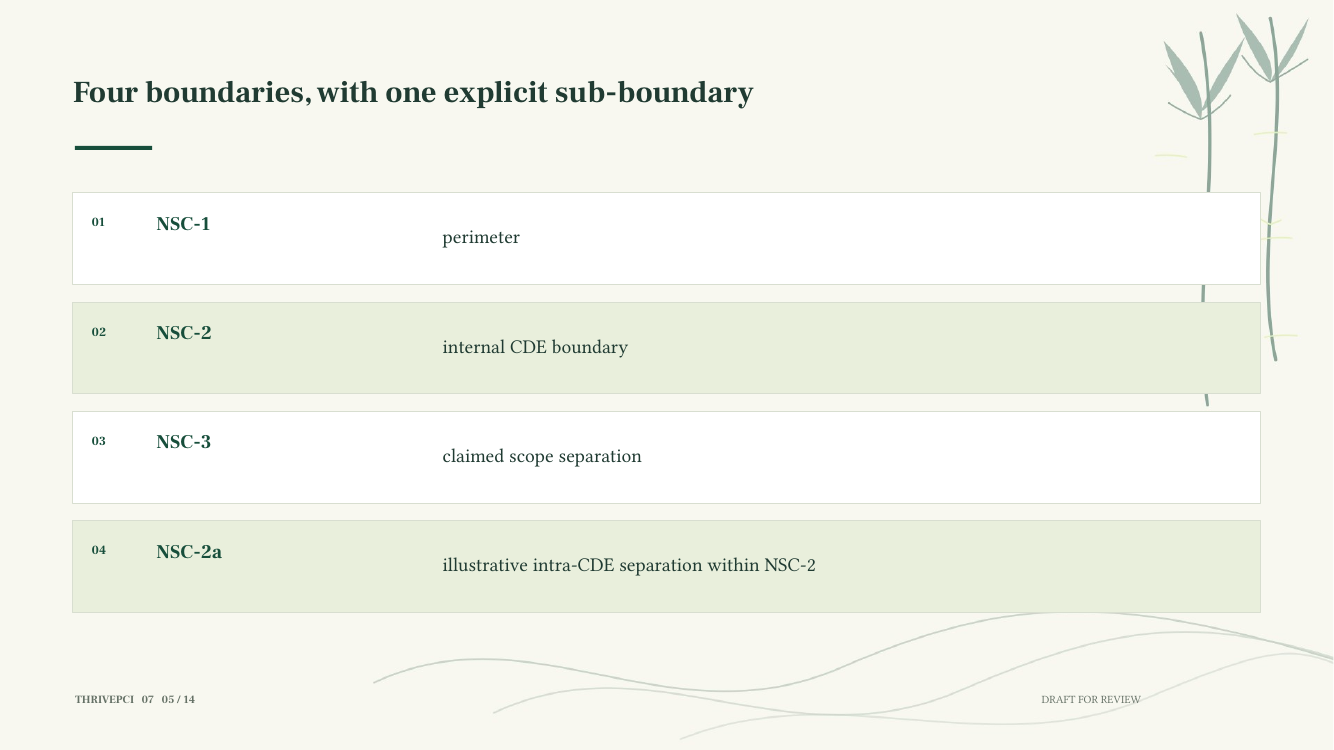
Four boundaries, with one explicit sub-boundary
NSC-1 · perimeter
NSC-2 · internal CDE boundary
NSC-3 · claimed scope separation
NSC-2a · illustrative intra-CDE separation within NSC-2
Read owner recording script
RECORDING SCRIPT · NOT RECORDED AUDIO
The model calls out four named boundaries. Three are the perimeter, the internal CDE boundary, and the claimed scope separation. The fourth label, NSC-2a, is a sub-boundary inside the internal boundary that highlights separation between the example application and data zones. That naming explains a source-document inconsistency: a reader could count NSC-2a as an additional peer wall and wonder why the title still says four. In this course, NSC-2a is shown as a nested control point within NSC-2, not a fifth top-level boundary. A real implementation may have more or fewer network security controls, and one device may enforce multiple logical boundaries.
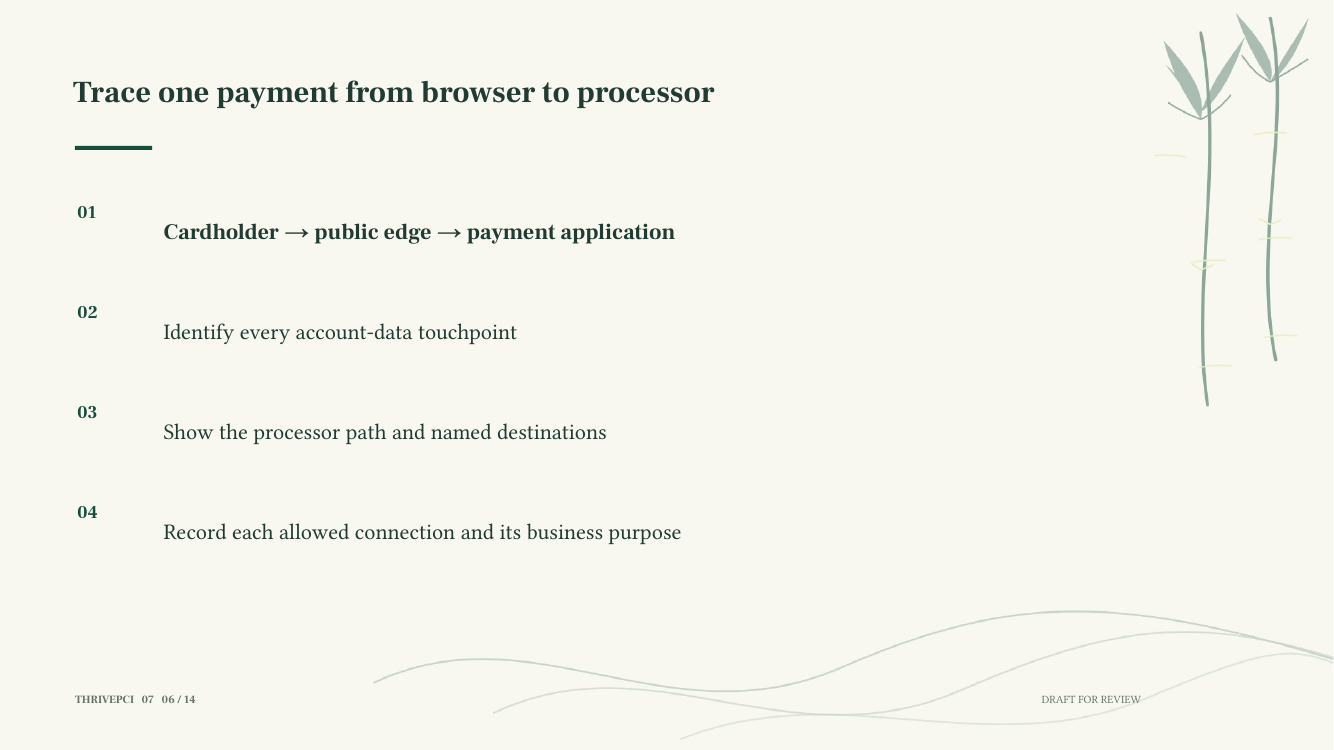
Record each allowed connection and its business purpose
Read owner recording script
RECORDING SCRIPT · NOT RECORDED AUDIO
Follow one payment from the browser through the public edge and payment application toward the processor. At each step, ask whether account data is stored, processed, or transmitted, and record the actual flow. Include the processor connection rather than ending the diagram at the organization’s border. The source model’s illustrative ports and technologies are examples only; use the entity’s real service names, endpoints, and approved business justification. Do not assume tokenization, mutual TLS, or a particular egress gateway is universally required by this six-zone model. Those may be design choices, while PCI DSS requirements apply according to their own text and scope.
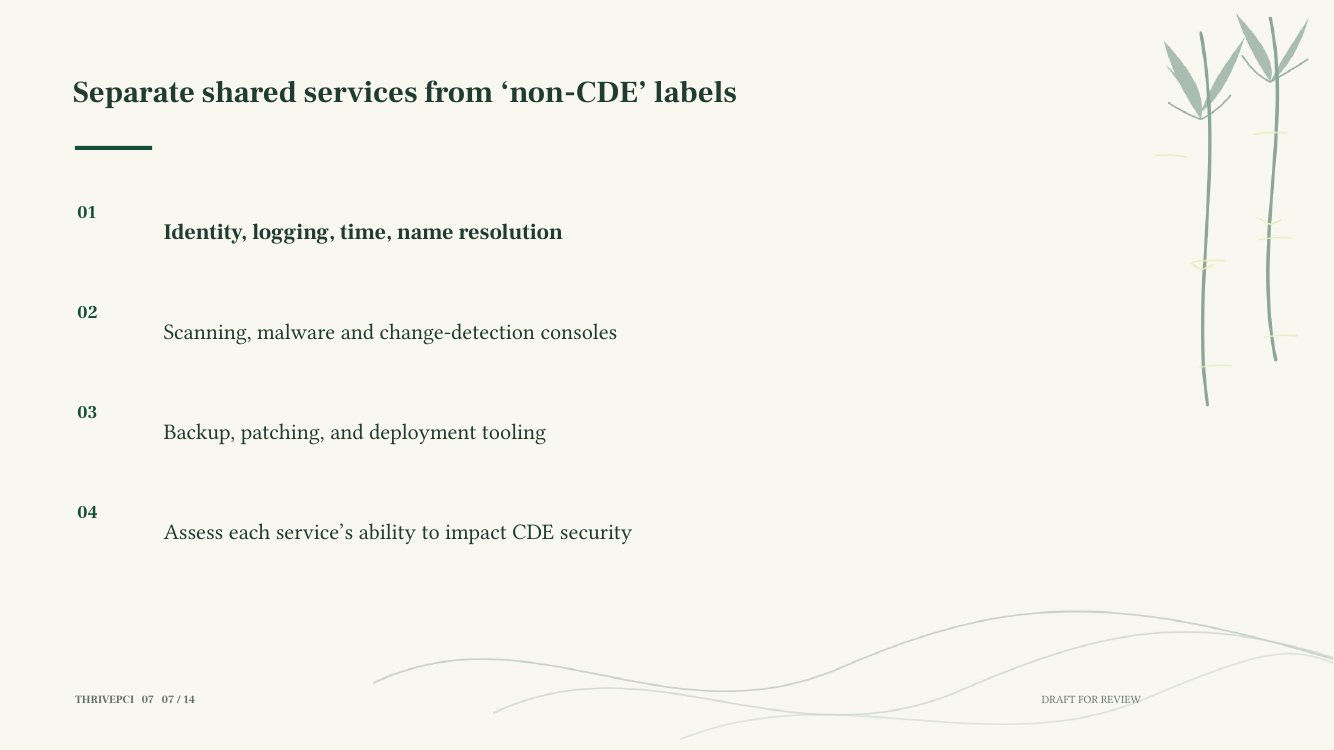
Assess each service’s ability to impact CDE security
Read owner recording script
RECORDING SCRIPT · NOT RECORDED AUDIO
A broad box labeled non-CDE can conceal services that affect the security of the CDE. Inventory identity, logging, time, name resolution, scanning, endpoint protection, change detection, backup, patching, and deployment functions. Then assess each service’s relationship to the CDE using the actual architecture and PCI DSS scope language. The source model places many of these in zone three as a conservative teaching example. That is useful for prompting questions, but the exact scope conclusion depends on the system’s capabilities and connections. Show the services and the paths rather than relying on a label.
Source note (not spoken): PCI DSS v4.0.1 Scope section, pp. 9–10; Requirements 8, 10, 11, and 12 as applicable
SLIDE 08
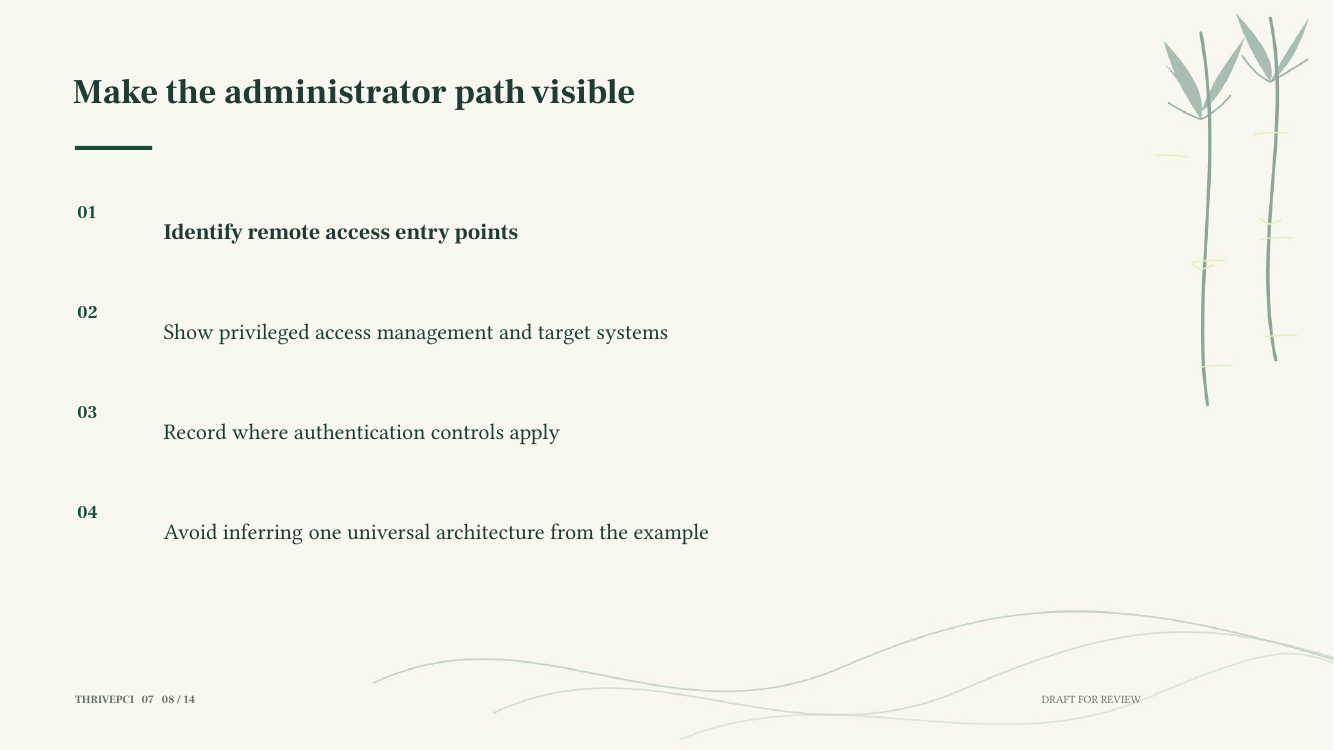
Make the administrator path visible
Identify remote access entry points
Show privileged access management and target systems
Record where authentication controls apply
Avoid inferring one universal architecture from the example
Read owner recording script
RECORDING SCRIPT · NOT RECORDED AUDIO
Administrative access is easy to omit from a payment-flow picture. Draw the actual remote access path, privileged access tools, administrator workstations, and target systems. Then evaluate the applicable authentication requirements and notes against the real arrangement. The source example illustrates a gateway followed by privileged access management and a second authentication step into the CDE. Treat that as a teaching scenario, not a mandatory topology. The precise requirement and applicability note govern. Record the control points and supporting evidence without turning this diagram into an attestation.
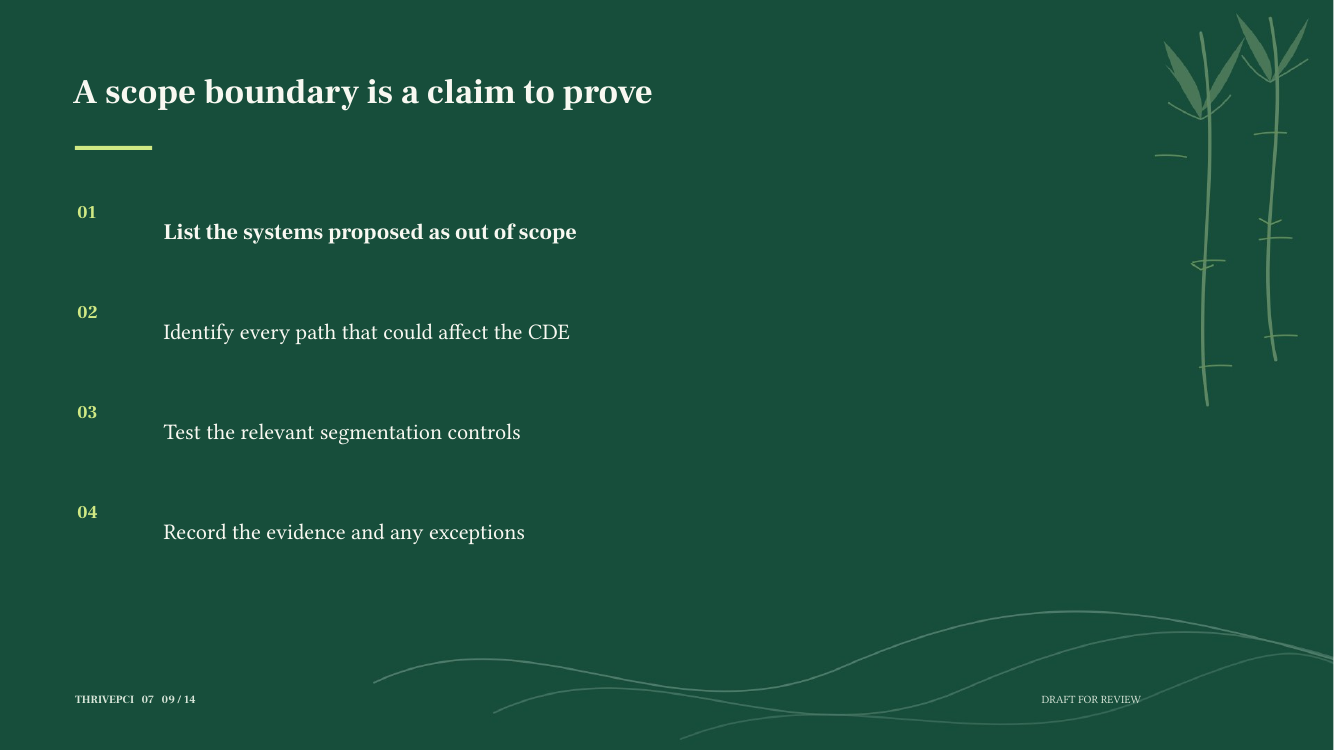
An out-of-scope label is a claim about impact and isolation. Identify the systems proposed as outside scope, list every possible route or trust relationship that could affect CDE security, and determine what segmentation testing applies. The standard’s segmentation guidance and the applicable testing requirements govern the evaluation. For service providers, additional timing and scope-confirmation rules may apply; do not generalize those intervals to every entity. A deny register is a practitioner aid that can turn a claim into specific test questions, but it does not replace the required testing method or assessor judgment.
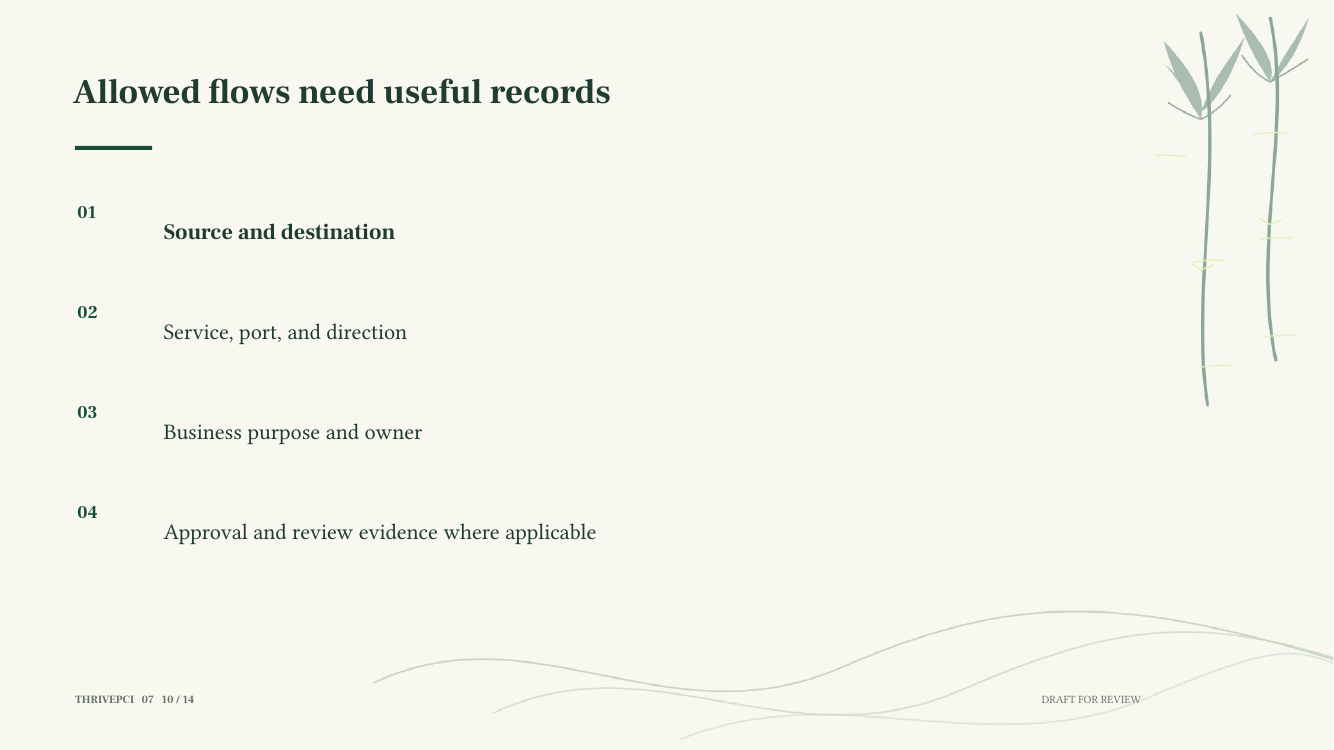
For each allowed connection, record enough detail for another person to understand and review it: source, destination, service or port, direction, business purpose, and responsible owner. Add approval and review evidence according to the entity’s process and applicable requirement. The example model numbers each flow to help cross-reference the diagram and register. A numbered arrow without a corresponding record is a broken link. Likewise, a register row that no longer matches the live configuration needs investigation. Keep internal planning fields distinct from PCI DSS requirements.
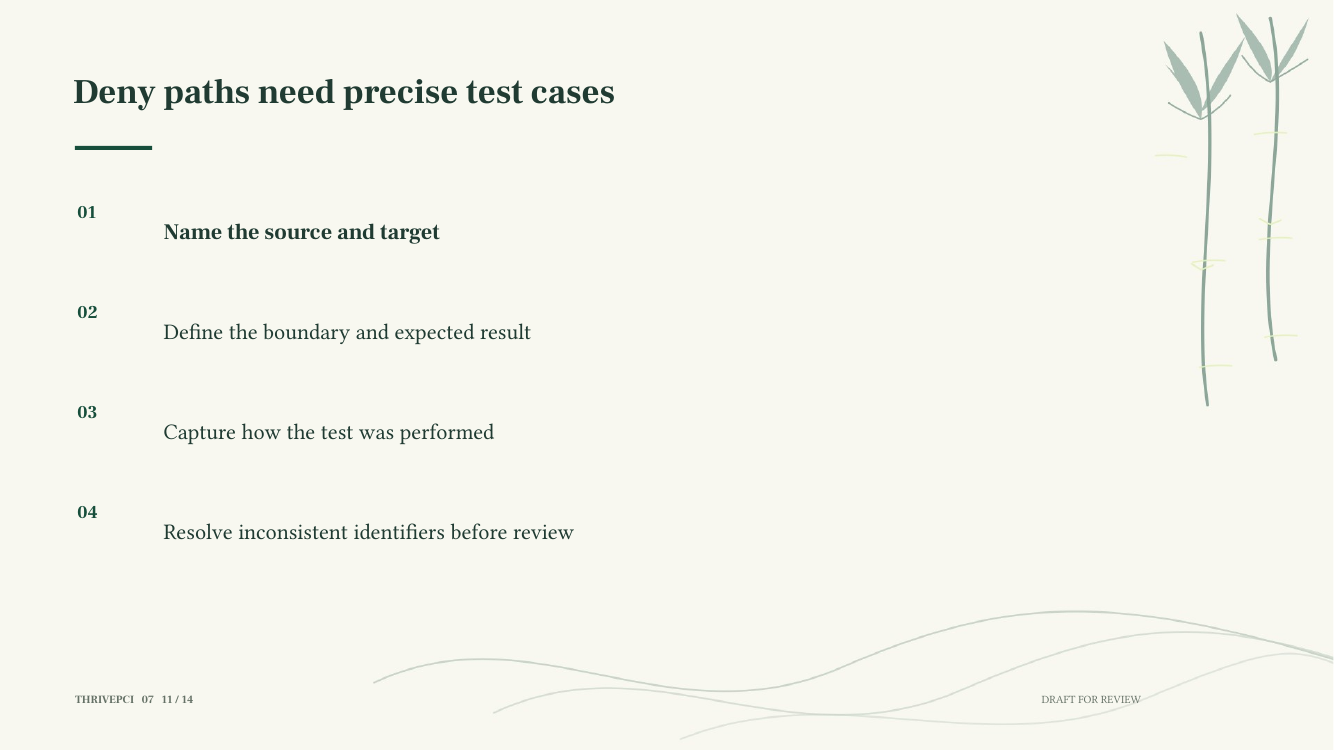
A deny register is most useful when each row describes a precise path, an expected result, and the evidence that will demonstrate it. The source material has a numbering mismatch: one slide refers to D3 and D4 while the surrounding narration and tables refer to other deny IDs, and one table lists D-07 before D-06. This course does not silently copy those identifiers. Establish one controlled register, use the same IDs in the diagram and testing record, and resolve every mismatch before a reviewer relies on the package. The testing frequency and method come from the applicable PCI DSS requirement.
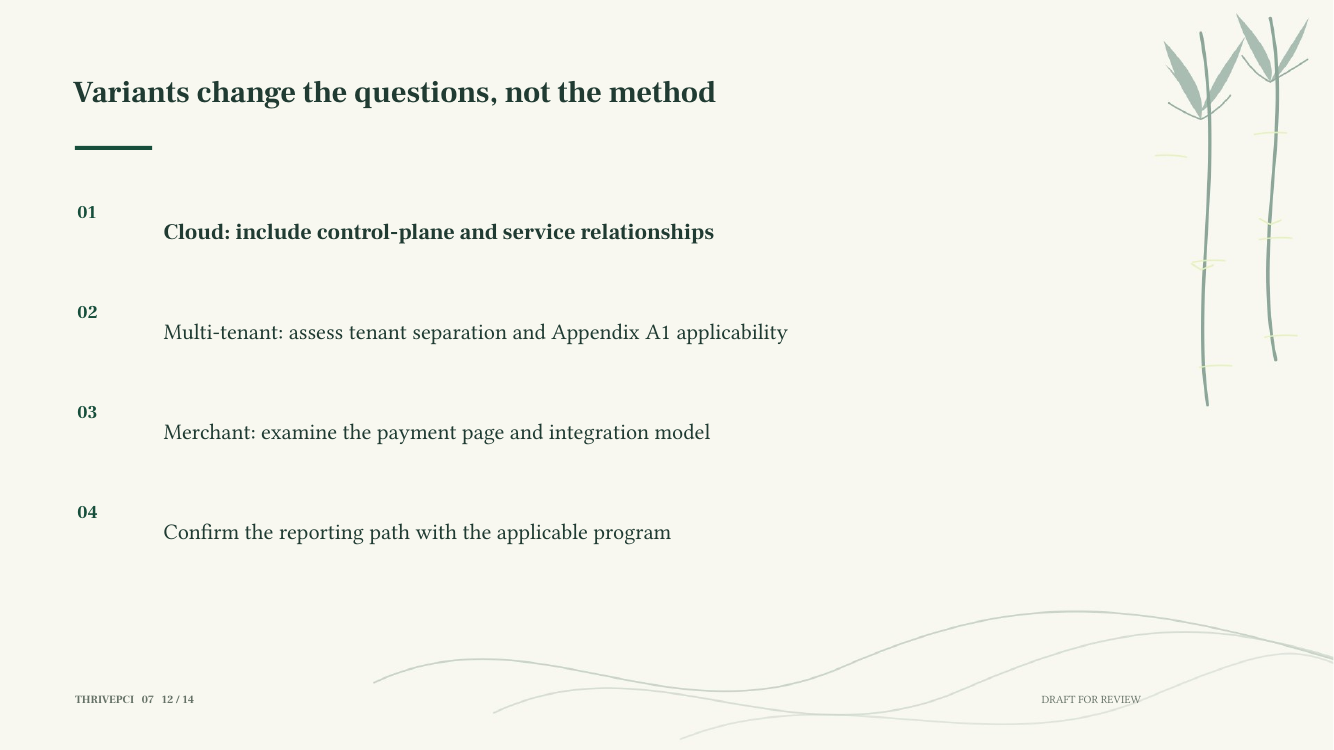
Cloud: include control-plane and service relationships
Multi-tenant: assess tenant separation and Appendix A1 applicability
Merchant: examine the payment page and integration model
Confirm the reporting path with the applicable program
Read owner recording script
RECORDING SCRIPT · NOT RECORDED AUDIO
The same investigation method can support different environments, but the architecture and applicable requirements change the questions. In cloud environments, identify relevant cloud services, control-plane functions, and responsibility allocations. For multi-tenant service providers, evaluate whether Appendix A1 applies and what separation evidence is needed. For merchants using an iframe, redirect, or listed P2PE solution, examine the actual implementation and corresponding applicability notes. Do not select a validation form from this model; the acquirer or other compliance-accepting organization determines that path under its program.
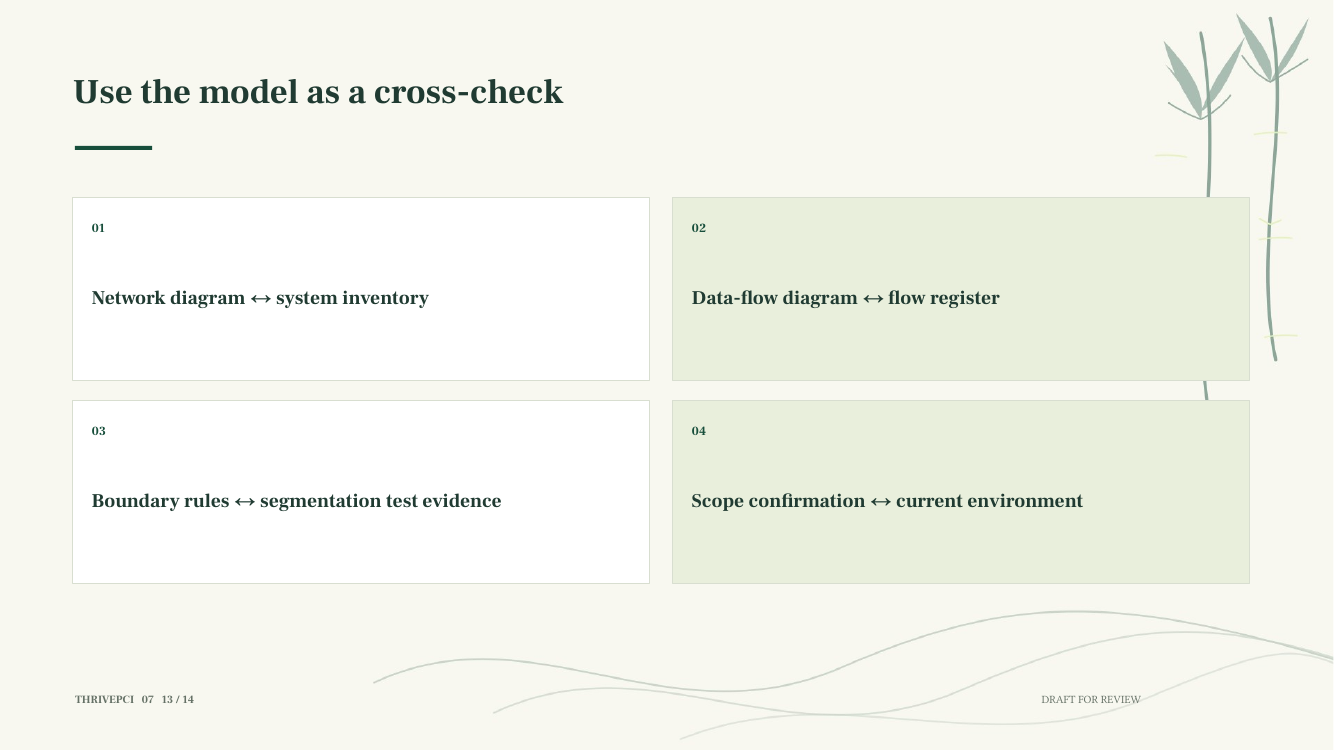
Now compare the artifacts. Does every component on the network diagram appear in the inventory? Does each account-data path appear on the data-flow diagram and connect to a flow record? Do the network control configurations match the documented connections? Do the segmentation test records address the claimed boundaries? Does scope confirmation reflect current systems, providers, locations, and changes? The zone model can make gaps easier to spot, but it cannot establish that the artifacts are complete or accurate. That depends on the entity’s environment and evidence.
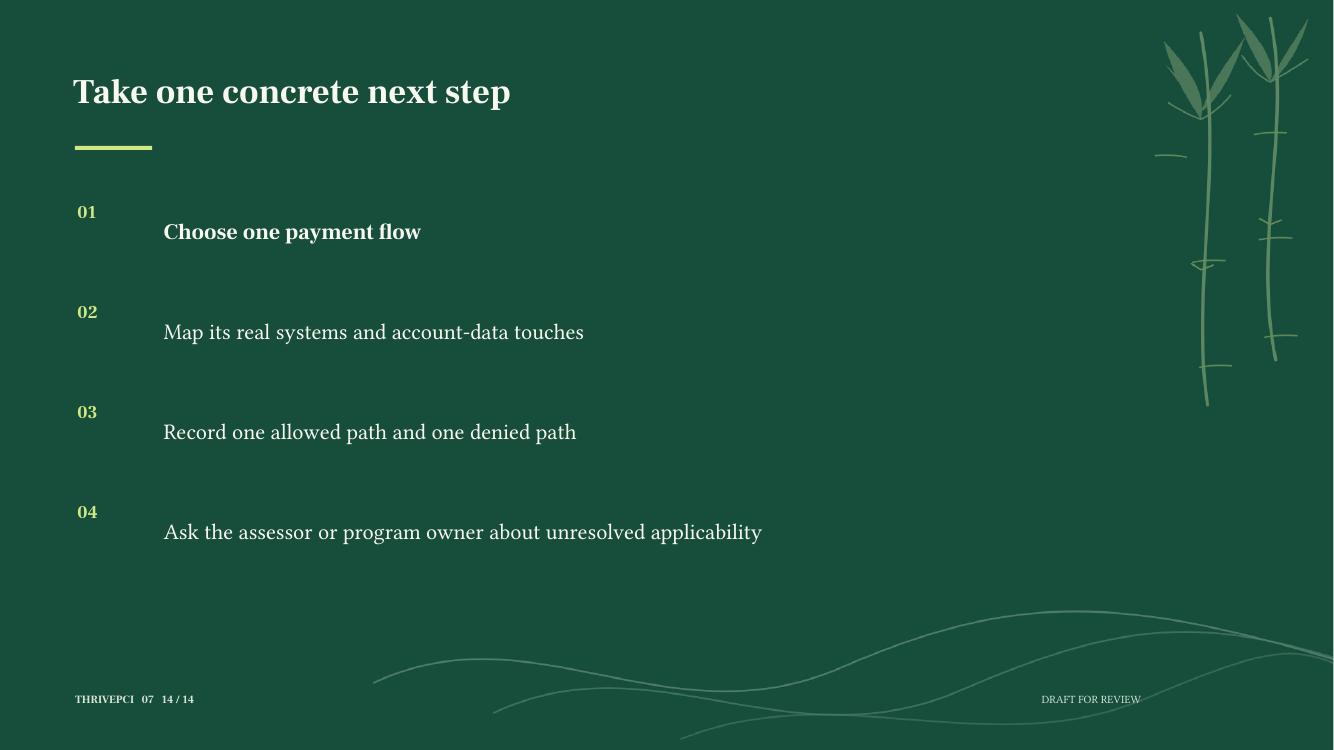
Ask the assessor or program owner about unresolved applicability
Read owner recording script
RECORDING SCRIPT · NOT RECORDED AUDIO
Choose one real payment flow, but use sanitized system names and no cardholder data in your training notes. Map the systems and account-data touches from entry through the processor. Write one allowed-path register row and one denied-path test question. Mark facts you have evidence for, assumptions you still need to check, and decisions that belong to the entity, assessor, provider, or compliance program. The model is a starting point for a better discussion. It is not a scope ruling or a promise of an assessment outcome. Thank you for working through it.
Source note (not spoken): Practitioner exercise; use the current PCI DSS v4.0.1 and applicable program materials
RELEASE BOUNDARY
Review pass complete; owner recording comes next.
Scott has completed the review pass. If this course changes, update its references and applicability notes; then record the scripts and return the MP4 for captions, playback, and accessibility review. This draft does not determine scope, compliance, validation path, or assessment outcome.