thrivePCISite v0.43.62+20261122T201000Z · Published November 22, 2026

SCOTT REVIEW · NEWSLETTER ISSUE 03

Give open decisions a clear owner

One newsletter issue and 6 supporting posts. Two downloadable visuals illustrate the practice. These drafts promote the current free preparation resources and the request-details contact route. The copy buttons copy ready-to-edit text to your clipboard. Nothing here posts to LinkedIn.

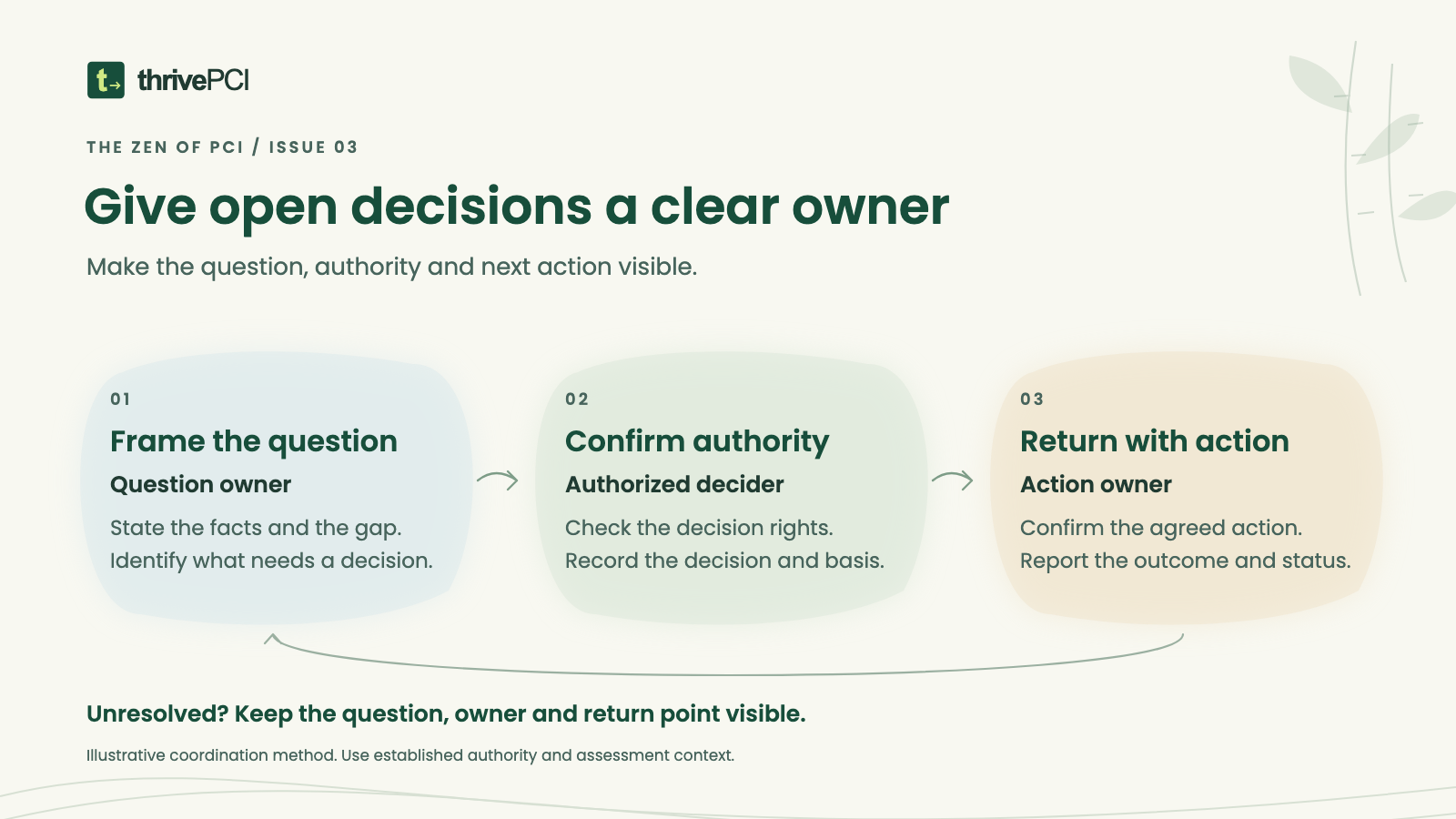
A three-stage ownership route: assemble the question and facts, obtain a decision from the authorized person, and assign and confirm the agreed action.
Keep the question, decision authority and follow-through connected. Download PNG · Download SVG

Newsletter: The Zen of PCI

Practical PCI preparation for the people who own the work: responsibilities, evidence, timing, and habits that last.

Suggested sequence: Supporting posts form a suggested editorial sequence; publication dates are set by Scott.

Suggested T+ release plan

T+0 = actual publication day for issue three. Offsets below use calendar days. Set T+0 only when the issue is ready for publication.

OffsetContentSuggested purpose
T+0Newsletter: Give open decisions a clear owner
Post: Give open decisions a clear owner
Publish issue three and introduce the ownership practice after copy approval.
T+2Post: Make the three responsibilities visibleInvite a discussion about the three responsibilities.
T+5Post: Help the authorized person reach a supported decisionExplore decision authority and the facts needed for an answer.
T+8Post: Give an unresolved question a return pointShow how unresolved questions receive a return point.
T+12Post: Try a short decision ownership checkOffer the short decision ownership exercise.
T+16Post: Bring a real preparation question to your learning planConnect the practice to the free sample and a request for pilot details.

Scott may adjust offsets to suit the editorial calendar, audience conversation and review readiness. These offsets make no claim about LinkedIn algorithm performance and are not PCI control intervals or engagement deadlines.

Download T+ plan · Download CSV

NEWSLETTER · ISSUE 03

Give open decisions a clear owner

An open question can move through several meetings without getting closer to a decision. Someone adds it to a list. Someone forwards the email. Another person promises to check. At the next review, the team still needs to know who can decide and what that person needs.

Clear ownership gives the question a route forward. It connects the person assembling the facts, the person authorized to decide, and the person carrying out the agreed action. Sometimes one person holds more than one role. Make that arrangement visible.

Follow a fictional supplier-access question

A fictional organization is preparing an evidence response for a payment-support application. Its preparation lead notices a supplier account with access that may no longer be needed. The supplier’s support contract has changed, and the request record does not explain whether the current access remains appropriate.

The preparation lead records a question: “Does this supplier account still need the access shown in the current export?”

That is a useful beginning. The team now needs a supported answer and an authorized decision through its established access process. The preparation lead’s responsibility for coordinating the response does not confer authority to approve the access.

In this fictional organization, the existing procedure assigns the access decision to the application owner after the relevant business need and technical facts have been established. Other organizations may assign that authority differently. Confirm the actual procedure and responsible roles before applying the example.

Give the facts an owner

The preparation lead coordinates the question. The supplier relationship owner confirms the changed service and support need. The access administrator identifies the account, permissions, environment, and available access records.

Record what is known and what remains missing. Link the approved records that support each material fact. If the supplier relationship owner cannot yet confirm the support need, keep that uncertainty visible and agree when the question will return.

A status such as “waiting for vendor” leaves several things unclear. A more useful note identifies the missing fact, the role following it up, and the return point. The coordinator can then check progress without pretending the underlying decision has been made.

Confirm who can make the decision

Give the authorized decision maker a concise question and the supporting facts. Explain any uncertainty that could affect the answer. If the authority itself is unclear, ask the appropriate governance owner to confirm it through the organization’s process.

A job title on a worksheet is only a starting point. The person needs the relevant authority for the decision being requested. A preparation coordinator or assessor is not automatically the approver for access, an exception, or acceptance of risk.

Once a decision is made, record the outcome, who made it, the basis that can be substantiated, and any conditions or follow-up required. Use the organization’s established approval and recordkeeping process.

Connect the decision to the action

Suppose the application owner decides through that process that the supplier account’s access should be removed. The access administrator receives the agreed action and records its completion through the approved change or account-management process.

The preparation lead keeps the decision and completion record connected. If confirmation is still outstanding, that part of the response remains open. A recorded decision and evidence that an action occurred answer different questions.

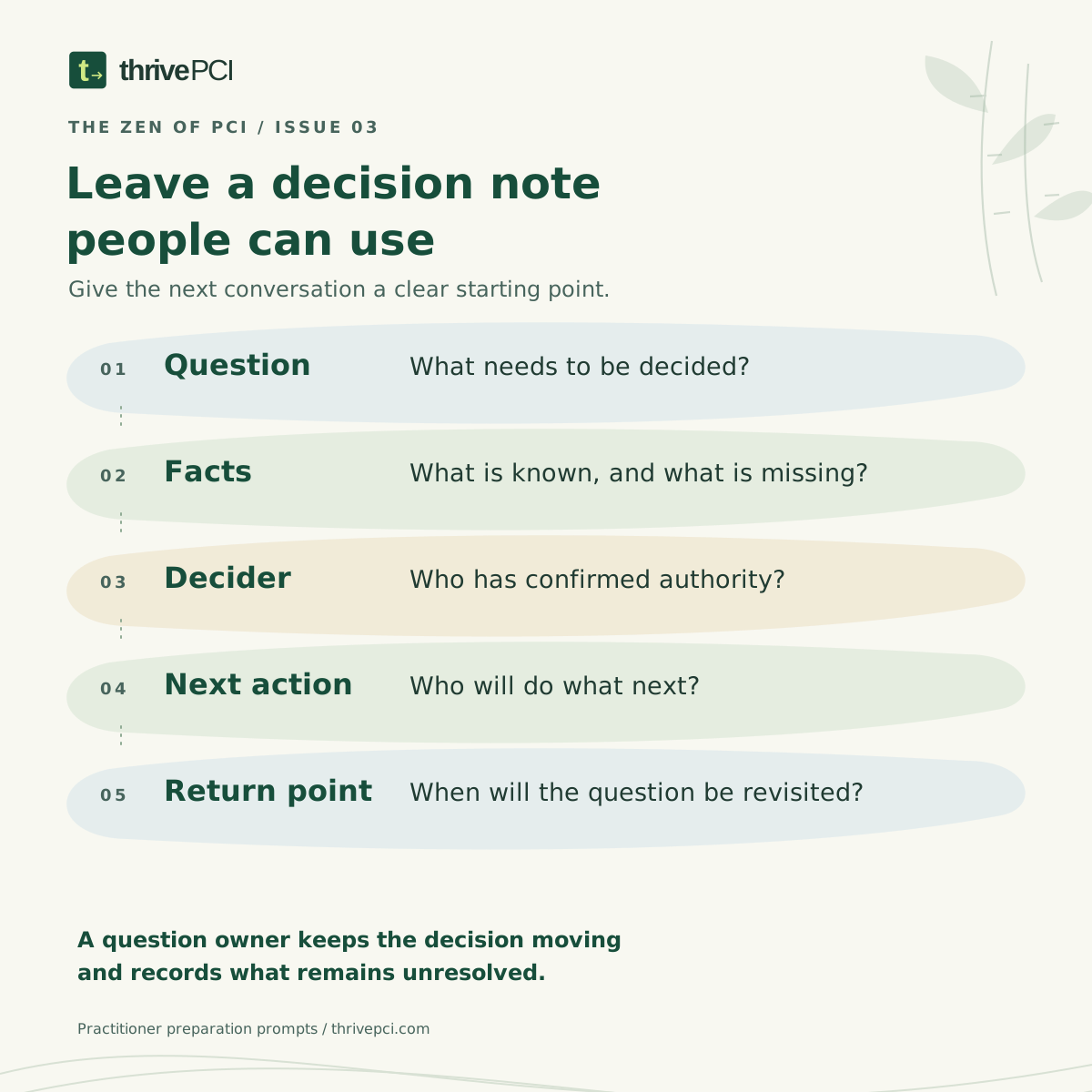
Leave a decision note people can use
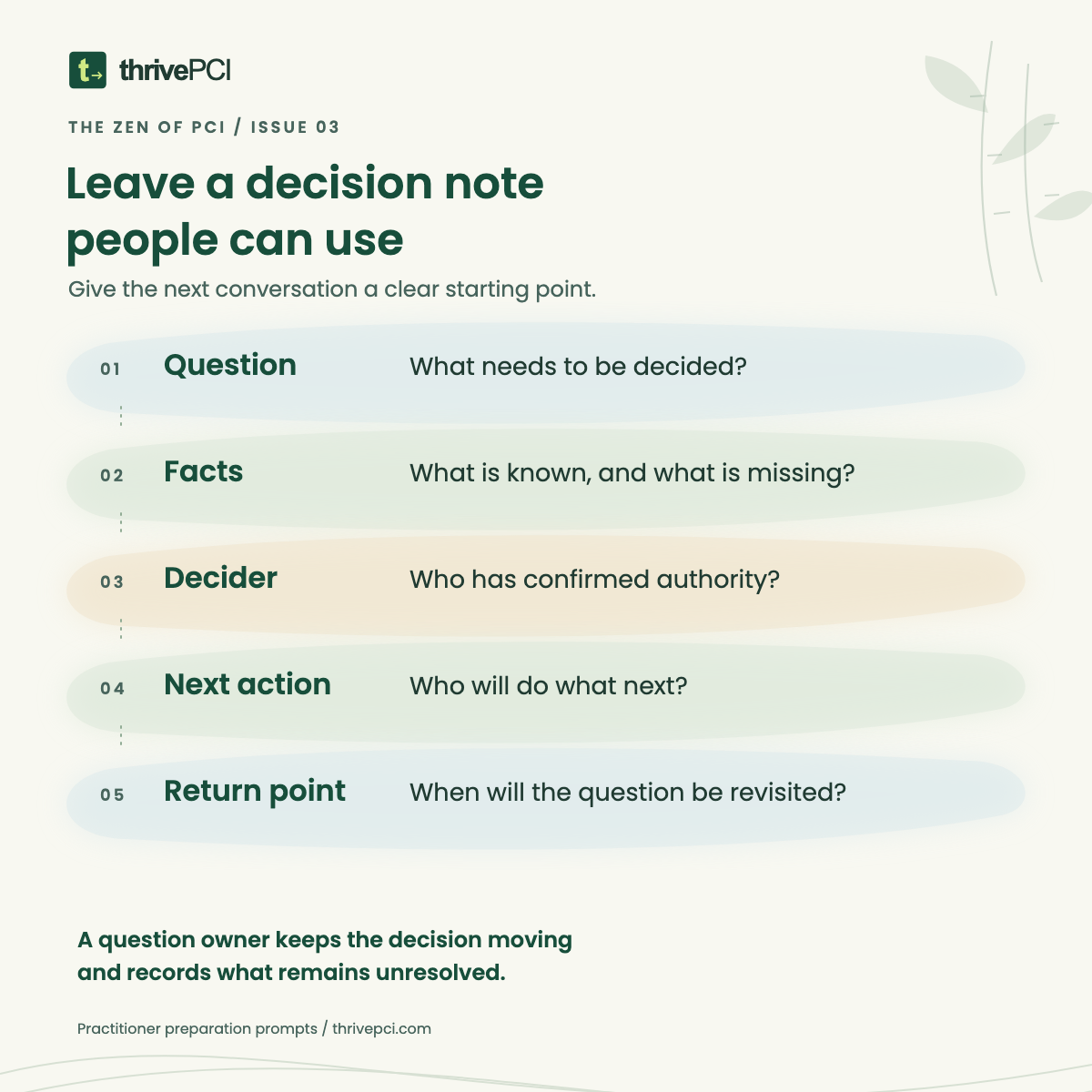
Five prompts for an open decision note: question, facts and missing facts, authorized decider, next action and owner, and return point.
Practitioner preparation prompts; use the organization’s established authority and governing process. Download PNG · Download SVG

Try five prompts: the question, the facts and missing facts, the authorized decider, the next action and its owner, and the return point. Link the supporting records in the approved evidence location.

The return point is when the team will revisit an unresolved item. Choose it to suit the urgency, governing process, and engagement context. Escalate through the established route when the matter requires attention sooner. An internal reminder does not replace an applicable control obligation or deadline.

Try one question at the next check-in

Choose one unresolved preparation question. Ask three people to identify who is gathering the facts, who can decide, and who would carry out the resulting action. Compare their answers with the organization’s process.

Where the answers differ, make that the next clarification task. Record the missing information and a return point. This practitioner exercise helps organize the work; the applicable requirement, testing procedures, and assessment context still govern evaluation.

The free thrivePCI guided Assessment Preparation path offers a place to practice clear responsibilities and useful handovers. Bring one open question, and give the people involved a clearer place to continue.

Practice clear ownership with the free guided path (opens in a new tab)

LINKEDIN POST

Give open decisions a clear owner

Suggested companion: download the matching PNG.

An unresolved question can appear on several meeting agendas without moving closer to a decision.

Try making three roles visible: the person assembling the facts, the person authorized to decide, and the person carrying out the agreed action.

The next issue of The Zen of PCI follows a fictional supplier-access question through that route. It considers missing information, decision authority, completion records, and a useful return point for work that remains open.

A preparation coordinator can keep those connections visible. The organization’s established process still determines who can approve a particular decision.

Choose one question your team is carrying forward. Could everyone involved identify the same route from question to decision to action?

thrivePCI’s free guided Assessment Preparation path gives you a place to practice that conversation.

Explore the free guided preparation path (opens in a new tab)

LINKEDIN POST

Make the three responsibilities visible

Suggested companion: download the matching PNG.

Who is gathering the facts? Who can make the decision? Who will carry out the agreed action?

Those questions can reveal different responsibilities inside one preparation task.

For a fictional supplier-access question, a relationship owner might confirm the support need. An access administrator might establish the current permissions. The authorized owner would make the access decision through the organization’s established process.

A coordinator can connect the work and follow up on missing information. Confirm the actual authority before assigning an approval to someone because their name appears on the task list.

Try adding these responsibilities to one open question at your next check-in. Ask the people involved to confirm the arrangement and identify any gap.

Where would that conversation make the next step clearer for your team?

Practice with the free preparation path (opens in a new tab)

LINKEDIN POST

Help the authorized person reach a supported decision

Suggested companion: download the matching PNG.

An open question becomes easier to consider when the authorized decision maker can see the facts and the uncertainty together.

State the question plainly. Identify the records supporting the material facts. Explain what is missing and how that uncertainty could affect the answer.

Then confirm that the person receiving the question has the relevant authority under the organization’s process. A job title or a place on a meeting invitation does not establish that authority by itself.

In a fictional supplier-access review, that might mean confirming who can approve the access decision before asking a preparation coordinator to move the response forward.

Choose one decision your team is waiting for. What would help the authorized person understand what is being asked and what remains unresolved?

Use the free handover prompts (opens in a new tab)

LINKEDIN POST

Give an unresolved question a return point

Suggested companion: download the matching PNG.

“Waiting for an answer” becomes more useful when the team can see what answer is needed, who is following it up, and when the question will return.

Try recording the missing fact in plain language. Identify the responsible role and link the approved records already available. Agree on a return point that fits the urgency and the organization’s process.

If the issue needs attention sooner, use the established escalation route. Keep the decision open until the authorized person has resolved it through that process.

This is an internal coordination practice. Applicable control obligations and engagement deadlines still need their own attention.

Which open item on your team would be easier to follow if the next check-in began with those details?

Explore the free Assessment Handover guide (opens in a new tab)

LINKEDIN POST

Try a short decision ownership check

Suggested companion: download the matching PNG.

Choose one unresolved preparation question for a short team exercise.

Ask three people to identify the role assembling the facts, the role authorized to decide, and the role that would carry out the agreed action.

Compare the answers with the organization’s established process. If the answers differ, record the clarification needed and the role that can help resolve it.

Then write a brief decision note: question, facts and missing facts, authorized decider, next action and owner, and return point. Use fictional identifiers and placeholder links while practicing with training material.

The value is a clearer route for the work and a visible place to resume the conversation.

Which of those five prompts exposed the most useful question for your team?

Try the free guided preparation path (opens in a new tab)

LINKEDIN POST

Bring a real preparation question to your learning plan

Useful preparation training can give people a question to take back to their own work.

For this issue of The Zen of PCI, try asking who is gathering the facts, who can decide, and who will carry out the next action for one unresolved item.

The free PCI Foundations sample on thrivePCI offers another way to practice asking supported questions through a fictional payment-provider scenario.

Try identifying a fact you can substantiate, an uncertainty that remains open, and the responsible role who could help with the answer.

If this approach fits your team’s learning needs, the same page lets you request details about the upcoming paid learning pilot. The form records interest; it does not place an order or collect payment.

What decision or ownership question would your evidence owners benefit from practicing?

Try the free lesson or request pilot details (opens in a new tab)

Scott’s publication review

The campaign links include UTM labels for later reporting; this release adds no visitor tracking. Source copy and editorial notes are versioned in GitHub.

Download the complete newsletter and post copy

Download copy and visual review pack (ZIP)