thrivePCISite v0.43.62+20261122T201000Z · Published November 22, 2026

SCOTT REVIEW · NEWSLETTER ISSUE 10

A status update another person can act on

One newsletter issue and 6 supporting posts. Two downloadable visuals illustrate the practice. These drafts promote the current free preparation resources and the request-details contact route. The copy buttons copy ready-to-edit text to your clipboard. Nothing here posts to LinkedIn.

A supported current position is connected to its source, an open question, and the next responsible owner and return point. Preparation completion, pending authorization and assessment conclusions remain distinct.
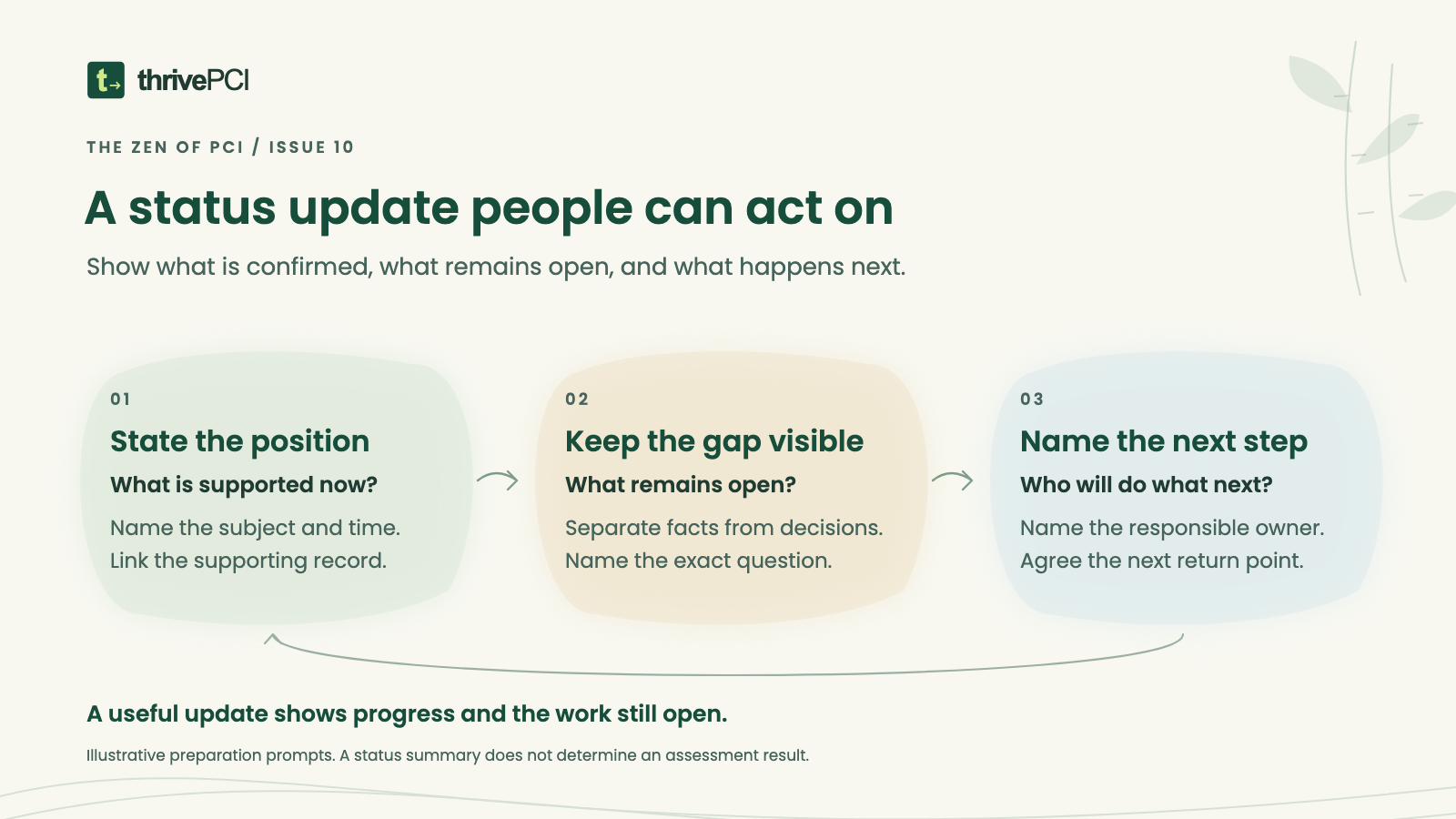
Explain the supported position, keep the open question visible, and show the next step through the established process. Download PNG · Download SVG

Newsletter: The Zen of PCI

Practical PCI preparation for the people who own the work: responsibilities, evidence, timing, and habits that last.

Suggested sequence: Supporting posts form a suggested editorial sequence; publication dates are set by Scott.

Suggested T+ release plan

T+0 = actual publication day for issue ten. Offsets below use calendar days. Set T+0 only when the issue is ready for publication.

OffsetContentSuggested purpose
T+0Newsletter: A status update another person can act on
Post: A status update another person can act on
Publish issue ten and introduce an actionable preparation update after review.
T+2Post: State the position the record supportsDescribe the position supported by the source, including time and coverage.
T+5Post: Give the open question a routeRoute a precise open question while preserving decision authority.
T+8Post: Make the return point meaningfulAgree a useful return point without displacing existing obligations.
T+12Post: Try a five-minute status noteInvite a short fictional status-note exercise and recipient check.
T+16Post: Practice an update someone else can continueConnect the practice to the free sample and request-details route.

Scott may adjust offsets for editorial readiness and audience conversation. These are publication suggestions, not PCI control intervals, engagement deadlines or claims about platform algorithm performance.

Download T+ plan · Download CSV

NEWSLETTER · ISSUE 10

A status update another person can act on

A useful status update gives another person a place to begin. It explains the current position, the record supporting it, the question still open, and the next owner or return point. The recipient should be able to tell what can happen next within their role.

Start with one item and a specific audience. Keep the subject, represented time, and coverage clear enough for the reader to understand what the update supports.

Continue the fictional supplier-access example

In issue nine, a covering colleague prepared an update about the supplier integration while checking the recipient and approved route. The handoff summary says “ready,” while the change record shows a pending integration decision. The responsible owners are confirming what each status describes.

The colleague can report that the relevant reference has been located and that the change record lists the decision as pending for the time it represents. The meaning of “ready” remains under confirmation. Neither statement establishes that the integration has been approved.

A useful update keeps those facts separate and connects the open question to the role that can confirm the answer.

Say what is currently supported

Describe the item and the part of the work being discussed. Is the update about preparing a handoff, completing an action, obtaining authorization, or confirming an outcome? Those statements can require different records and different responsible roles.

Use wording supported by the available source. “The record is available for review” describes a different position from “the proposed integration is approved.” Keep completion of preparation work, an operational approval, and an assessment conclusion distinct.

Include the time or version represented by the source where relevant. The time you write an update does not automatically make the underlying information current. If the position needs confirmation, say who can provide it and keep that uncertainty visible.

Make the supporting record usable

Reference the approved record through a route the authorized recipient can use. Preserve the source context, coverage, and any limitation relevant to the statement. Follow the handling practices discussed in issue nine rather than pasting unnecessary detail into the update.

In the fictional example, the approved change record supports the reported pending decision at its recorded point. The handoff summary raises a question about what “ready” means. Retaining both references helps the responsible owners explain the apparent difference.

A short update can point to those sources without turning their existence into proof that the underlying work is complete.

Leave a status note people can use
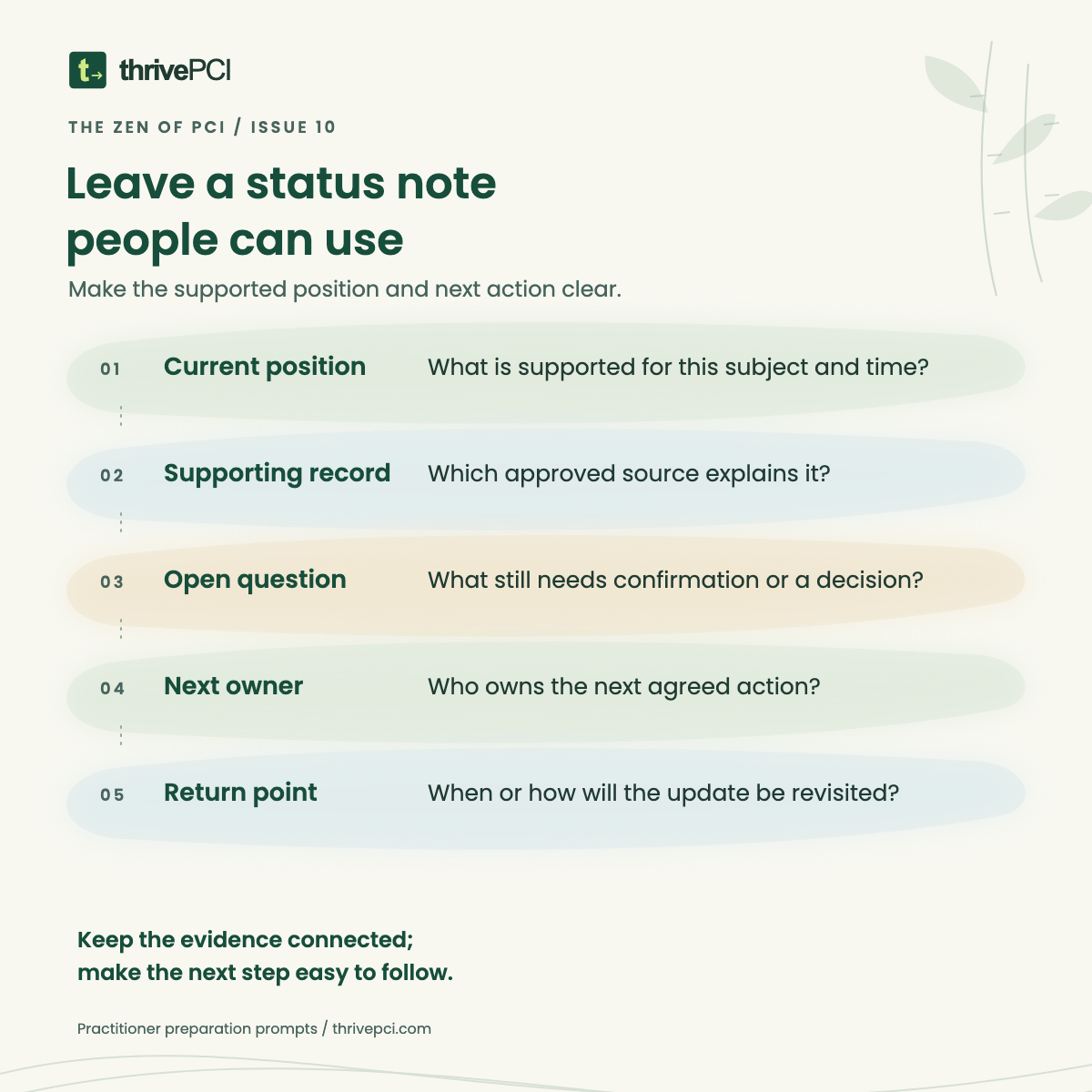
Five prompts for a status note: Current position, Supporting record, Open question, Next owner, and Return point. Preserve relevant subject, time and coverage and route confirmation through established roles.
Practitioner preparation prompts; a status note does not grant approval, assign new authority or establish an assessment outcome. Download PNG · Download SVG

Try five prompts: Current position, Supporting record, Open question, Next owner, and Return point.

A fictional note could say: “The integration handoff reference is available. The change record lists the integration decision as pending for its represented time. Confirm whether ‘ready’ refers only to preparation coordination. The service owner is the role responsible for confirming the decision status through the established process. The coordinator will seek agreement on the next return point and record it in the approved workspace.”

The note makes the missing confirmation visible. It does not create an approval, assign new decision authority, or promise a response date that nobody has agreed.

Give the open question a route

State the question precisely enough for its owner to recognize what is needed. Identify the next action through the normal process: confirm a fact, supply a reference, clarify responsibility, or make an authorized decision.

Keep coordination responsibility and decision authority clear. A coordinator may follow up on the question while another role retains the decision. If responsibility or a return point has not been agreed, show that gap and route it for confirmation.

Existing deadlines, required activities, and escalation triggers continue to apply. A suggested return conversation does not postpone an obligation or authorize an action outside the recipient’s role.

Check the update with its reader

Ask an authorized recipient to explain three things back: what is confirmed, what still needs an answer, and what happens next. If they infer approval from a preparation label, revise the explanation with the appropriate owner.

For practice, use a fictional record and placeholder identifiers. Write a short status note, ask a colleague to follow its references, and record which detail helped them understand the next step. Keep missing facts visible throughout the exercise.

These are practitioner preparation prompts. Applicable PCI requirements, prescribed activities and intervals, established approvals, handling rules, and assessment context still govern the underlying work. A status note does not establish compliance or determine an assessment outcome.

The free thrivePCI Assessment Handover guide offers a place to practice an update another person can use.

Practice with the free Assessment Handover guide (opens in a new tab)

LINKEDIN POST

A status update another person can act on

Suggested companion: download the matching PNG.

What can the next person understand and do from your preparation update?

Issue ten of The Zen of PCI continues our fictional supplier-integration example. A handoff is marked “ready,” while the change record shows a pending decision. The covering colleague needs to explain what is supported without implying that approval has been granted.

Try five prompts: Current position, Supporting record, Open question, Next owner, and Return point.

Keep the subject, time, and coverage connected to the source. Identify who can confirm the open question through the established process. If a return point is not agreed, keep that gap visible.

Which detail would help your next reader distinguish completed preparation work from a decision still awaiting confirmation?

Practice with the free Assessment Handover guide (opens in a new tab)

LINKEDIN POST

State the position the record supports

A short status label can leave a reader with a large question: what exactly does it describe?

Name the item and the part of the work. Preparing a handoff, completing an action, obtaining authorization, and checking an outcome can involve different records and responsible roles.

In our fictional example, locating the integration record helps the preparation conversation. It does not establish that the proposed integration has been approved.

Use wording the source supports. Include its represented time or version where relevant, and keep any limitation visible. The timestamp on your new update does not automatically refresh the information behind it.

Choose one fictional update. What would you add so a colleague can explain the current position without guessing?

Use the free guided preparation path (opens in a new tab)

LINKEDIN POST

Give the open question a route

A useful update makes the remaining question specific enough for its responsible owner to recognize.

In our fictional example, the covering colleague asks whether “ready” refers to preparation coordination and which record confirms the integration decision status. Those are separate claims to check.

Identify the next action through the normal process: confirm a fact, provide a reference, clarify responsibility, or make an authorized decision. Keep the role coordinating follow-up distinct from the role holding decision authority.

If the owner or return point is not agreed, show that gap and route it for confirmation. A status note does not assign new authority or create a response promise.

Which question would make your next preparation update easier to act on?

Practice with the free Assessment Handover guide (opens in a new tab)

LINKEDIN POST

Make the return point meaningful

A return point helps people know where the next explanation should appear.

Agree it through the established process and keep it connected to the open question, the responsible roles, and the approved record. If it has not been agreed, say so and identify the next coordination step.

The fictional integration update can explain which decision status needs confirmation without inventing a response date. The coordinator seeks agreement and records the resulting return point in the approved workspace.

Existing deadlines, prescribed activities, and escalation triggers continue to apply. A planned conversation does not postpone them.

Look at one fictional status note. Could a colleague explain what should happen at its return point and which obligation still applies before then?

Use the free guided preparation path (opens in a new tab)

LINKEDIN POST

Try a five-minute status note

Suggested companion: download the matching PNG.

Choose a fictional preparation item and use placeholder records. Give it one supported fact and one question that still needs confirmation.

Write five prompts: Current position, Supporting record, Open question, Next owner, and Return point.

Ask a colleague to explain what is confirmed, what remains open, and what happens next. Which source supports their explanation? Does a pending approval remain visibly pending?

Keep any missing owner, permission, or agreed return point visible and describe the normal route for resolving it. Use fictional material rather than live evidence for this exercise.

These prompts support preparation practice; real actions, decisions, evidence handling, and required activities follow the organization’s established processes.

Which detail helped your colleague act within their role?

Practice with the free Assessment Handover guide (opens in a new tab)

LINKEDIN POST

Practice an update someone else can continue

A preparation update becomes more useful when another person can follow the record and understand the next step.

Try the free PCI Foundations sample on thrivePCI with a colleague. It uses a fictional payment-provider scenario to practice supported questions. Discuss how you would report the current position while keeping an unanswered question visible.

Which record supports the statement? Who can confirm what remains open? Where would the next explanation be recorded?

Keep real decisions and actions within the established roles and processes.

If this approach fits your team, the same page offers a request-details route for the upcoming paid learning pilot. The request records interest; it does not place an order or collect payment.

Which status update would your team practice first?

Try the free sample or request pilot details (opens in a new tab)

Scott’s publication review

The campaign links include UTM labels for later reporting; this release adds no visitor tracking. Source copy and editorial notes are versioned in GitHub.

Download the complete newsletter and post copy

Download copy and visual review pack (ZIP)