
NEWSLETTER · ISSUE 19
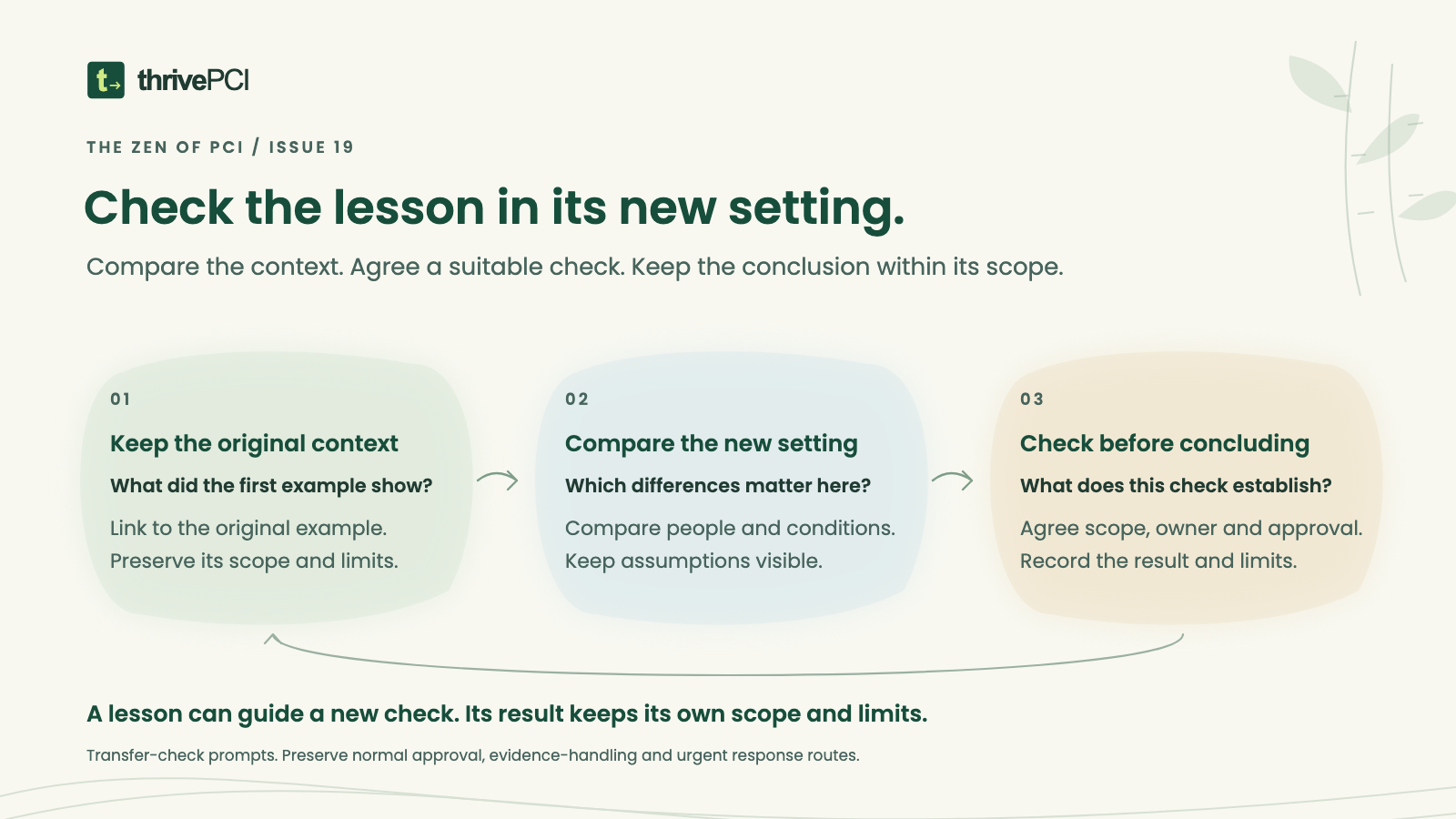
Check the lesson in its new setting
A shared lesson gives a receiving team a useful place to begin. Its value grows when the team compares the original setting with its own, agrees an appropriate check, and records what the result actually supports. That small bridge helps an idea become relevant working knowledge.
The first question is practical: what is similar enough to learn from, and what is different enough to examine? A familiar document title or process name may conceal different participants, permissions, information, or working conditions. Making those differences visible gives the lesson a fair chance to help.
In our fictional supplier-integration exercise, the earlier placeholder wording trial produced one invented observation: a participant could identify the next question from a revised handoff. Another fictional team wants to consider that idea. Its receiving participant has less background knowledge, and its handoff includes a different responsibility boundary.
Those differences suggest a useful question: can this participant identify both the next question and the role responsible for answering it? The team can consider an appropriately authorized, limited check using made-up records. The separate contributor-capacity question and pending live integration decision remain with their appropriate owners.
Keep the original context available
Begin with the original observation and its authorized reference. Preserve the participants, wording version, conditions, and limits needed to understand the example. Describe a possible explanation as a possibility. One participant finding a question does not establish why the wording helped or how it will work elsewhere.
Then ask the receiving owner which local differences matter. Less background knowledge might change how much explanation is needed. A different responsibility boundary might change what a clear next step must identify. These are useful considerations for shaping a check rather than reasons to assume that transfer will succeed or fail.
An accurate comparison respects both settings. It lets the receiving team learn from earlier work while keeping responsibility for its own decisions.
Leave a transfer-check note people can use
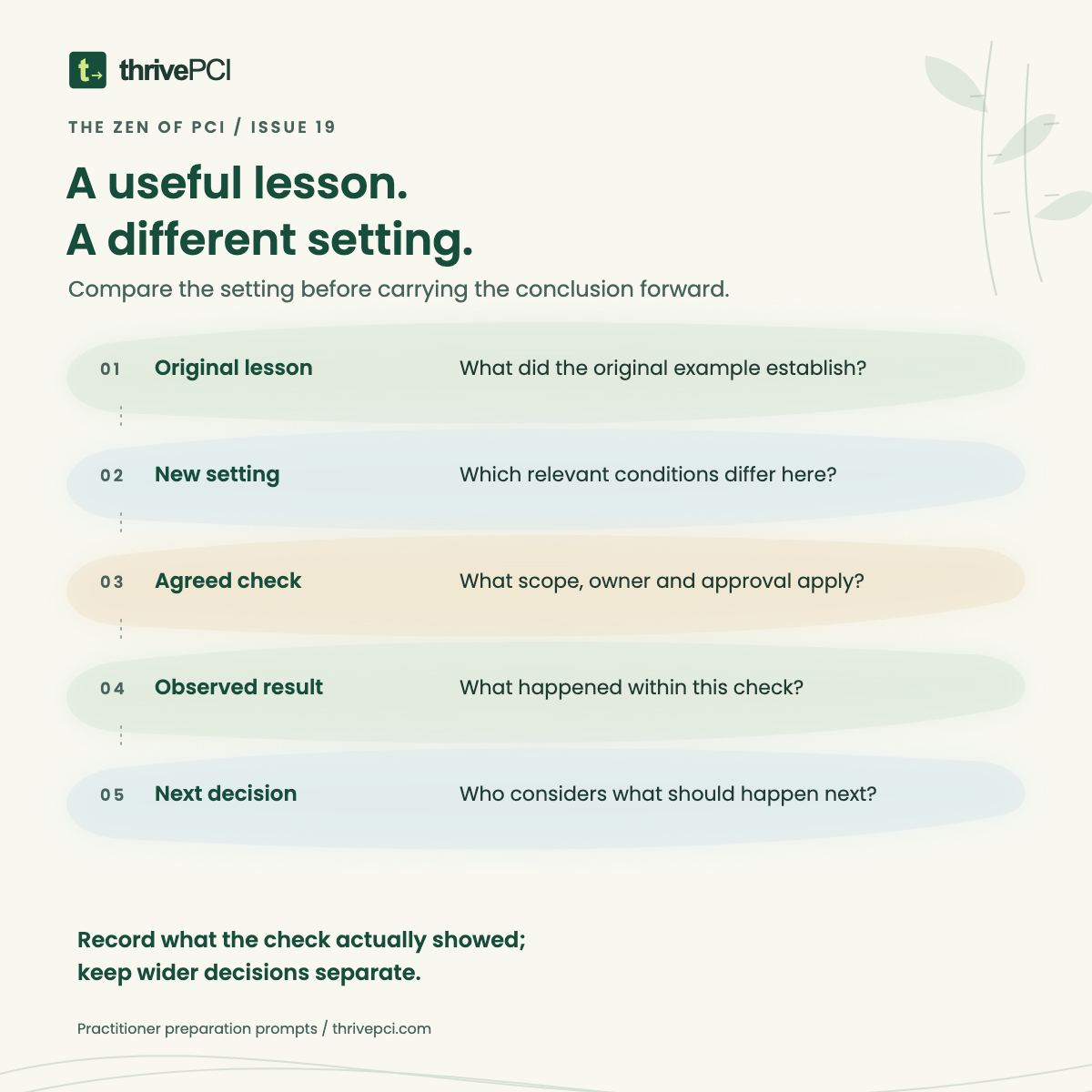
Use five prompts to connect the lesson with a specific question in its new setting:
Original lesson: State the observed lesson and identify its supporting example through an authorized reference. Keep the original scope and limits attached. A reader should be able to distinguish what happened from what someone hopes the lesson could achieve elsewhere.
New setting: Describe the relevant similarities and differences. Identify the people, information, environment, and responsibility boundaries that could affect the result. Include only context the receiving participants are permitted to use; keep underlying evidence in its approved location.
Agreed check: Confirm the specific question, accepted owner, applicable authorization, and conditions before any check proceeds. Describe the method and what would count as a useful observation. Acknowledging a suggestion, accepting ownership, and approving an activity are distinct positions. Record each through the normal route.
Observed result: Record what happened in the agreed check, including relevant conditions and uncertainty. Compare it with the question that was actually examined. Preserve an incomplete or mixed result as such; a promising observation can inform another question without supporting a broad conclusion.
Next decision: Identify what the authorized role needs to decide next and where that decision belongs. The result might support revising the example, seeking more context, proposing another appropriate check, or leaving the idea unused. Keep proposed action, approval, and work performed separate.
The note supports the existing approval, change, evidence-handling, assessment, and operating processes. It creates no PCI activity interval or changed deadline and never delays required urgent action. Its purpose is to make the next conversation easier to continue accurately.
Make room for a mixed result
For illustration, suppose the fictional team obtains the applicable authorization and confirms the stated conditions for its limited placeholder check. The participant identifies the question but cannot identify the responsible role from the handoff alone. That invented result is useful: it points to a local gap the original example did not examine.
The team can describe the result without calling the whole approach ineffective or successful. A proposed role label still needs appropriate consideration and any required approval. Neither fictional check authorizes a live integration, a wider rollout, or a compliance conclusion.
Try the comparison together
Use invented role names and placeholder wording. Write the five prompts, leaving the check proposed until the required owner and authorization are confirmed. Ask a partner to identify the difference that matters, the question being checked, and the next decision a mixed result would leave open.
Keep real evidence and sensitive details out of the exercise. Revise any phrase that turns an interesting possibility into an established result. A shared lesson becomes more useful when its next setting receives careful attention and its next decision rests on what was actually learned.
Explore the free Program Maintenance guide (opens in a new tab)