
NEWSLETTER · ISSUE 05
When change means reopening a settled question
A settled question has a useful place in preparation. Someone identified the issue, an authorized person made a decision, and the team recorded the action and outcome. Other people can follow that explanation without rebuilding it from memory.
Then something changes.
A new connection, service, role, or operating condition can affect the assumptions behind that answer. The practical question becomes: does the earlier conclusion still describe the situation we now need to explain?
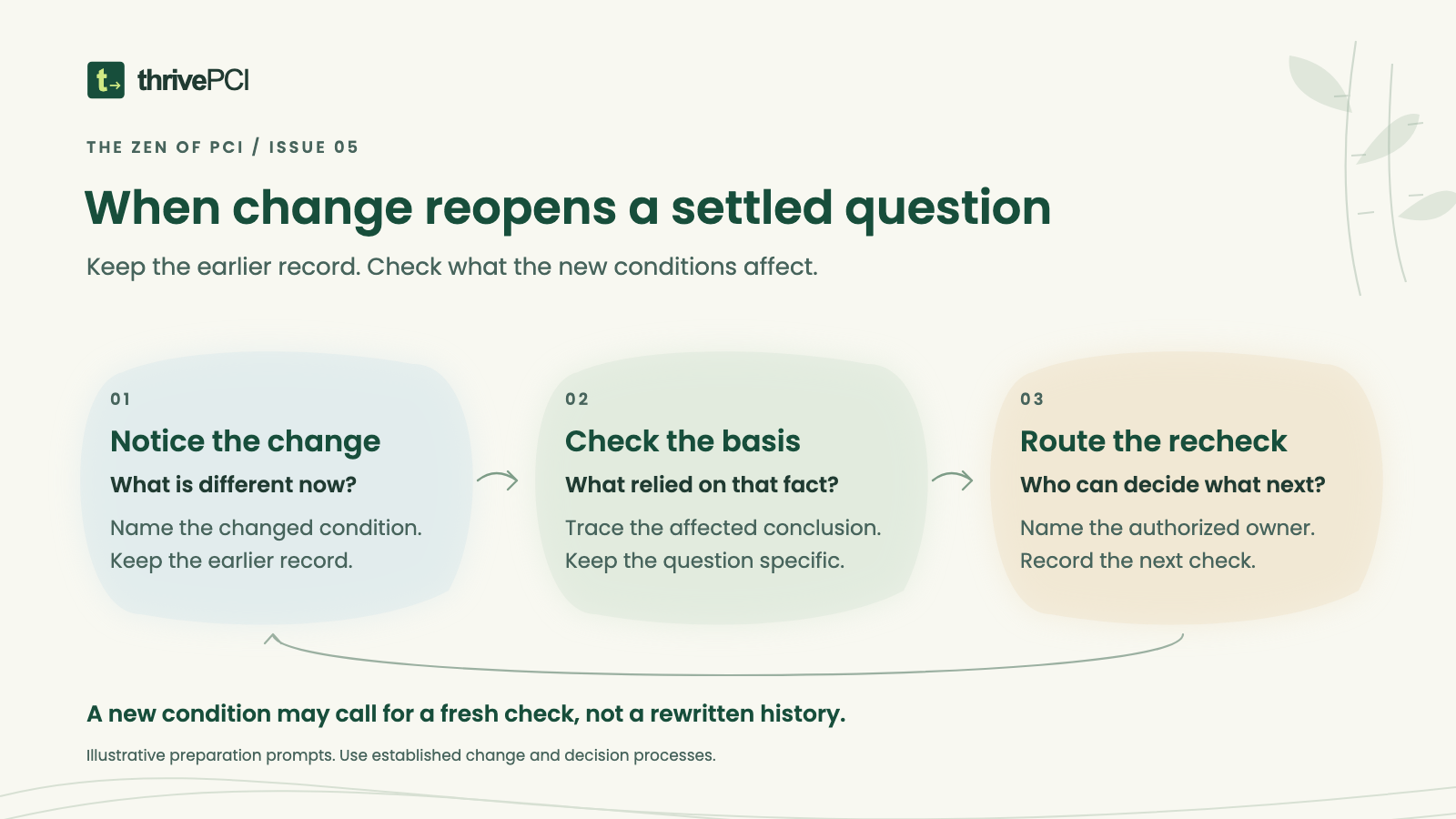
A calm response starts by identifying what changed and which part of the earlier reasoning it could affect. Preserve the previous record, and give the new question a clear path to an answer.
Continue the fictional supplier-access example
In issue four, a fictional team confirmed that the targeted supplier application account was disabled. It retained the authorized action, completion record, outcome check, and a separately owned question about another access path.
Later, a proposed support integration introduces a different connection between the supplier and the application. A colleague points to the earlier closure note and asks whether the access question is already resolved.
The earlier check still explains the account state examined at that time. The proposed integration introduces a new fact to evaluate through the organization’s established change, access, and review processes. The preparation lead links the proposal to the earlier note and identifies the owner who can determine its effect.
Name the changed condition
Start with a specific description: what is proposed or has changed, which service or component it affects, and when that condition applies. Distinguish a proposal from an implemented change. Keep supporting records in approved channels, using identifiers appropriate to that audience.
In the fictional case, “supplier support changed” is too broad to guide a useful review. The new integration’s purpose, connection, permissions, and affected environment give the responsible people a clearer starting point.
If important details are unavailable, record the missing information and who can confirm it. Avoid filling the gap with the previous answer simply because that answer was once well supported.
Find the assumption that needs another look
Read the earlier decision alongside its stated coverage, conditions, and evidence. Ask which of those could be affected by the change. It may be the identity involved, the access path, the system boundary, the responsible party, or the time represented by a supporting record.
Keep the question proportionate to the change and the governing process. A responsible owner may confirm that the earlier conclusion remains applicable within its coverage. They may identify a focused follow-up or determine that a broader review is needed.
The preparation lead helps organize those facts and routes the question. Authority to approve a change, interpret its operational impact, or accept a result stays with the roles established by the organization.
Leave a recheck note people can use
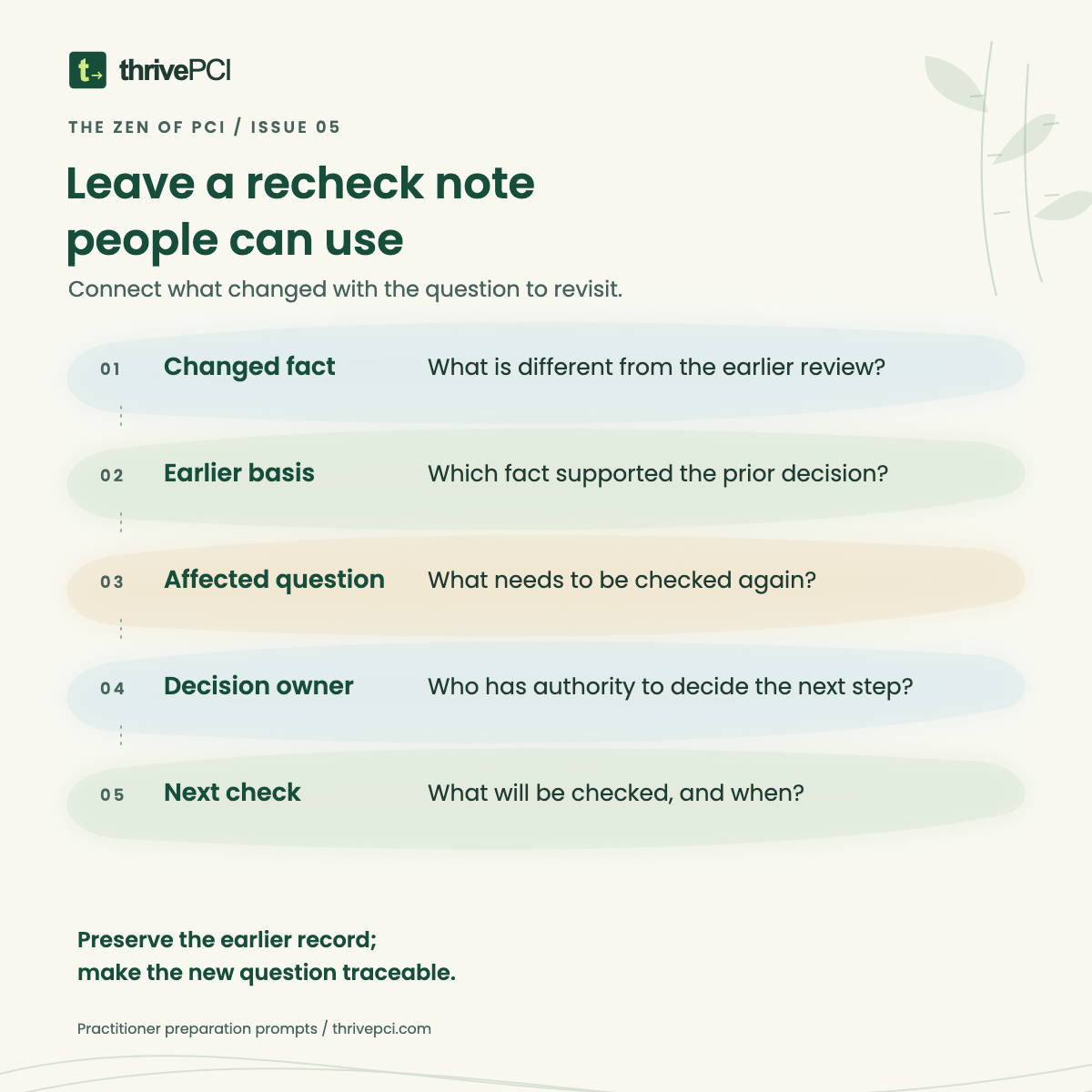
Try five prompts: changed fact, earlier basis, affected question, decision owner, and next check.
For the fictional integration, the note could say: “The proposed support connection introduces a new access-path question. The earlier note confirms the targeted account state at the recorded check time. The service owner will coordinate review of the proposal through the established process. The change record links the required information and return point.”
When the responsible roles have reviewed the change, connect the resulting decision and supporting records to the note. Describe the coverage and time of any new check. If a question remains open, retain its owner and next step. Follow the established escalation route when circumstances require it.
Preserve the sequence
Keep the earlier decision and its evidence available. Link the later change, review, and resulting action so another reader can understand why the explanation evolved. An updated conclusion should identify what it replaces or supplements, within the organization’s recordkeeping process.
This practice supports a traceable preparation response. Applicable requirements, testing procedures, and assessment context still determine what must be evaluated. These prompts do not prescribe a PCI review interval or decide an assessment result.
Try a five-minute change check
Choose one fictional or appropriately approved completed preparation item. Introduce a single change: a new supplier connection, a revised service responsibility, or a different environment.
Ask a colleague which assumption could be affected, who should evaluate it, and what record would support the next answer. Write a short recheck note. Keep any uncertainty visible rather than treating the exercise as proof of readiness.
The free thrivePCI Assessment Handover guide offers a practical place to rehearse clear explanations. Start with one changed condition, and make the next question easier for its owner to answer.
Practice with the free Assessment Handover guide (opens in a new tab)