
NEWSLETTER · ISSUE 24
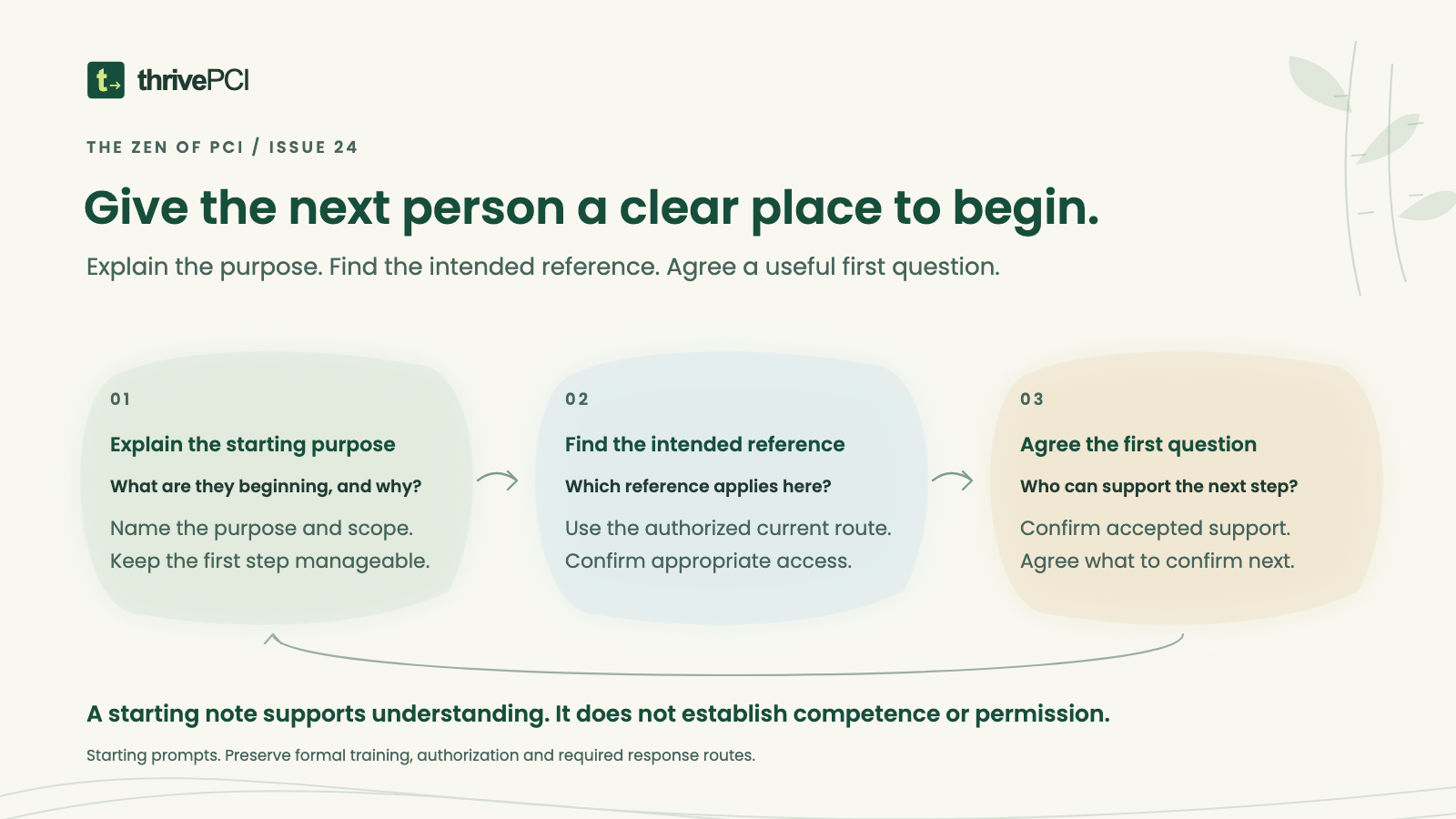
Give the next person a clear place to begin
A new participant brings useful questions as well as a different starting point. They may understand their own discipline while being unfamiliar with this team's references, decisions, and working routes. A clear introduction helps them find the part of the work they are meant to consider without asking them to reconstruct every earlier conversation.
The aim is a manageable beginning: a bounded purpose, an applicable reference, accepted support, a useful first question, and an honest way to confirm what follows. Those details can make a welcome practical while keeping responsibilities and permissions understandable.
In our fictional supplier-integration exercise, a new participant joins a defined role without the earlier handoff background. The optional wording trial has closed. Its mixed observation remains historical context: a participant found the next question but could not identify its responsible role. Current authorized guidance and that earlier example have different purposes.
The introduction should make those purposes clear. It does not settle the underlying responsibility question, the separate contributor-capacity decision, or the pending live integration decision. Giving someone a place to begin helps them engage with the current position rather than implying that the open questions have disappeared.
Explain the starting purpose
Begin with what the person is being invited to understand or contribute. A request to review a fictional handoff for an unclear role is more useful than an instruction to get up to speed on everything. Explain the relevant boundary, what is already established, and which decisions remain elsewhere.
Ask what context the participant needs for that purpose. Familiar terms can carry different meanings across teams. Let a question reveal a missing explanation without treating uncertainty as a personal shortcoming. The first conversation can be both welcoming and precise.
A starting point should fit the person and the work. It can become more detailed as the next appropriate step becomes clear.
Leave a starting note people can use
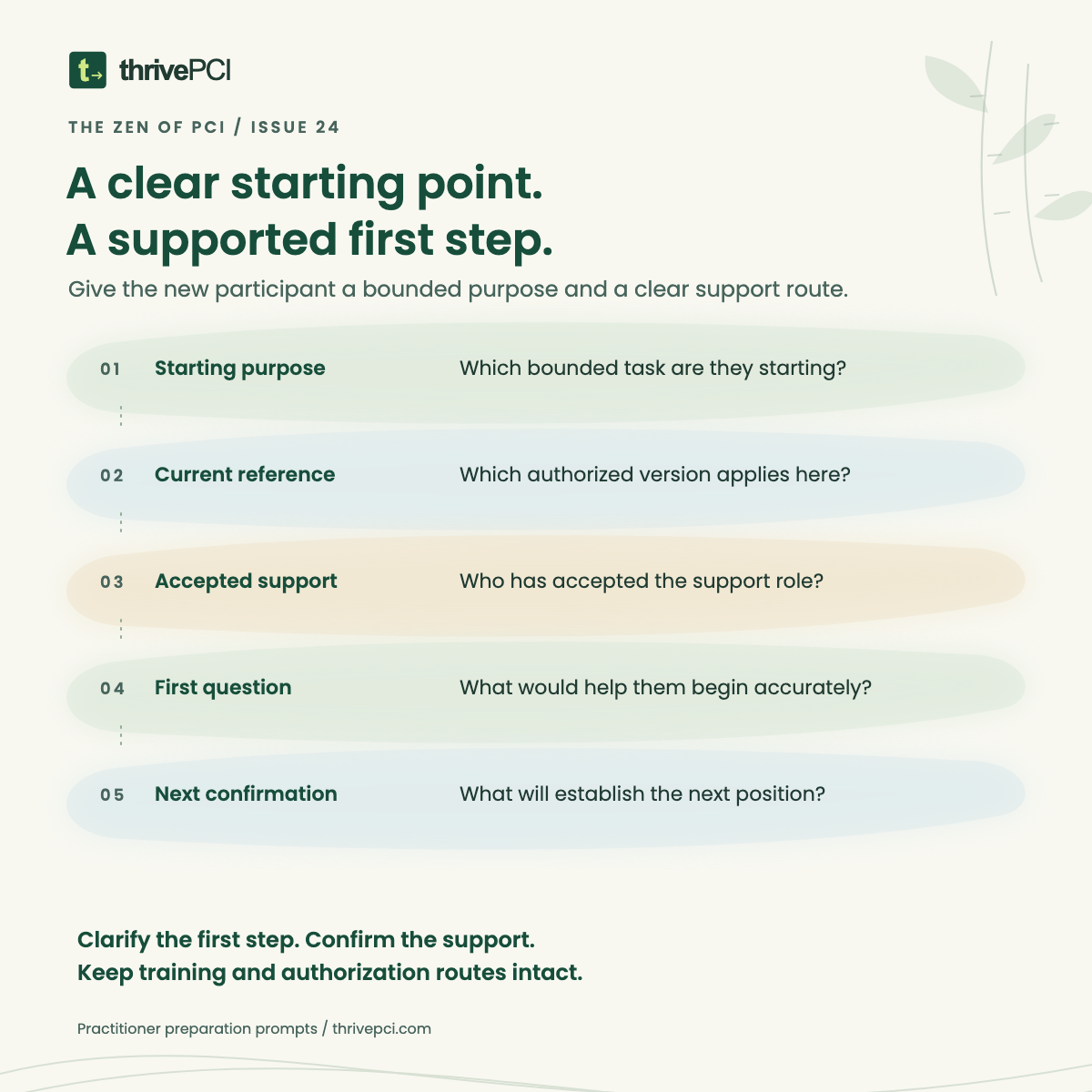
Use five prompts to make the introduction easy to continue:
Starting purpose: Describe the specific work or question the participant is joining and why their involvement matters. Identify its current scope and position. Keep an invitation to understand the work distinct from an assigned action, an accepted responsibility, or authority to make a decision.
Current reference: Point to the applicable authorized reference, its relevant version, and the context needed to use it. Confirm access through the proper route. Mark retained examples as historical and explain why they remain useful. Avoid creating an uncontrolled copy or sharing underlying evidence simply to make the introduction convenient.
Accepted support: Confirm who has agreed to help with the initial question within their responsibility. Explain the normal route for clarification or escalation when the answer belongs elsewhere. A copied recipient is not automatically an available support person, and accepting support does not transfer another role's decision authority.
First question: Agree one useful question the participant can examine with the information and permissions available. In the fictional example, they could identify which role is named in the current guidance and where the handoff still leaves uncertainty. Asking the question does not authorize changing the reference or conducting a live trial.
Next confirmation: Agree how the participant and support person will check their shared understanding and identify a supported next step. A short restatement can reveal whether the purpose, reference, and remaining uncertainty are understood. Record any accepted follow-up through the normal process, keeping a proposed action distinct from permission to proceed.
These prompts accompany the formal training, access authorization, role assignment, and operating processes that apply. They do not establish competence or control effectiveness, introduce a PCI interval, or alter a deadline. Required controls and prescribed urgent response continue through their normal routes.
Find the intended reference
Walk the route the new participant will actually use. Can they locate the applicable guidance, understand its scope, and distinguish it from the closed trial's retained example? If access is missing, use the authorized request route rather than borrowing another person's access or copying restricted material into the note.
Keep the introduction focused. More links do not necessarily provide a clearer beginning. A suitable reference, a short explanation of its purpose, and an accepted person to ask can create a more usable first conversation than an unexplained archive.
Try the first question together
Use invented role names, fictional guidance versions, and a placeholder handoff. Write the five prompts. Ask a partner to explain the purpose, find the applicable reference, identify the accepted support person, and restate the first question with its limits.
Leave one responsibility question open. Agree what the next confirmation can establish and what still requires another role's decision. Use no real evidence or sensitive details. A useful introduction leaves the next person able to begin, ask, and continue accurately without assuming more than the current position supports.
Explore the free Program Maintenance guide (opens in a new tab)