thrivePCISite v0.43.62+20261122T201000Z · Published November 22, 2026

SCOTT REVIEW · NEWSLETTER ISSUE 23

Make the current reference easy to find

One newsletter issue and 6 supporting posts. Two downloadable visuals illustrate the practice. These drafts promote the current free preparation resources and the request-details contact route. The copy buttons copy ready-to-edit text to your clipboard. Nothing here posts to LinkedIn.

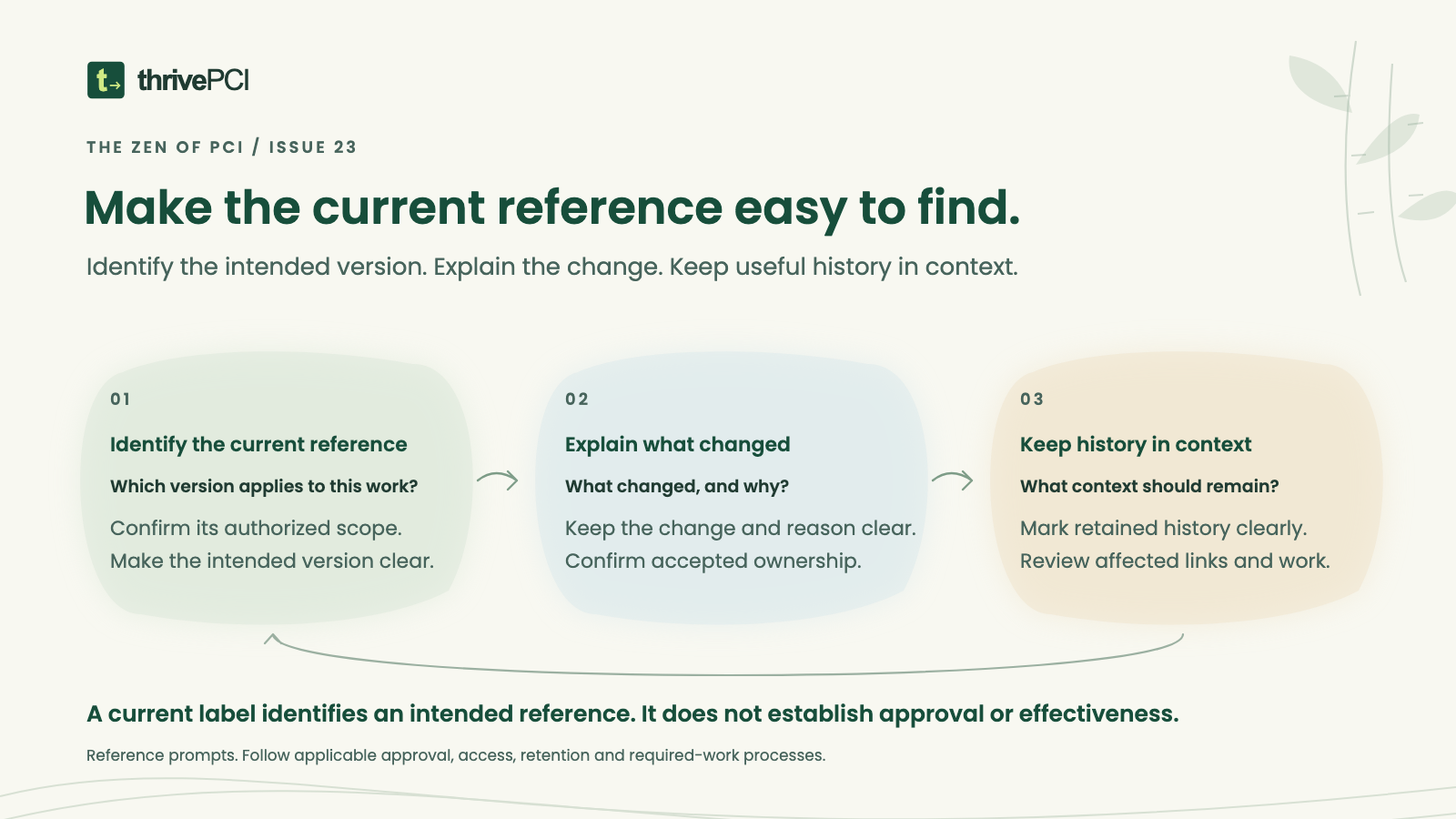
Three soft Forest Zen fields connect Identify the current reference, Explain what changed, and Keep history in context. Current guidance retains its scope while historical examples remain clearly identified and appropriately handled.
Make the current starting point clear while preserving useful history and the limits of what it establishes. Download PNG · Download SVG

Newsletter: The Zen of PCI

Practical PCI preparation for the people who own the work: responsibilities, evidence, timing, and habits that last.

Suggested sequence: Supporting posts form a suggested editorial sequence; publication dates are set by Scott.

Suggested T+ release plan

T+0 = actual publication day for issue twenty-three. Offsets below use calendar days. Set T+0 only when the issue is ready for publication.

OffsetContentSuggested purpose
T+0Newsletter: Make the current reference easy to find
Post: Make the current reference easy to find
Publish issue twenty-three and introduce five prompts for current references with useful history.
T+2Post: Check the route someone will actually followConfirm the applicable reference and follow the route a reader actually uses.
T+5Post: Explain the change without widening its meaningExplain the revision scope and confirm accepted maintenance ownership.
T+8Post: Give retained history a clear roleDistinguish retained history from current instruction under applicable handling rules.
T+12Post: Practice a current reference with useful historyInvite a fictional paired reference-note exercise with an unresolved question.
T+16Post: Make everyday references easier to useConnect the practice to the free guide and request-details route.

Scott may adjust offsets for editorial readiness and audience conversation. These are publication suggestions, not PCI control intervals, engagement deadlines or claims about platform algorithm performance.

Download T+ plan · Download CSV

NEWSLETTER · ISSUE 23

Make the current reference easy to find

A useful reference helps someone continue the right work with the right context. When guidance changes, that usefulness depends on two things staying clear: which version applies now, and why earlier material remains available. Keeping both understandable gives people a current starting point without losing the story behind it.

A folder full of similarly named files can make that distinction difficult. A familiar link might open an older copy. A retained example might look like today's instruction. A new label might appear before the appropriate review and approval have established what the reference supports.

In our fictional supplier-integration exercise, the optional wording trial has closed through its proper decision route. Its mixed observation remains useful: the participant found the next question but could not identify the responsible role. The team now wants people to find the authorized guidance relevant to continuing work, while retaining that earlier context appropriately.

That reference update does not demonstrate that the responsibility question is resolved. Contributor capacity and the live integration decision remain separate pending matters. A clearer route to guidance can help people continue accurately while those questions keep their own owners and records.

Identify the current reference

Begin with the reference that the appropriate owner has confirmed for the relevant purpose. Which version applies, to whom, and under what conditions? Keep its approval and effective scope available through the normal route. A filename containing current or latest does not establish those facts.

Then follow the route another participant will actually use. Does the working page, task, or handoff point to the intended version? Does it explain what the reader needs to do if their situation differs? A useful reference should be easy to find and difficult to mistake for something broader.

Preserving history supports that clarity. Earlier material can explain a decision, show what an example examined, or help someone understand why a revision was made. Its value grows when its historical role and limits are visible.

Leave a reference note people can use
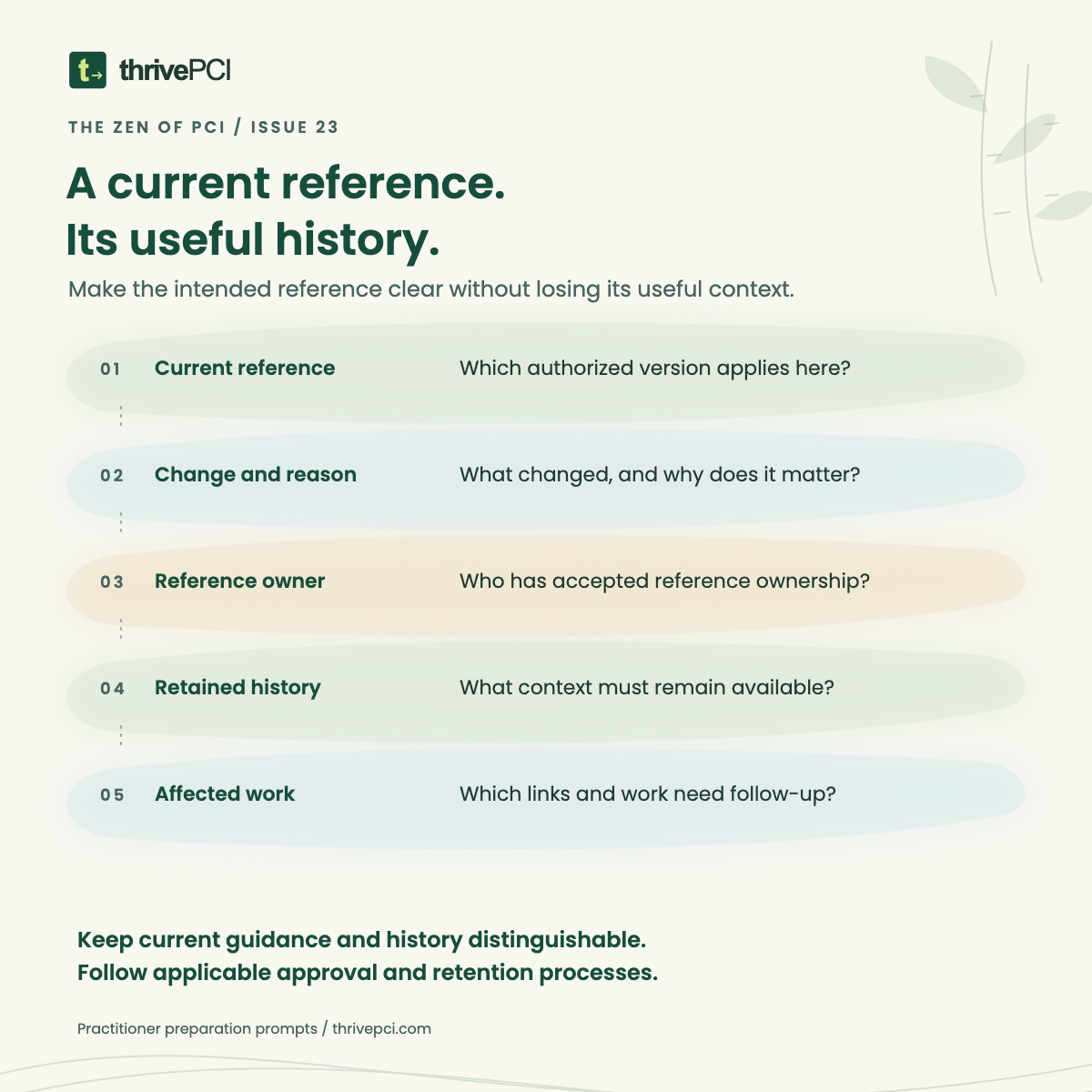
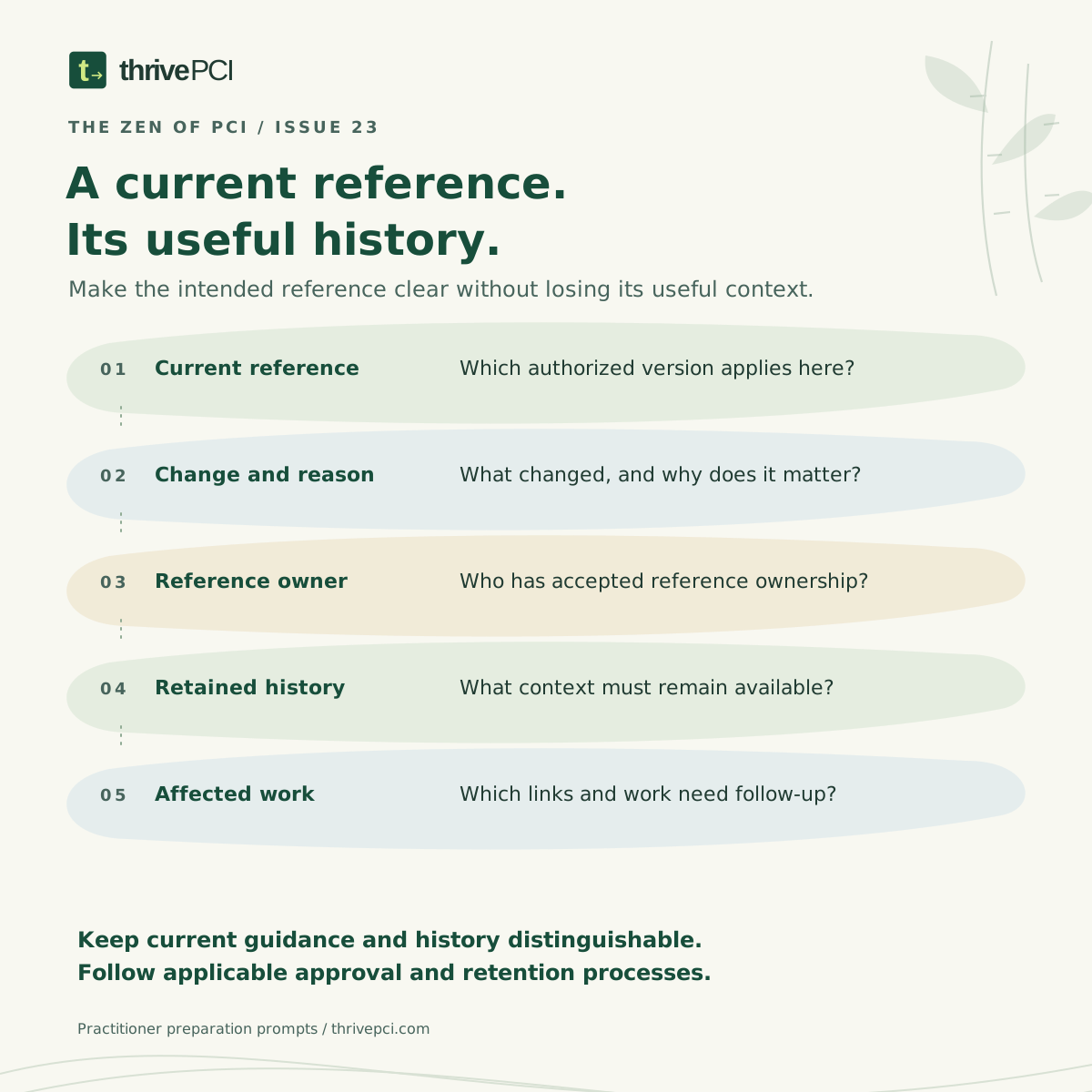
Five reference-note prompts: Current reference, Change and reason, Reference owner, Retained history, and Affected work. Keep current approval and scope traceable, historical context distinct, and follow-up ownership accepted.
Practitioner prompts for a usable reference, a clear owner, and history that supports understanding without becoming current instruction. Download PNG · Download SVG

Use five prompts to connect the current reference with its reason, ownership, history, and effect on work:

Current reference: Identify the authorized location, relevant version, intended purpose, and effective scope. Keep the applicable approval or confirmation traceable. Distinguish the reference that guides current work from a retained example or earlier instruction. Confirm the reader has the appropriate access rather than creating an uncontrolled copy for convenience.

Change and reason: Describe what changed and why it matters to the receiving person. Keep a revised explanation distinct from a changed responsibility or approved process. In the fictional exercise, updating a guidance link does not by itself settle the role question revealed by the earlier check.

Reference owner: Confirm who has accepted responsibility for maintaining this reference through the normal process. Identify approval, contribution, and operational responsibilities that belong elsewhere. Receiving a change notice is different from accepting ownership, authorizing a revision, or completing an affected task.

Retained history: Identify the earlier material that remains relevant and how its historical status is made clear. Preserve access, context, and handling under the applicable retention and record-management rules. This note specifies no universal retention period and does not authorize deleting earlier evidence or required records.

Affected work: Identify links, instructions, tasks, or participants that may need an update. Confirm accepted follow-up ownership and how the intended reference will be checked in use. Keep unresolved questions visible. Replacing a link, communicating a revision, and confirming that affected work now uses the right reference are separate positions.

These prompts support existing approval, change, evidence-handling, assessment, and operating processes. They introduce no PCI activity interval or altered deadline. Required controls and urgent response continue through their established routes while reference changes are considered.

Keep history in context

For illustration, the fictional team could link the closed trial's limited observation from its authorized history while directing current work to the applicable guidance. A reader can then see why the extra trial ended, what the example established, and which responsibility question still needs follow-up.

If the context changes again, the retained explanation can inform another appropriate decision. It does not automatically reinstate an old instruction or approve a new activity. The current owner still considers the relevant scope and conditions.

Try following the reference together

Use invented guidance versions and role names. Write the five prompts, then give a partner one current reference and one clearly historical example. Ask which applies to the fictional task, why the other remains, and who accepts an affected-link update.

Use no real evidence or sensitive details. Revise any label that implies unsupported approval or makes history look like current instruction. A useful reference lets people find today's starting point and understand yesterday's context without confusing the two.

Explore the free Program Maintenance guide (opens in a new tab)

LINKEDIN POST

Make the current reference easy to find

Suggested companion: download the matching PNG.

A useful reference makes today's starting point clear while keeping earlier context understandable.

Issue twenty-three of The Zen of PCI connects five prompts: Current reference, Change and reason, Reference owner, Retained history, and Affected work.

In our fictional handoff exercise, the optional wording trial has closed, but its mixed observation remains useful. People still need the authorized guidance for continuing work and an honest account of the earlier example's limits.

A current label does not establish approval, effective scope, or a resolved responsibility question. Keep those positions traceable through the normal route.

Which link would someone actually follow in your next handoff, and could they distinguish the applicable reference from material retained for history?

Explore the free Program Maintenance guide (opens in a new tab)

LINKEDIN POST

Check the route someone will actually follow

Which version applies to the work in front of the reader?

Start with the authorized location, relevant version, intended purpose, and effective scope. Keep the applicable approval or confirmation traceable through the normal route. A familiar filename containing current or latest does not establish those facts.

Then follow the working link from the task, page, or handoff someone will use. Confirm it opens the intended reference and makes the relevant conditions understandable.

In our fictional example, a clearer guidance link helps people find a starting point without demonstrating that the underlying responsibility question is resolved.

What would help the next person understand both which reference applies and what to do when their situation differs?

Explore the free Program Maintenance guide (opens in a new tab)

LINKEDIN POST

Explain the change without widening its meaning

A changed explanation can be useful without changing who is responsible for the work.

Describe what the revision changes and why it matters. Keep a guidance-link update, a clarified example, a revised responsibility, and an approved process change distinct.

Confirm who has accepted maintenance of the reference through the normal process. Approval, contribution, and operational responsibilities may sit with other roles. A copied recipient does not automatically accept those responsibilities.

In our fictional handoff, publishing a clearer reference does not settle contributor capacity or authorize live integration. Those decisions remain separately pending.

Which part of your next change notice would help a reader understand the revision's actual scope and the owner who has accepted its continuing care?

Explore the free Program Maintenance guide (opens in a new tab)

LINKEDIN POST

Give retained history a clear role

Earlier material can explain a decision or preserve the limits of an example.

Make that historical role visible so a reader can distinguish it from current instruction. Keep the relevant context, authorized location, and access conditions understandable through the normal route.

In our fictional exercise, the closed wording trial's mixed observation remains useful. It can explain why the proposal ended without becoming proof that the responsibility question is resolved or permission to repeat the trial.

Apply the relevant retention and record-management rules. A reference note sets no universal retention period and does not authorize deleting earlier evidence or required records.

What would keep your next retained example useful without inviting someone to treat it as today's instruction?

Explore the free Program Maintenance guide (opens in a new tab)

LINKEDIN POST

Practice a current reference with useful history

Suggested companion: download the matching PNG.

Use invented guidance versions and role names. Keep real evidence and sensitive details out.

Write five prompts: Current reference, Change and reason, Reference owner, Retained history, and Affected work. Give a partner one applicable reference and one clearly historical example from the fictional closed trial.

Ask which version applies to the task, why the earlier example remains, and who has accepted an affected-link update. Leave one responsibility question unresolved and keep contributor capacity and live integration separately pending.

Revise labels that imply unsupported approval, automatic ownership, or a historical instruction being current. Preserve the applicable access and retention rules.

This optional practice creates no PCI interval or assessment outcome. Required controls and urgent response remain in effect.

Explore the free Program Maintenance guide (opens in a new tab)

LINKEDIN POST

Make everyday references easier to use

Clear references connect the applicable version with its reason, accepted owner, useful history, and affected work.

The free Program Maintenance guide offers a starting point for the continuing work behind preparation. The thrivePCI pilot page includes a free sample and a request-details route for people exploring further training.

Practice with invented versions and role placeholders. Keep evidence in its authorized location, apply the relevant retention and access rules, and distinguish an updated link from a confirmed result. A current label alone does not demonstrate approval or control effectiveness.

Requesting details records interest without purchase or enrollment. Training promises no compliance or assessment outcome.

Which everyday reference would become easier to use if its current purpose and retained history were clearer?

Try the free sample or request pilot details (opens in a new tab)

Scott’s publication review

The campaign links include UTM labels for later reporting; this release adds no visitor tracking. Source copy and editorial notes are versioned in GitHub.

Download the complete newsletter and post copy

Download copy and visual review pack (ZIP)