thrivePCISite v0.43.62+20261122T201000Z · Published November 22, 2026

SCOTT REVIEW · NEWSLETTER ISSUE 16

Make escalation a responsible next step

One newsletter issue and 6 supporting posts. Two downloadable visuals illustrate the practice. These drafts promote the current free preparation resources and the request-details contact route. The copy buttons copy ready-to-edit text to your clipboard. Nothing here posts to LinkedIn.

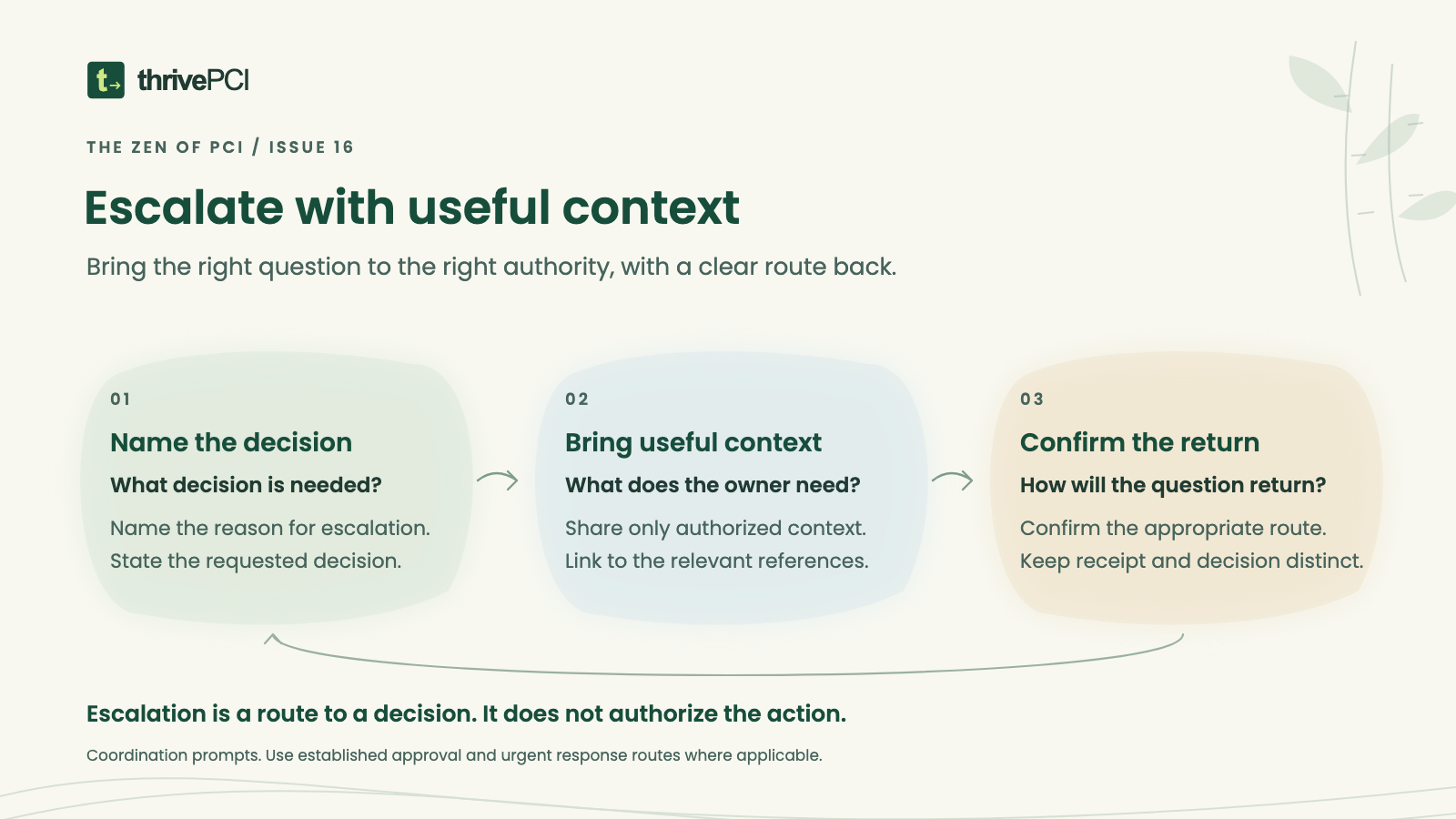
Responsible escalation connects a supported reason, the decision needed, relevant authorized context, the appropriate decision route, and a return point. Receipt and an authorized decision remain distinct.
Bring a clear question through the appropriate route, preserve obligations, and confirm the supported position. Download PNG · Download SVG

Newsletter: The Zen of PCI

Practical PCI preparation for the people who own the work: responsibilities, evidence, timing, and habits that last.

Suggested sequence: Supporting posts form a suggested editorial sequence; publication dates are set by Scott.

Suggested T+ release plan

T+0 = actual publication day for issue sixteen. Offsets below use calendar days. Set T+0 only when the issue is ready for publication.

OffsetContentSuggested purpose
T+0Newsletter: Make escalation a responsible next step
Post: Make escalation a responsible next step
Publish issue sixteen and introduce five prompts for responsible escalation.
T+2Post: Explain why another decision route is neededDescribe the supported reason for an appropriate decision route, preserving urgent handling.
T+5Post: Bring the context the recipient is authorized to useShare the minimum authorized context and important limits.
T+8Post: Receipt is a position, not an approvalDistinguish receipt, accepted follow-up, and an authorized decision.
T+12Post: Try a fictional escalation conversationInvite a fictional paired escalation-note practice.
T+16Post: Give an unresolved question a responsible route forwardConnect the practice to the free guide and request-details route.

Scott may adjust offsets for editorial readiness and audience conversation. These are publication suggestions, not PCI control intervals, engagement deadlines or claims about platform algorithm performance.

Download T+ plan · Download CSV

NEWSLETTER · ISSUE 16

Make escalation a responsible next step

A preparation question can reach a point where the people discussing it cannot responsibly settle it. An approval belongs elsewhere. A commitment conflicts with available capacity. The consequences of waiting need a decision beyond the group's authority. Responsible escalation gives that question an appropriate route, with enough context for someone to act.

The aim is a useful decision request. Escalation should make the unresolved position easier to understand, preserve applicable obligations, and keep follow-up owned. Sending a message does not transfer every responsibility or establish that a decision has been made.

In our fictional supplier-integration example, authorized participants can now find the current approved guidance. Permission to trial clearer handoff wording remains pending. The proposed trial also conflicts with a contributor's existing commitment. The coordinator cannot approve the trial or resolve that commitment on another owner's behalf.

The live integration decision remains pending, too. Making the trial question more visible does not settle it. Each decision needs the appropriate authority and the established approval route.

Know which route the situation requires

Describe why the question needs attention beyond the present group. Is a required decision outside its authority? Is information missing? Could an unresolved dependency threaten an applicable commitment? Preserve uncertainty where the consequence is not yet confirmed. Avoid presenting a preferred answer as an already established necessity.

Use the existing channel that fits the situation. An urgent security event, suspected incident, or other condition requiring immediate action belongs in its prescribed response and escalation process. Do not delay that action while preparing a polished coordination note. Risk, corrective-action, operational, and assessment processes may each have their own required handling.

For the fictional trial, the coordinator identifies the decision needed and routes it to the authorized owner. The capacity conflict may require a separate decision. One recipient should not be assumed to hold both responsibilities.

Leave an escalation note people can use
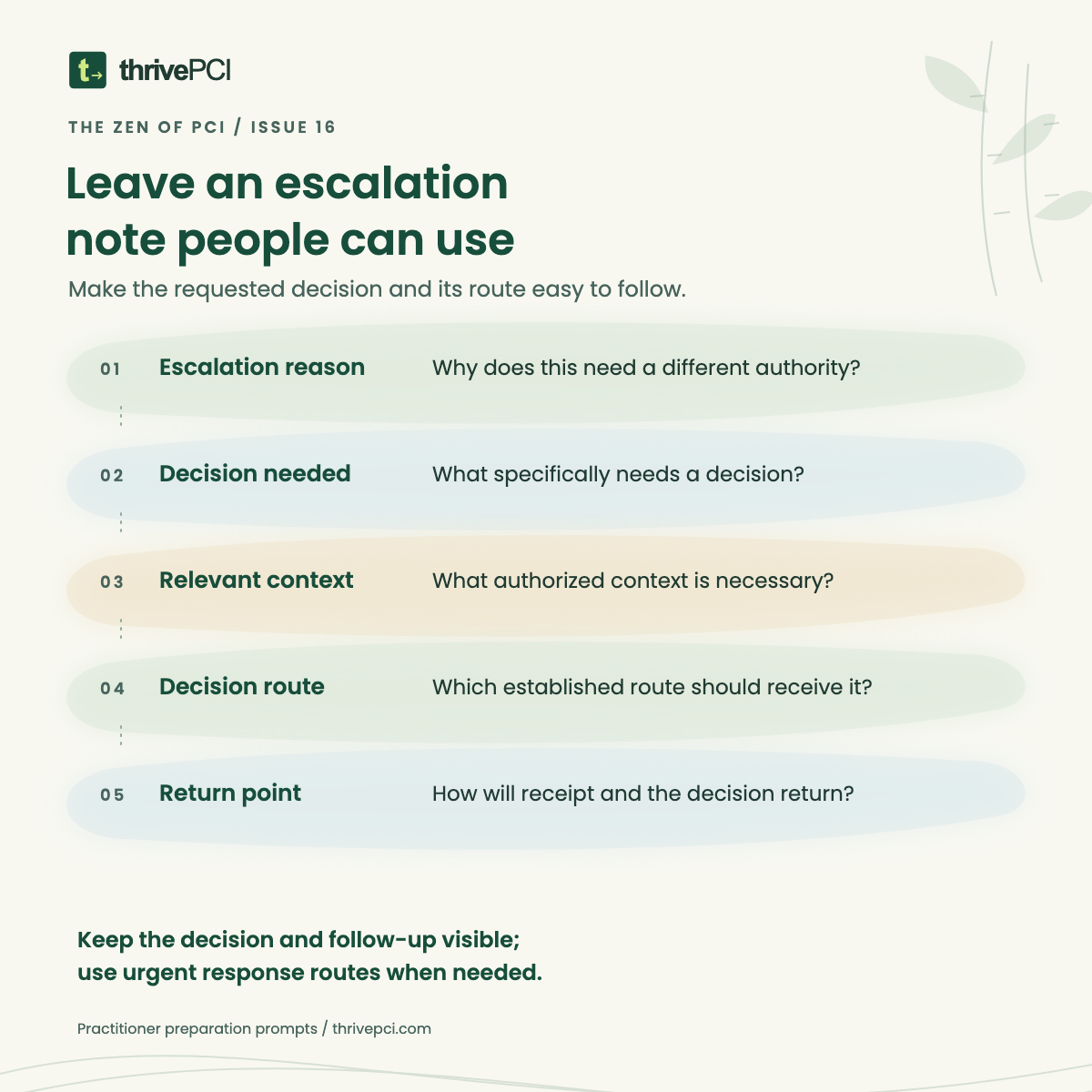
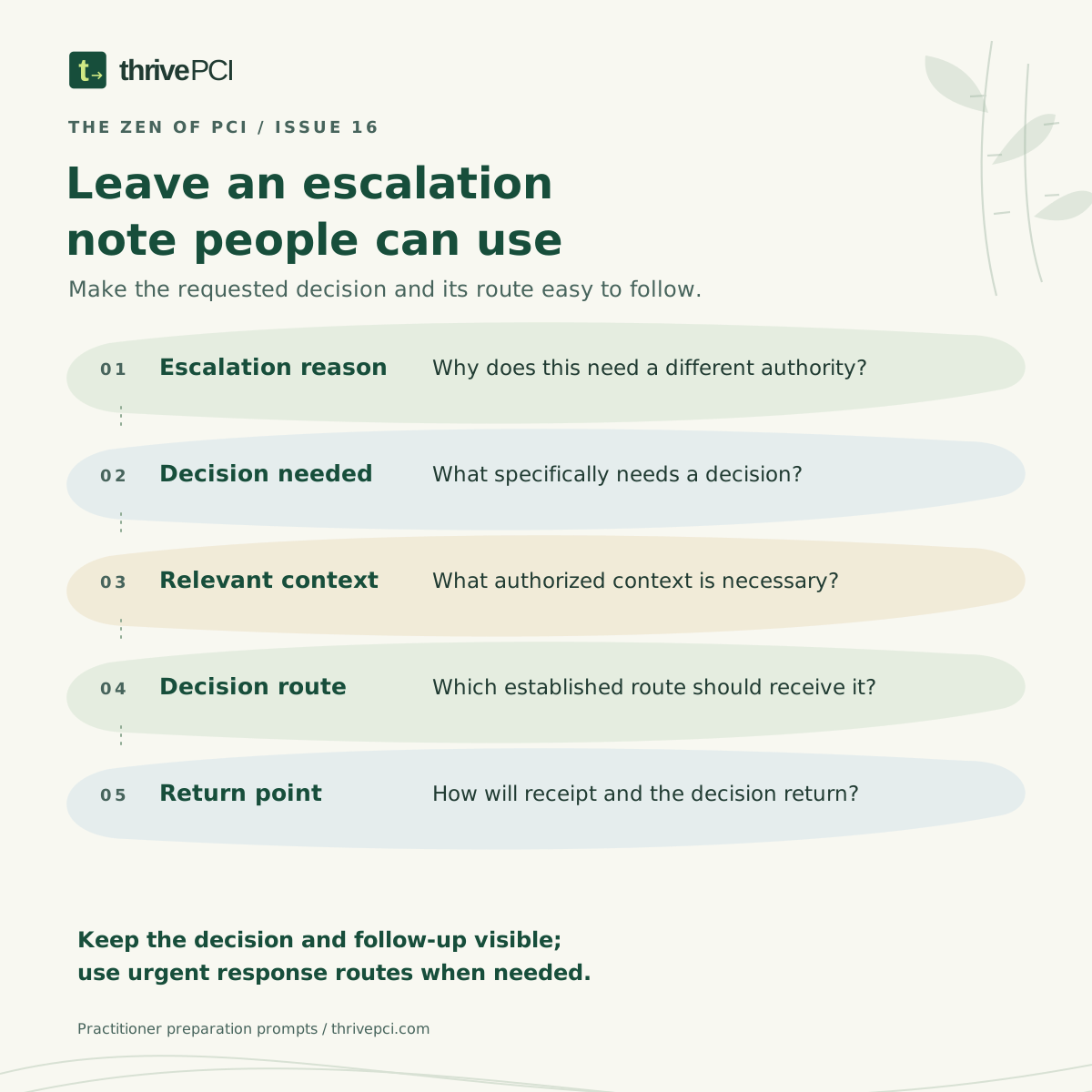
Five escalation-note prompts: Escalation reason, Decision needed, Relevant context, Decision route, and Return point. Keep urgent prescribed action, authority, acceptance, and follow-up explicit.
Practitioner escalation prompts; a sent message does not establish approval, accepted ownership, or a waiver. Download PNG · Download SVG

Use five prompts to make the request and its boundaries clear:

Escalation reason: State the supported condition that requires another decision route. Explain the relevant consequence of leaving it unresolved, including applicable commitments and uncertainty. Keep urgency consistent with the established process and available information.

Decision needed: Name the specific question the authorized person must resolve. Distinguish permission to run a placeholder trial from a decision about contributor commitments or the live integration. Record a proposed option as proposed, with its important limits.

Relevant context: Provide the minimum authorized context needed to understand the question. Identify approved references, the current position, relevant dependencies, and what is unknown. Keep evidence in its proper location and share references only with recipients permitted to receive them.

Decision route: Identify the appropriate role and channel, and confirm receipt and accepted follow-up responsibility through the normal process. A forwarded message or copied recipient does not establish acceptance, authority, approval, or permission to defer required work.

Return point: Record how the unresolved question will return and who will continue coordination. Preserve applicable deadlines, required intervals, and urgent escalation routes. If circumstances change or the agreed response is missing, use the established next route rather than assuming silence resolves the question.

The note supports the actual process. It does not replace required approvals, incident reporting, formal risk decisions, corrective-action records, or assessment procedures. It creates no waiver or new PCI activity interval.

Confirm the position after the message

Suppose the fictional decision owner acknowledges the trial request. That confirms receipt within the acknowledged scope. It does not by itself authorize the trial. Confirm what responsibility was accepted and keep the decision pending until the appropriate process establishes its outcome.

When a decision arrives, record its supported meaning and reference. Check which activity it permits, which conditions remain, and who must receive the resulting next step. Preserve decisions that still belong to another role. An escalation can clarify the route while leaving substantial work to complete.

Try a small escalation conversation

Use an invented trial, a placeholder approval, and a fictional capacity conflict. Write an escalation note with the five prompts. Ask a partner to identify the decision requested, the authorized route, and the person continuing follow-up. Add an acknowledgement that confirms receipt without granting approval.

Revise wording that mistakes receipt for agreement, transfers ownership without acceptance, or implies a deadline has changed. Use no real evidence. This optional practice promises no assessment outcome and never replaces prescribed urgent action.

A responsible escalation leaves a clear question with an appropriate decision route, a supported current position, and someone continuing the follow-up.

Explore the free Program Maintenance guide (opens in a new tab)

LINKEDIN POST

Make escalation a responsible next step

Suggested companion: download the matching PNG.

A preparation question can reach the limit of the present group's authority.

Issue sixteen of The Zen of PCI explores responsible escalation through five prompts: Escalation reason, Decision needed, Relevant context, Decision route, and Return point.

In our fictional supplier-integration example, current guidance is available, but trial approval remains pending. A contributor's existing commitment also needs an appropriate decision. The coordinator can clarify those questions without deciding them for another owner.

Keep the live integration decision separate. Confirm the authorized route, receipt, and accepted follow-up responsibility. A forwarded message is not approval or a waiver of required work.

Which unresolved question would benefit from a more specific decision request and a clearer route back?

Explore the free Program Maintenance guide (opens in a new tab)

LINKEDIN POST

Explain why another decision route is needed

“Please escalate” leaves the next person needing context.

Describe the supported condition. Does the decision belong outside the present group's authority? Is an unresolved dependency affecting an applicable commitment? Which consequence is known, and which still needs confirmation?

Keep a proposed answer visibly proposed. A coordinator's concern does not establish approval, a changed deadline, or another person's acceptance of responsibility.

Use the channel the situation requires. Urgent security events, suspected incidents, and other conditions needing immediate action belong in their prescribed response processes. Do not wait for a polished note before taking required action.

What would help an authorized recipient understand why the specific question needs attention and what they are being asked to decide?

Explore the free Program Maintenance guide (opens in a new tab)

LINKEDIN POST

Bring the context the recipient is authorized to use

A useful escalation gives the recipient enough context to understand the decision.

Name the current position, relevant dependencies, approved references, and important unknowns. Explain the specific question without copying an evidence package into a general coordination channel.

Our fictional wording trial still needs permission, even after participants can find the current approved guidance. A capacity conflict may need a separate owner. Neither question settles the pending live integration decision.

Use the minimum authorized context and the established handling route. Being copied on a message does not establish permission to receive every supporting record.

Which reference or limitation would make your next decision request easier to understand while keeping the underlying evidence in its proper location?

Explore the free Program Maintenance guide (opens in a new tab)

LINKEDIN POST

Receipt is a position, not an approval

An acknowledgement can be useful progress. Its meaning still needs care.

In our fictional example, the trial decision owner confirms receipt of the request. That does not by itself authorize the trial, resolve contributor commitments, or approve the live integration.

Confirm which follow-up responsibility has been accepted through the normal process. Keep the decision pending until the appropriate route establishes an outcome. Silence and a forwarded message do not establish approval.

When a decision arrives, record its scope, conditions, and approved reference. Identify the next action and any question still assigned elsewhere.

What would help someone distinguish an acknowledged request, accepted follow-up, and an authorized decision in the next position you share?

Explore the free Program Maintenance guide (opens in a new tab)

LINKEDIN POST

Try a fictional escalation conversation

Suggested companion: download the matching PNG.

Use a made-up wording trial, a placeholder approval, and an invented conflict with another commitment. Keep real evidence out.

Write five prompts: Escalation reason, Decision needed, Relevant context, Decision route, and Return point. Identify which role can decide each question and who will continue follow-up.

Ask a partner to read an acknowledgement that confirms receipt but grants no approval. What changed? What remains pending? Which next action has someone actually accepted?

Revise phrases that imply assumed ownership, a waived obligation, or a changed deadline. Keep the live integration decision separate.

This optional practice creates no PCI interval, promises no assessment outcome, and never delays or replaces prescribed incident response, urgent escalation, approval, or corrective-action processes.

Explore the free Program Maintenance guide (opens in a new tab)

LINKEDIN POST

Give an unresolved question a responsible route forward

Clear escalation connects a supported reason, a specific decision request, authorized context, an appropriate route, and a return point.

The free Program Maintenance guide offers a starting point for considering the continuing work behind preparation. The thrivePCI pilot page includes a free sample and a request-details route for people exploring further training.

Practice with fictional examples. Keep evidence in its authorized location and preserve established approval, risk, incident, corrective-action, and assessment processes. Confirm what an acknowledgement or decision actually establishes before changing the work's position.

Requesting details records interest. It does not place an order or enroll you. Training promises no compliance or assessment outcome.

Which open question would benefit from a clearer shared route?

Try the free sample or request pilot details (opens in a new tab)

Scott’s publication review

The campaign links include UTM labels for later reporting; this release adds no visitor tracking. Source copy and editorial notes are versioned in GitHub.

Download the complete newsletter and post copy

Download copy and visual review pack (ZIP)