
NEWSLETTER · ISSUE 07
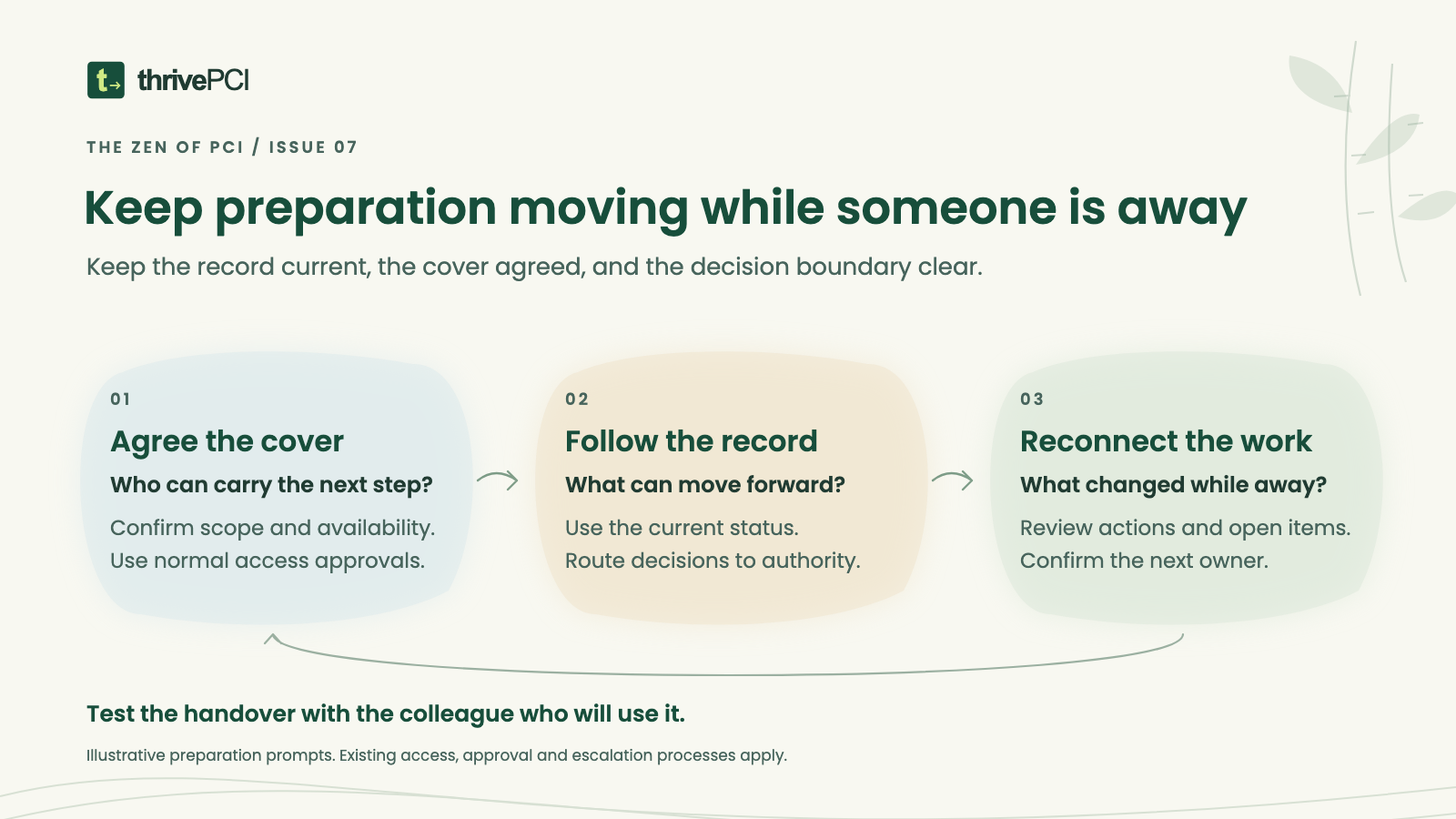
Keep preparation moving when a key person is away
Preparation should be easier to continue when the explanation lives somewhere an authorized colleague can use. A well-kept record helps, but the next person also needs to understand the pending work, the agreed cover, and the decisions that remain with another role.
An upcoming absence gives a team a practical opportunity to check that handoff. Choose one active item and ask whether someone else can explain its next step without relying on the usual coordinator’s memory.
Continue the fictional supplier-access example
Our fictional team has retained an earlier account-removal outcome and routed the proposed support integration through its established change process. Its handoff now includes the approved record reference and current question owner.
The service coordinator will be away. A colleague has agreed to handle preparation updates during that period. The integration question still awaits a decision from the authorized service owner.
The colleague can coordinate an update, but the cover arrangement does not give them authority to approve the integration. The team needs to make both responsibilities visible before the absence begins.
Start with the current explanation
Link the approved record that describes the item’s current state. Identify what has been completed, what remains unconfirmed, and which question is waiting for an answer. Keep earlier conclusions connected to the coverage and time they describe.
In the fictional example, the record distinguishes the completed account check from the open integration review. The covering colleague can explain why those are separate matters and where the pending decision is recorded.
Use references appropriate to the recipient’s role. Sensitive details stay in approved systems. Confirm that the colleague can use the record through their own normal, approved access; a shared password is not a handoff method.
Agree the cover and its boundaries
Discuss the arrangement with the people who will carry it out and the roles responsible for the process. Identify who has agreed to cover, which activities they can perform, and when the arrangement applies. Being named in a note does not automatically reassign a responsibility.
Keep coordination distinct from decision authority. Who can provide a status update? Who can authorize the next action? Which question must wait for, or be routed to, a designated decision-maker?
If a decision or access issue could block the work, identify the established support or escalation route. Do not assume that urgency permits broader permissions or a different approval path. Gaps need an owner and a next step through the governing process.
Leave a cover note people can use
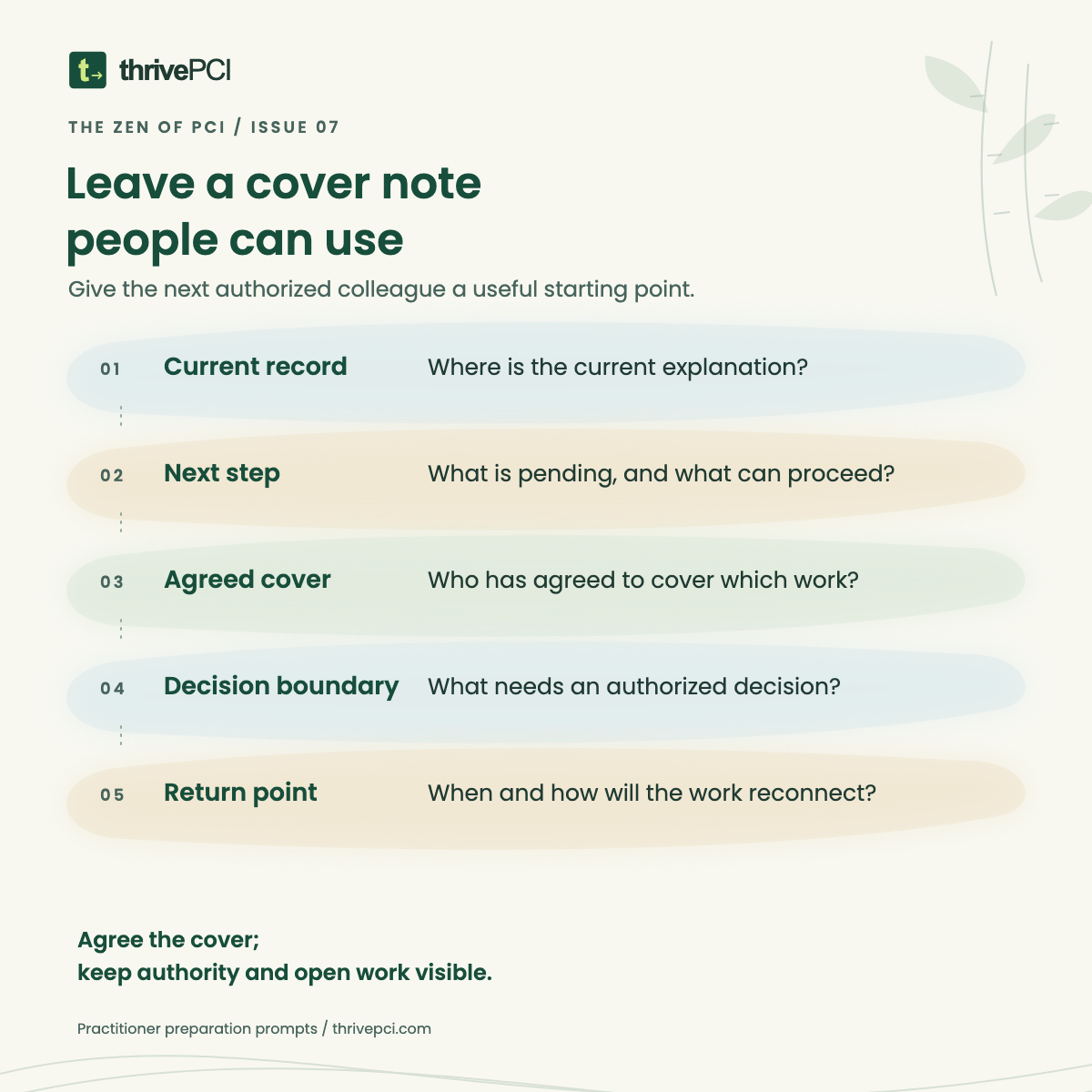
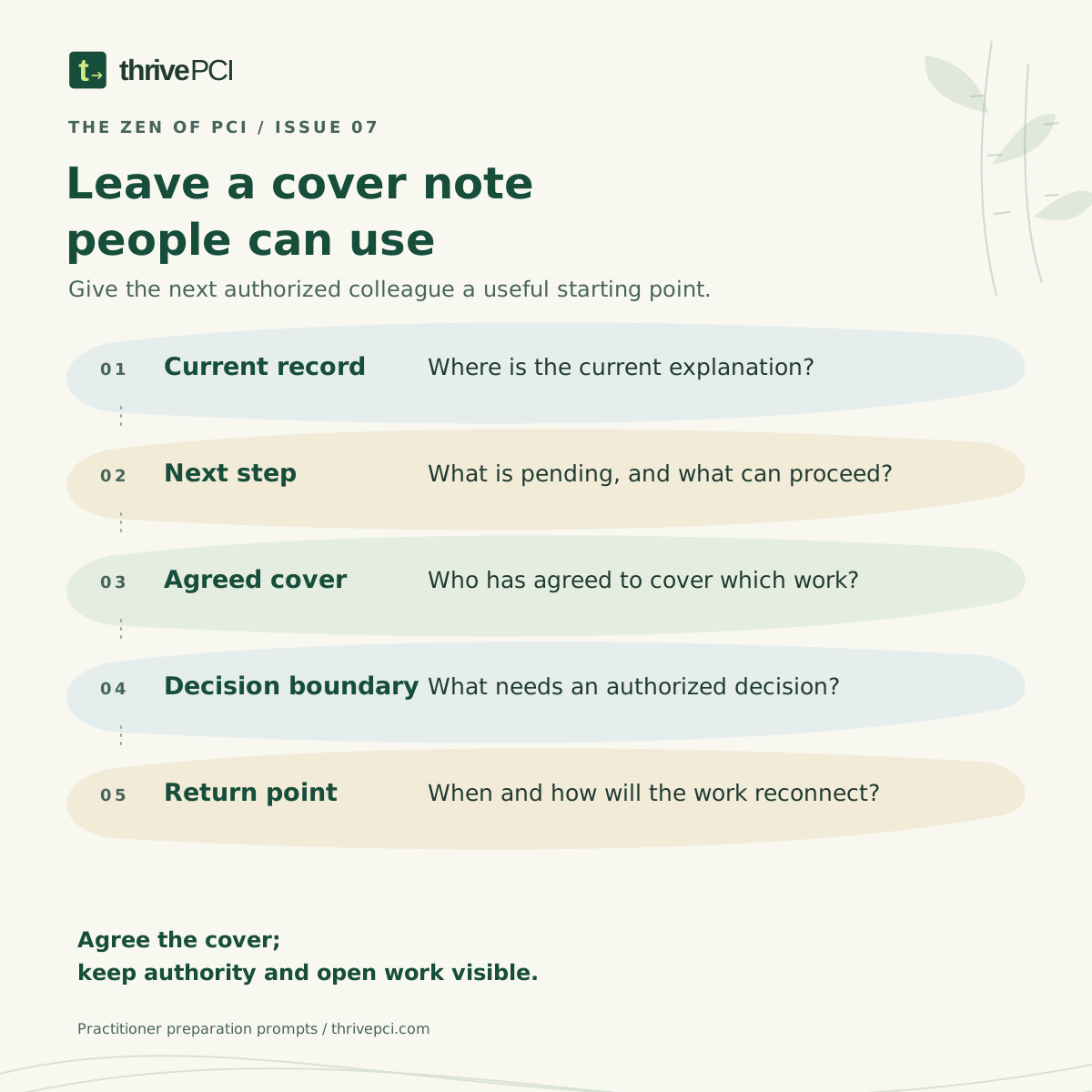
Try five prompts: Current record, Next step, Agreed cover, Decision boundary, and Return point.
For the fictional integration, the note might say: “The approved change record contains the current integration question. The covering colleague will coordinate the scheduled preparation update. The service owner retains the integration decision. Questions outside the agreed cover follow the established escalation route. Updates and unresolved items will be reconciled at the agreed return point.”
The return point gives people a place to reconnect the work. It could be the coordinator’s return handoff or another agreed review moment. It does not replace an earlier deadline, required activity, or escalation trigger.
Try the handoff before it is needed
Ask the authorized colleague to open the approved record using their own access. Have them explain the item’s status, the next step, who has agreed to act, and which decision belongs elsewhere.
Listen for uncertainty. An unclear record label, missing permission, or unavailable decision-maker may require a different response. Assign each gap to an appropriate owner rather than treating a completed note as proof that cover will work.
This is a focused preparation check, not a request to perform a live change or approve anything during the exercise. Use fictional or appropriately approved material and follow normal handling rules.
Reconnect when the person returns
Record updates through the established system while the coordinator is away. At the return point, review what changed, what was decided, and what remains open. Confirm the ongoing owner through the normal process so an item does not disappear between two assumptions about responsibility.
These prompts support preparation continuity. Applicable PCI requirements, prescribed activities and intervals, approvals, and assessment context continue to govern the underlying work. Cover notes do not establish compliance or an assessment outcome.
Start with one active item. The free thrivePCI Assessment Handover guide offers a place to rehearse an explanation another person can use.
Practice with the free Assessment Handover guide (opens in a new tab)