thrivePCISite v0.43.62+20261122T201000Z · Published November 22, 2026

SCOTT REVIEW · NEWSLETTER ISSUE 09

Share useful context without oversharing evidence

One newsletter issue and 6 supporting posts. Two downloadable visuals illustrate the practice. These drafts promote the current free preparation resources and the request-details contact route. The copy buttons copy ready-to-edit text to your clipboard. Nothing here posts to LinkedIn.

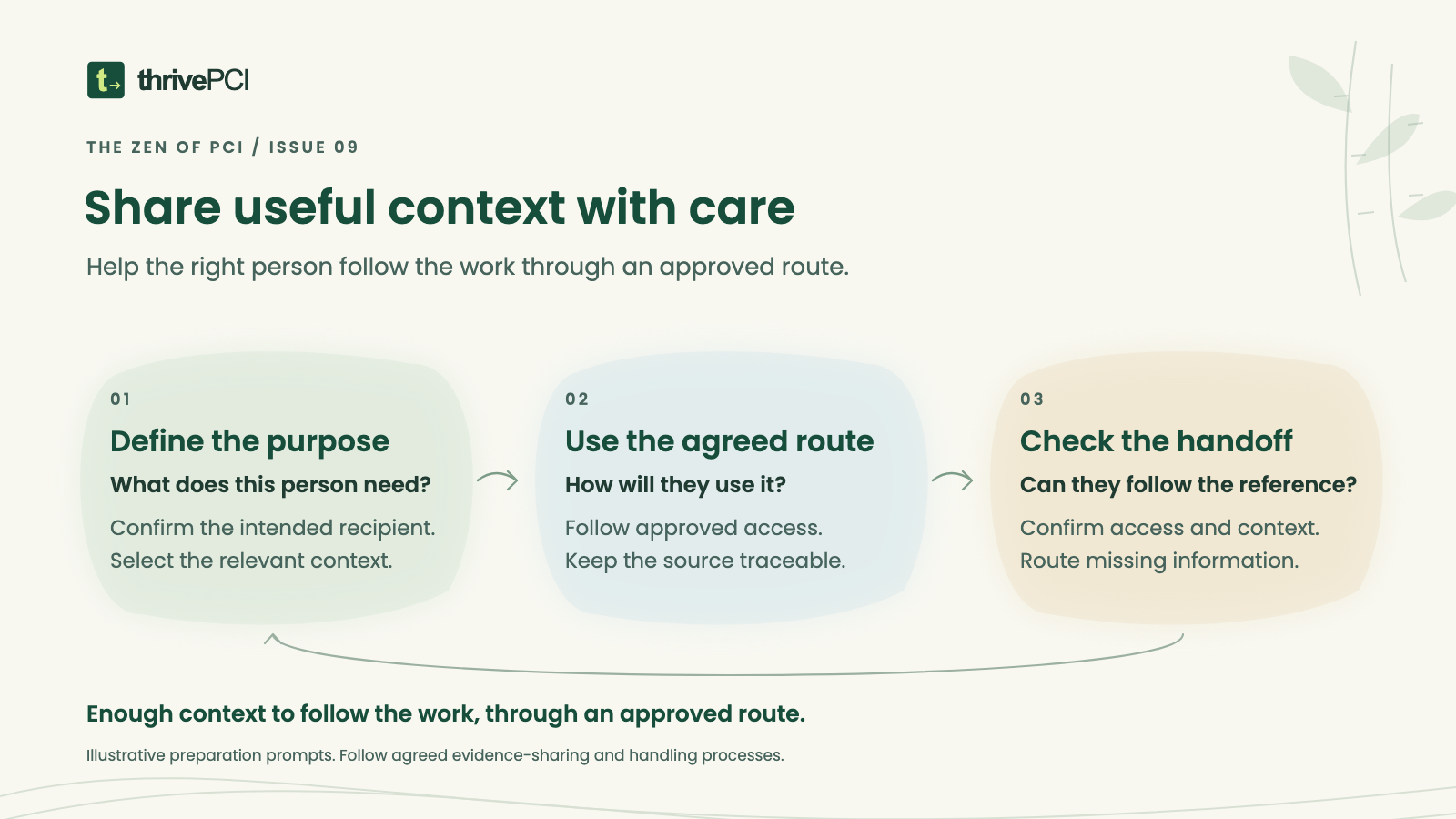
A preparation question is connected to an authorized recipient, a useful summary and the relevant source through an approved route. Sensitive details remain in the approved system and the source reference is checked for usability.
Share the context needed for the task and keep the evidence on its approved route. Download PNG · Download SVG

Newsletter: The Zen of PCI

Practical PCI preparation for the people who own the work: responsibilities, evidence, timing, and habits that last.

Suggested sequence: Supporting posts form a suggested editorial sequence; publication dates are set by Scott.

Suggested T+ release plan

T+0 = actual publication day for issue nine. Offsets below use calendar days. Set T+0 only when the issue is ready for publication.

OffsetContentSuggested purpose
T+0Newsletter: Share useful context without oversharing evidence
Post: Share useful context without oversharing evidence
Publish issue nine and introduce purposeful sharing after review.
T+2Post: Start with the task and the recipientIdentify the task, intended recipient and channel audience before sending.
T+5Post: Make the source reference usableConfirm a usable source reference through approved access and delivery routes.
T+8Post: Keep an extract connected to its sourceKeep extracts traceable and distinguish preparation summaries from required evidence.
T+12Post: Try a five-minute sharing noteInvite a short fictional sharing exercise for two different recipient tasks.
T+16Post: Practice a useful explanation with the right boundariesConnect the practice to the free sample and request-details route.

Scott may adjust offsets for editorial readiness and audience conversation. These are publication suggestions, not PCI control intervals, engagement deadlines or claims about platform algorithm performance.

Download T+ plan · Download CSV

NEWSLETTER · ISSUE 09

Share useful context without oversharing evidence

Useful context helps another person understand the question, find the relevant record, and take the next authorized step. It does not always require copying the underlying evidence into the conversation.

Before sharing, ask what the recipient needs to accomplish and which route is appropriate for that information. A concise explanation can point to the supporting record while keeping sensitive detail in the approved system.

Continue the fictional supplier-access example

In issue eight, a covering colleague compared a handoff marked “ready” with a change record showing a pending integration decision. The responsible owners are confirming what each status describes.

The colleague now needs to update another authorized participant. An easy response would be to paste a large screenshot or attach a full export. Either could contain unrelated people, technical details, or information the recipient does not need for that task.

Instead, the colleague prepares a short statement of the open question, identifies the relevant record, and checks the recipient’s approved route to it. The explanation preserves the uncertainty about the integration decision.

Begin with purpose and recipient

Name the task the information should support. Is the recipient coordinating an update, confirming a decision, or reviewing requested evidence? Those purposes may require different detail and different authorized routes.

Confirm the intended recipient and the audience of the channel. A familiar group name does not establish that every member should receive the same information. If the audience or permission is unclear, ask the responsible owner or use the established support process before sending.

In the fictional case, the participant needs to understand the status question and who will answer it. A raw log or broad screenshot would not resolve that question by itself.

Choose the context that helps

State the subject, the relevant time or version, what is supported, and what remains uncertain. Include the owner and next step where appropriate. Keep the wording consistent with the source rather than turning a pending decision into a completed approval.

Avoid pasting credentials, secrets, account data, raw logs, or unnecessary personal information into an informal summary. Follow the organization’s handling rules for the information involved. If a task needs underlying evidence, use the approved request and delivery process.

A reference is helpful only if the authorized recipient can actually use it. Confirm the intended record, approved access, and any relevant instructions. A reference does not establish that access is authorized, and an unusable reference leaves the handoff unfinished.

Leave a sharing note people can use
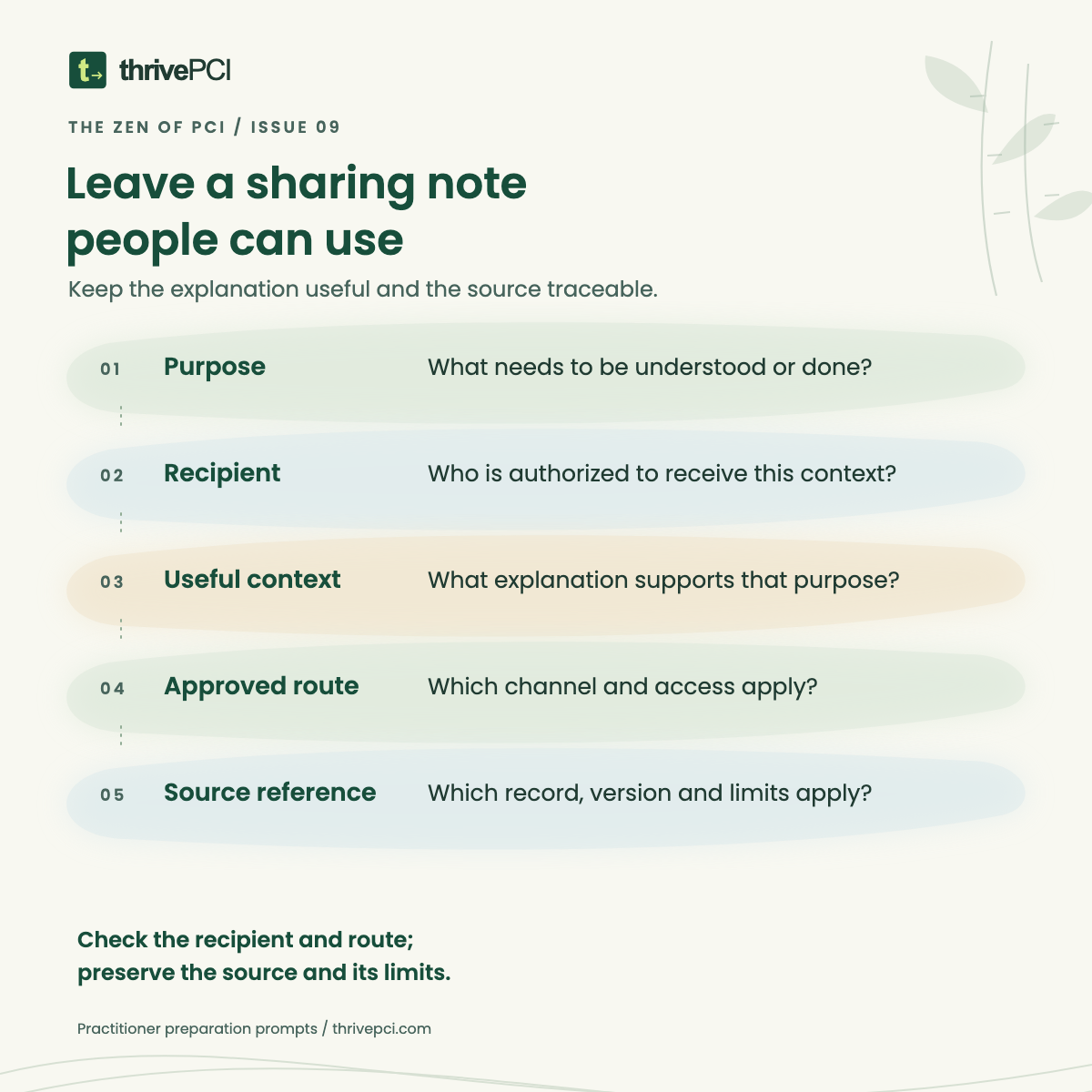
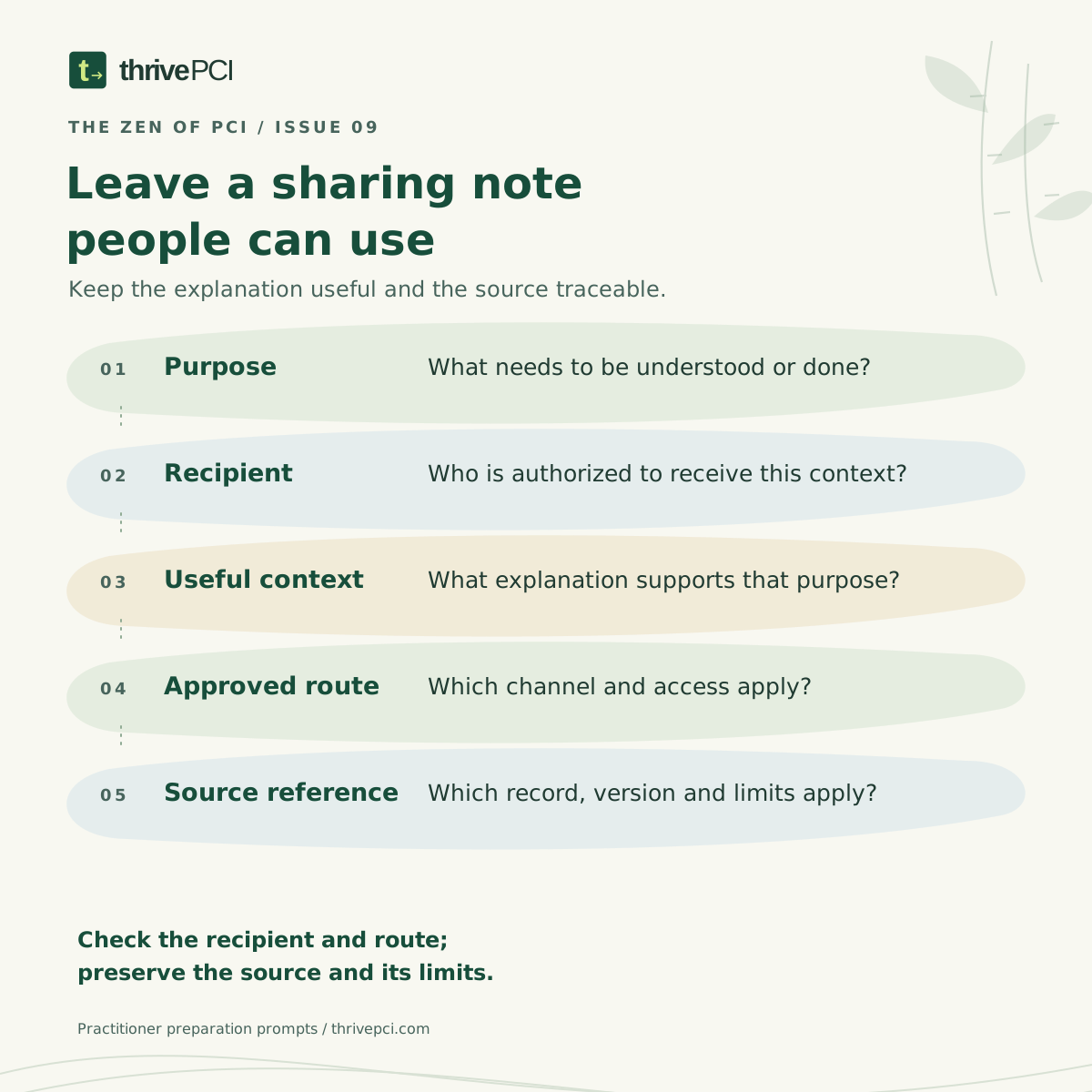
Five prompts for a sharing note: Purpose, Recipient, Useful context, Approved route, and Source reference. Confirm the task, audience, needed context, delivery channel and usable reference through established processes.
Practitioner preparation prompts; real access, information handling and evidence requests follow established processes. Download PNG · Download SVG

Try five prompts: Purpose, Recipient, Useful context, Approved route, and Source reference.

For the fictional integration, the note could say: “The participant needs a preparation status update. Summarize the unresolved meaning of ‘ready,’ identify the service owner’s next check, and reference the relevant change record through the approved workspace. Confirm that the participant can use that reference with their own authorized access.”

The note connects the explanation to its purpose and route. It does not authorize access, change a record’s handling requirements, or settle the integration decision.

Keep an extract connected to its source

Sometimes an approved extract or redacted copy is appropriate. Have the responsible role confirm how it should be prepared and delivered. Preserve the original through the established recordkeeping process.

Retain the context needed to understand what the extract shows: source reference, represented time or version, relevant coverage, and any limitation introduced by the selection or redaction. Make the relationship traceable without exposing the detail that the approved process is intended to protect.

If removing detail would make the evidence misleading or insufficient for the request, seek an appropriate secure route for the necessary information. A formal assessor request should follow the agreed evidence-handling process. These preparation prompts are not a reason to withhold required evidence or substitute a summary that does not answer the request.

Try a five-minute sharing check

Use a fictional preparation question and placeholder records. Describe two recipients with different agreed tasks. Write a sharing note for each and compare the context and delivery route they need.

Ask a colleague whether they can identify the question, relevant source, and next step from the summary. Keep any missing permission or handling decision visible and assign it through the normal process.

These are practitioner preparation prompts. Applicable PCI requirements, prescribed processes and intervals, authorized handling rules, and assessment context still govern the underlying work. A careful summary does not establish compliance or an assessment result.

The free thrivePCI Assessment Handover guide offers a place to practice useful context with fictional material.

Practice with the free Assessment Handover guide (opens in a new tab)

LINKEDIN POST

Share useful context without oversharing evidence

Suggested companion: download the matching PNG.

What does the next person need to understand, and where should the supporting evidence stay?

Issue nine of The Zen of PCI continues our fictional supplier-integration example. A covering colleague needs to explain an unresolved status question. Copying a broad screenshot or full export could add unrelated detail without answering that question.

The colleague starts with the task, the authorized recipient, and the approved route to the relevant record.

Try five prompts: Purpose, Recipient, Useful context, Approved route, and Source reference.

Keep what is supported and what is uncertain clear. Confirm that the recipient can use the reference through their own approved access.

Which preparation update would benefit from a shorter explanation and a better source reference?

Practice with the free Assessment Handover guide (opens in a new tab)

LINKEDIN POST

Start with the task and the recipient

A useful preparation update begins with a specific task. Someone coordinating an update may need different information from someone confirming a decision or reviewing requested evidence.

Name the purpose before choosing what to send. Confirm the intended recipient and the audience of the channel through the organization’s established process.

Our fictional integration update needs to explain an unresolved status question and identify the owner’s next check. A raw export would not settle the question by itself.

If the audience or permission is unclear, ask the responsible owner or use the support route before sharing. A familiar group name is not enough to establish who should receive the detail.

What task should your next update help its recipient complete?

Use the free guided preparation path (opens in a new tab)

LINKEDIN POST

Make the source reference usable

A record reference helps only when the authorized recipient can use it.

Check that the link points to the intended record, that the recipient has the appropriate approved access, and that the delivery channel fits the information. Keep access decisions with the established roles and processes.

In our fictional example, the summary explains the integration status question and points to the approved change record. The reference does not establish authorization or settle the pending decision.

If access is missing, route that gap through the normal support process. Copying the evidence into another channel can create a different handling problem.

Ask a colleague to try a fictional handoff reference. Can they find the explanation and identify the next step?

Practice with the free Assessment Handover guide (opens in a new tab)

LINKEDIN POST

Keep an extract connected to its source

An approved extract can help a recipient focus on the relevant information. Its context still matters.

Follow the established process for preparing and delivering an extract or redacted copy. Preserve the original and retain the source reference, represented time or version, relevant coverage, and any limitation introduced by the selection.

If removing detail would make the evidence misleading or insufficient for the request, seek an appropriate secure delivery route for the needed information.

Formal assessor requests follow the agreed evidence-handling process. A preparation summary is not a reason to withhold required evidence or replace it with an answer that does not meet the request.

Which source detail would another reader need to understand an extract correctly?

Use the free guided preparation path (opens in a new tab)

LINKEDIN POST

Try a five-minute sharing note

Suggested companion: download the matching PNG.

Choose a fictional preparation question and use placeholder records. Describe two recipients with different agreed tasks.

Write five prompts for each: Purpose, Recipient, Useful context, Approved route, and Source reference.

Ask a colleague what each recipient needs to understand and where the supporting record belongs. Which time, version, or coverage detail makes the summary useful? What should remain in the approved source?

Then have them explain how the recipient would reach the record through their own authorized access. Keep missing permissions or handling decisions visible for the appropriate owner.

Use fictional material for the exercise. Real evidence and assessor requests follow the organization’s agreed handling processes.

Which prompt helped you keep the explanation useful and appropriately routed?

Practice with the free Assessment Handover guide (opens in a new tab)

LINKEDIN POST

Practice a useful explanation with the right boundaries

A preparation handoff should help another person understand the question and reach the relevant record through an appropriate route.

Try the free PCI Foundations sample on thrivePCI with a colleague. It uses a fictional payment-provider scenario to practice supported questions. Discuss what context an authorized recipient would need and which details belong in the approved source.

Name the purpose, recipient, useful context, approved route, and source reference. Keep real access and handling decisions within established processes.

If this approach fits your team, the same page offers a request-details route for the upcoming paid learning pilot. The request records interest; it does not place an order or collect payment.

Which sharing conversation would your team practice first?

Try the free sample or request pilot details (opens in a new tab)

Scott’s publication review

The campaign links include UTM labels for later reporting; this release adds no visitor tracking. Source copy and editorial notes are versioned in GitHub.

Download the complete newsletter and post copy

Download copy and visual review pack (ZIP)