
NEWSLETTER · ISSUE 27
Choosing a payment provider and understanding shared responsibilities
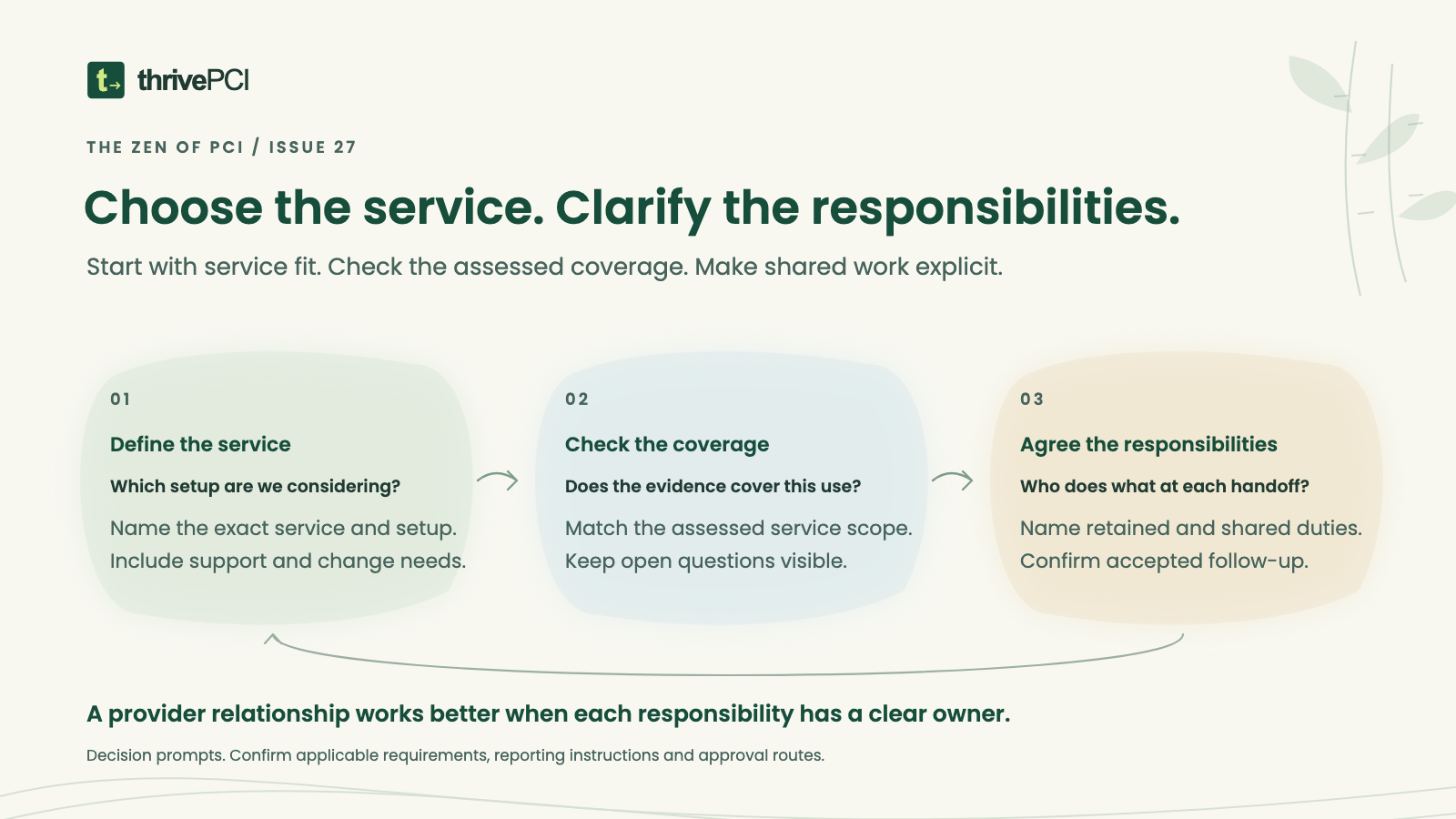
Choosing a payment provider is also choosing a working relationship. The checkout needs to suit the business, and the people involved need a clear understanding of who will configure, operate, support, and review the arrangement.
A useful comparison starts with the service you will actually use. Fees and a smooth demonstration matter, but they cannot answer every question about the integration or the responsibilities that remain with your team. Give those questions a place in the decision before they become assumptions in production.
Compare arrangements, not just names
Our fictional subscription startup is considering two unnamed provider arrangements. One offers a hosted checkout; another involves a different integration and more work by the startup's developer. The founder has not chosen either. The team describes the same intended customer journey for both, including subscription changes, refunds, administration, and support.
They ask which payment channels and recurring-payment needs are supported, what implementation effort is expected, how support works, and which commercial terms need review. These are practical selection questions. A feature list does not establish PCI scope, assessment coverage, or the allocation of responsibilities.
Leave a provider decision note people can use
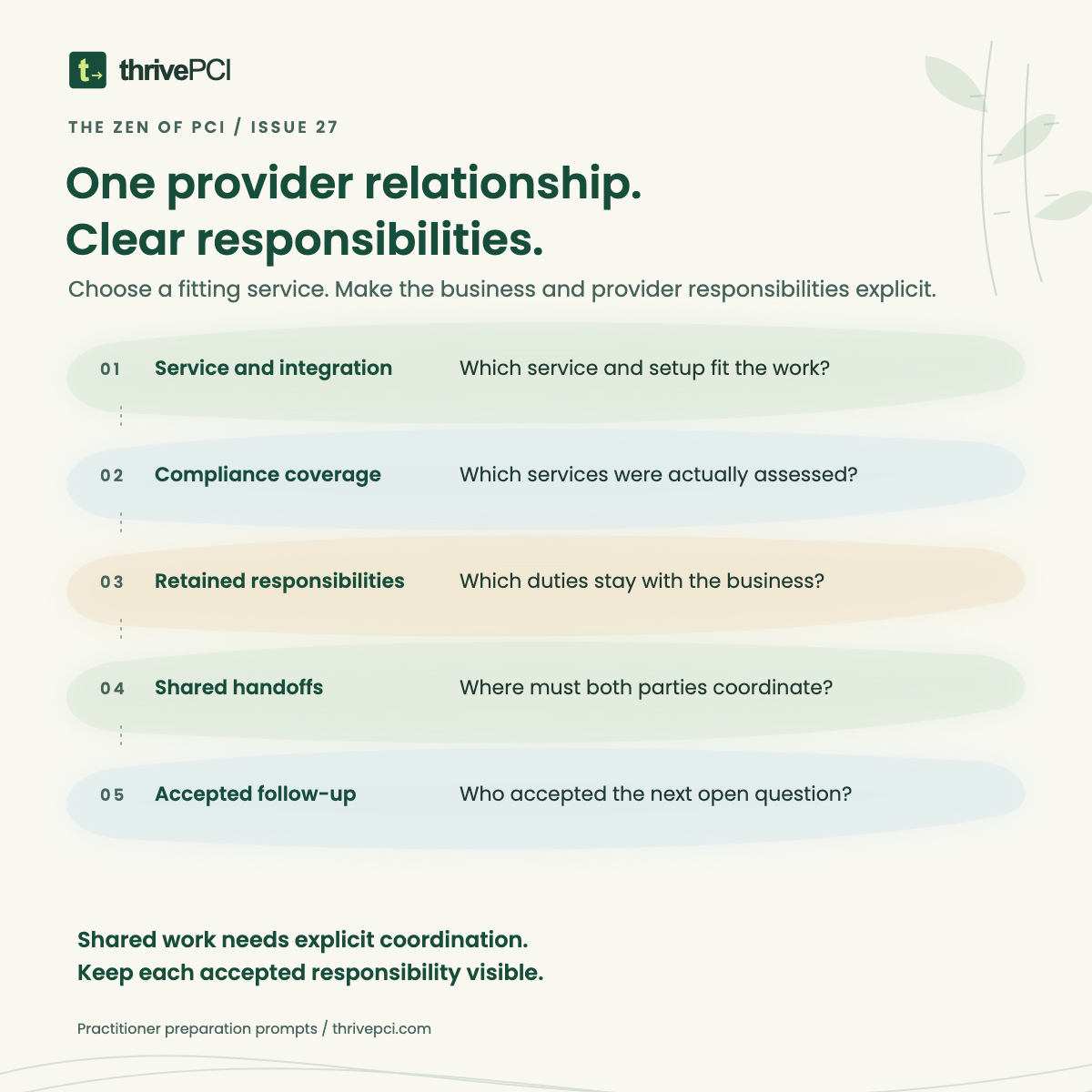
Use five prompts to compare the relationship as well as the product:
Service and integration: Name the exact service and proposed integration. Describe the intended payment journey and the systems, people, and access involved. Separate a demonstrated feature from a confirmed capability in your arrangement. Ask about implementation, operation, support, service changes, and exit arrangements. Record the assumptions that could change the choice, including the effort your own team would need to sustain.
Compliance coverage: Ask for evidence relevant to the services you intend to use. An Attestation of Compliance, or AOC, records information about a PCI DSS assessment and its result. Check that the service and relevant responsibilities are covered. PCI SSC explains that where an applicable AOC is unavailable, specific evidence may be needed to establish that relevant requirements are met. A missing AOC is a question requiring follow-up, not an automatic conclusion about compliance.
Retained responsibilities: Identify the duties your business must perform and who will perform them. PCI SSC explains that customers must oversee their third-party service-provider relationships. Outsourcing a function does not make every related customer responsibility disappear. For the proposed arrangement, ask who configures the integration, manages access, reviews relevant changes, and maintains the necessary records. Confirm each answer; these examples do not assign universal duties to one side.
Shared handoffs: Describe where the provider's work and the business's work depend on each other. What information must pass between them? Who receives a security concern, coordinates an incident contact, or explains a change affecting the service? Give each part an accepted owner and record the answers in a responsibility matrix or another agreed record. Use the applicable operating and response processes. The word shared should lead to a clear handoff, not leave an activity waiting between two organizations.
Accepted follow-up: Name who accepted each unresolved question, what answer or evidence is needed, and which decision depends on it. Confirm how the relationship's responsibilities and compliance status will be reviewed through the applicable process. Keep a proposal distinguishable from an agreed arrangement. A convenient product trial, copied recipient, or sales conversation does not establish operational acceptance or authority to proceed.
Check what the evidence can establish
Keep assessment evidence connected to the service and implementation being considered. A provider's AOC does not establish your business's compliance. Leave questions about current status, service changes, and customer implementation visible.
PCI SSC also explains that a service provider's merchant questionnaire or merchant AOC is insufficient evidence for its customers. Ask for appropriate service-provider evidence and qualified clarification where needed. Confirm your own validation and reporting route with the organization that manages it; do not infer questionnaire eligibility from the provider's marketing example.
Make the next conversation useful
In the fictional comparison, one provider response leaves a configuration handoff unclear. The founder records the question and the person who accepted coordination, then asks the developer and provider to explain the proposed boundary. The team can compare fit while that point remains open, without treating a tentative choice as a completed readiness conclusion.
Practice with two invented arrangements and no real payment details or customer records. Complete the five prompts, leave one shared handoff unresolved, and ask a partner to identify the next useful question and its owner.
These preparation prompts support a decision; they are not a complete procurement checklist, all applicable PCI DSS requirements, or a compliance conclusion. A stronger provider choice leaves the business with a suitable service, visible responsibilities, and an owned route for the questions still open.
Explore the free Provider Responsibilities guide (opens in a new tab)