thrivePCISite v0.43.62+20261122T201000Z · Published November 22, 2026

SCOTT REVIEW · NEWSLETTER ISSUE 30

Going live with clear ownership and a rollback plan

One newsletter issue and 6 supporting posts. Two downloadable visuals illustrate the practice. These drafts promote the current free preparation resources and the request-details contact route. The copy buttons copy ready-to-edit text to your clipboard. Nothing here posts to LinkedIn.

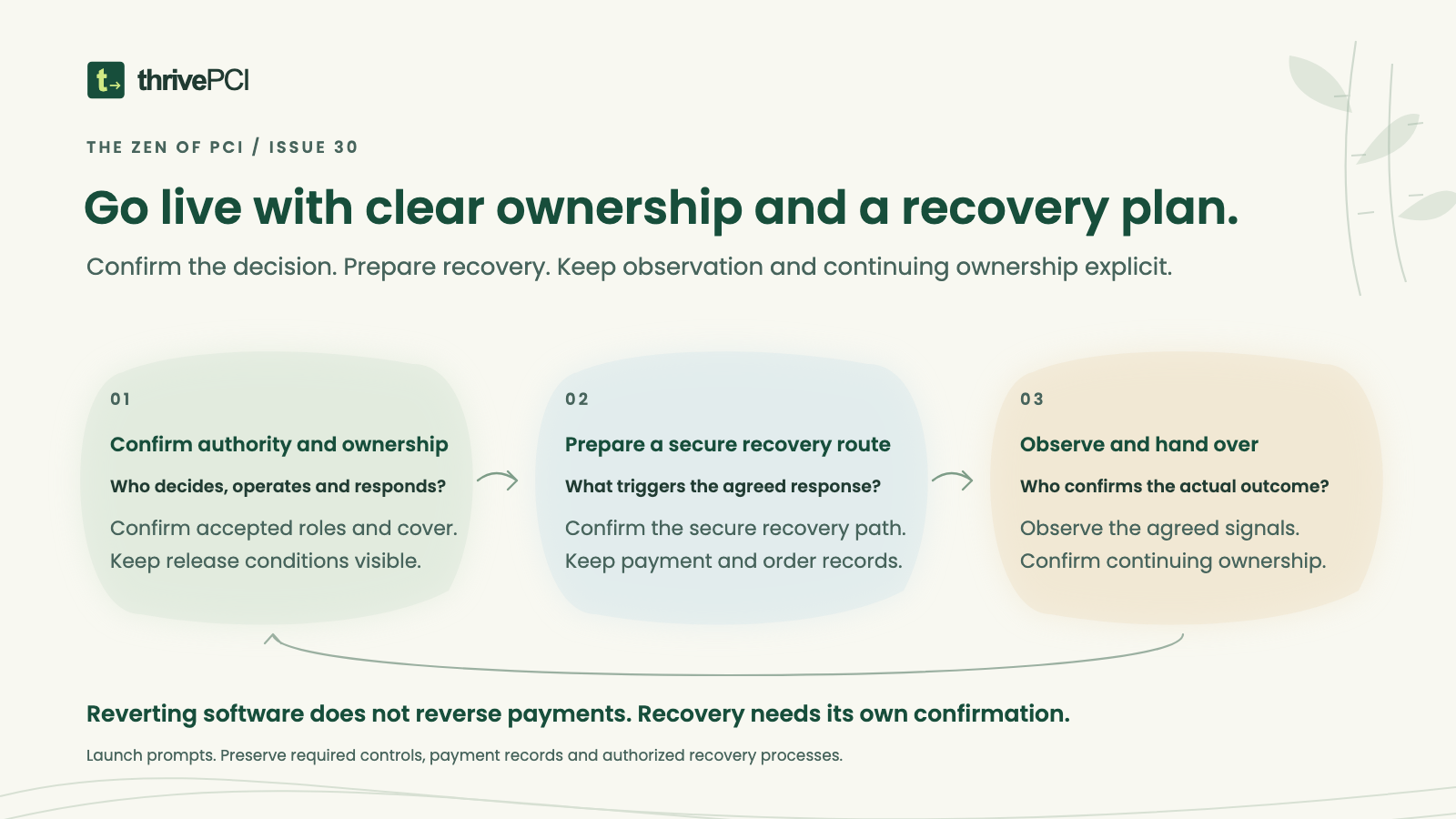
Three soft Forest Zen fields connect Confirm authority and ownership, Prepare a secure recovery route, and Observe and hand over. Confirm accepted launch roles, preserve a secure recovery route and payment records, and keep observation and handoff owned.
A launch note connects authorized decisions with accepted owners, secure recovery and the operating handoff. Download PNG · Download SVG

Newsletter: The Zen of PCI

Practical PCI preparation for the people who own the work: responsibilities, evidence, timing, and habits that last.

Suggested sequence: Supporting posts form a suggested editorial sequence; publication dates are set by Scott.

Suggested T+ release plan

T+0 = actual publication day for issue thirty. Offsets below use calendar days. Set T+0 only when the issue is ready for publication.

OffsetContentSuggested purpose
T+0Newsletter: Going live with clear ownership and a rollback plan
Post: Going live needs accepted owners and a usable recovery route
Introduce accepted launch ownership and a usable route to a secure state.
T+2Post: Confirm the people behind the launch rolesConfirm authority, accepted owners, availability and backup routes.
T+5Post: Make recovery more specific than go back to the old versionDescribe a context-specific recovery route and its decision authority.
T+8Post: Protect the payment records when recovering the integrationKeep financial and order records intact through provider-aligned reconciliation.
T+12Post: Leave one readiness condition open and rehearse the decisionRehearse a launch note with an open condition and unavailable contact.
T+16Post: Leave a launch record the operating team can useConnect the launch practice to the free guide and request-details route.

Scott may adjust offsets for editorial readiness and audience conversation. These are publication suggestions, not PCI control intervals, engagement deadlines or claims about platform algorithm performance.

Download T+ plan · Download CSV

NEWSLETTER · ISSUE 30

Going live with clear ownership and a rollback plan

Going live is a decision about who will act, what they will watch, and how they will respond if the change does not behave as intended. A clear launch note connects the tested implementation with the people responsible for operating it.

The aim is a usable decision record. Someone should be able to find the authorized release, the accepted owners, the remaining conditions, and the route back to a secure operating position without reconstructing the whole project.

Confirm authority and ownership

Our fictional subscription startup has corrected the repeated-notification mismatch from its earlier test and retested the affected behavior through the proper process. That result now joins the other readiness evidence. The people with appropriate authority still need to confirm the release conditions and decide whether the proposed launch may proceed.

The developer, business operator, and provider contact walk through their parts together. They confirm who can authorize the change, execute it, observe the results, coordinate a problem, and make a recovery decision. A named person should have accepted the responsibility and be available when needed.

Leave a launch note people can use
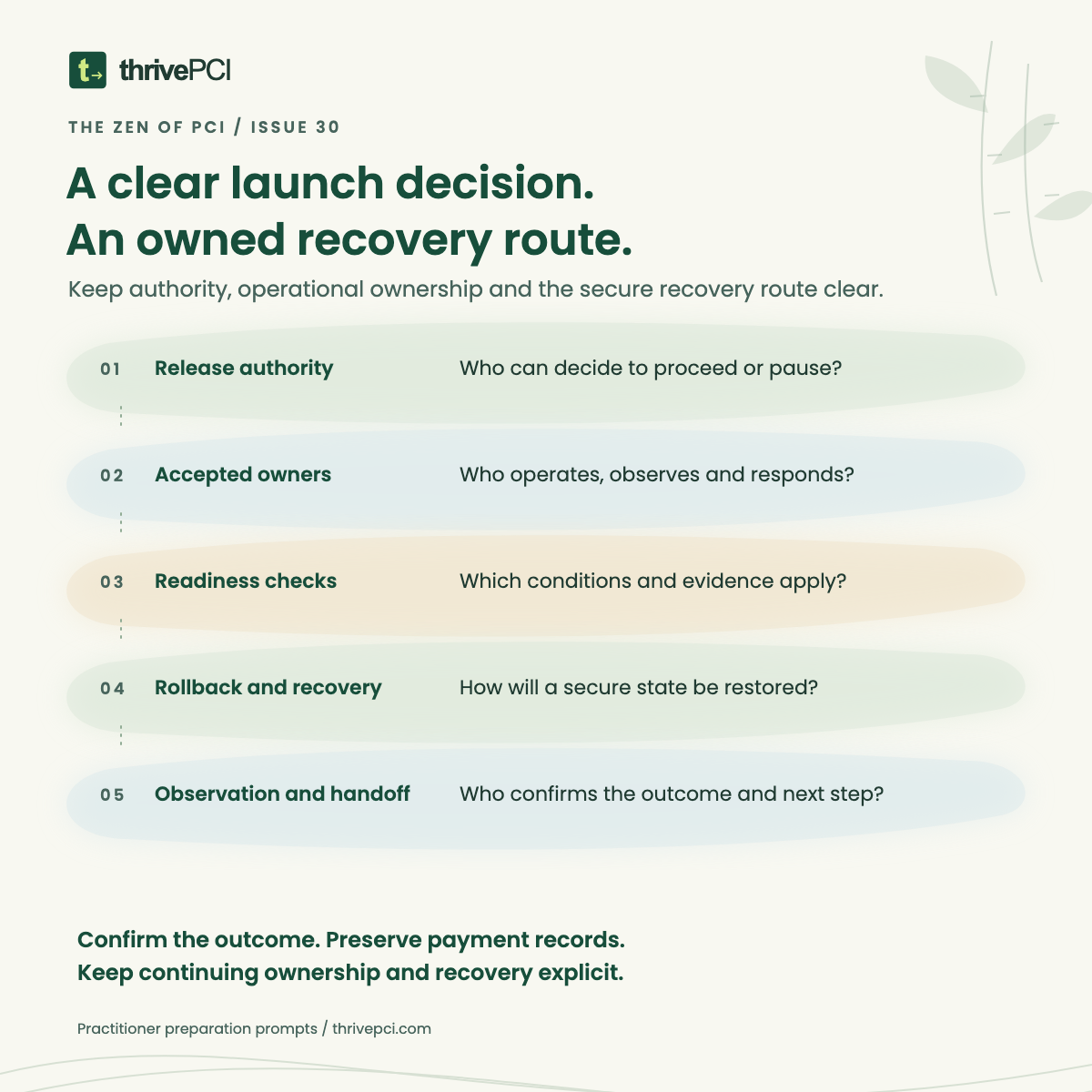
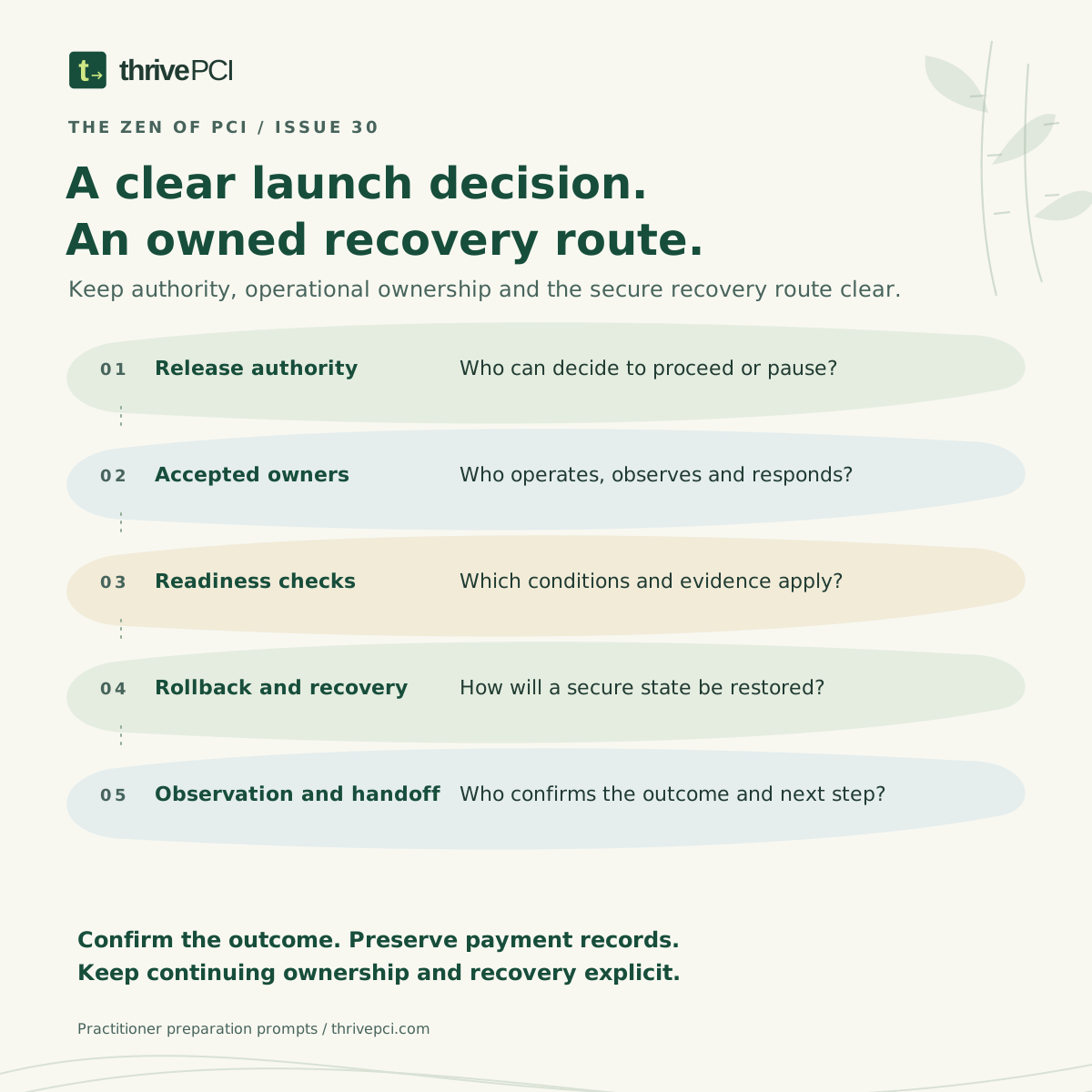
Five launch prompts: Release authority, Accepted owners, Readiness checks, Rollback and recovery, and Observation and handoff. Keep launch decisions, operational roles, payment records and recovery responsibilities clear.
Preparation prompts connect the release decision, accepted ownership, readiness conditions and a usable route to a secure state. Download PNG · Download SVG

Use five prompts to connect the release decision with the work around it:

Release authority: Identify the proposed change and the person or role authorized to decide whether it proceeds, pauses, or requires further review. Record the conditions for that decision and the approved route for changing it. A successful functional test, a calendar invitation, or a copied recipient does not supply release permission or establish PCI DSS compliance.

Accepted owners: Confirm who will execute, monitor, communicate, and coordinate provider support. Identify the accepted backup or escalation route if someone becomes unavailable. Explain the limits of each role's authority. One coordinator can keep the conversation moving while the business and provider retain their respective responsibilities. PCI SSC's guidance makes customer oversight of provider relationships an ongoing responsibility.

Readiness checks: Bring together the relevant test results, corrections, security work, configuration review, access approvals, operating instructions, and unresolved issues for the actual arrangement. Keep each condition's position and owner visible. Confirm what the authorized decision-maker needs to establish before release. A collection of green task labels should not conceal an unobserved result or an unmet requirement.

Rollback and recovery: Describe the conditions that call for pausing or recovering, who can decide and execute, and the approved steps for reaching a secure state. Choose triggers relevant to the service and its risks, with appropriate review. Confirm that any rollback is compatible with the current integration and records. A previous version is not automatically a safe destination. Where rollback is unsuitable, use the properly authorized recovery or containment route.

Observation and handoff: Agree what will be observed, who receives concerns, how provider and business contacts connect, and what establishes a stable operating position. Record what the next owner needs to know and confirm acceptance of the handoff. Keep monitoring, response, and required controls operating through the transition; the launch note does not suspend them.

Prepare a secure recovery route

Reverting code or configuration does not undo charges or refunds, repair order states, or settle transactions already in progress. Preserve the relevant payment and order records. Coordinate reconciliation of pending, repeated, or delayed events through the provider's documented process. Avoid a blind restore that loses current records or an improvised retry that creates duplicate financial activity.

In the fictional rehearsal, the team considers an order update that disagrees with the documented payment state. They explain who can pause the affected automated step through the approved route, who examines the records, and who contacts the provider. They practice the recovery decision using invented records and synthetic messages in an authorized test setting. No live payment activity is needed.

PCI DSS v4.0.1 addresses documented production change procedures, authorized approval, security-impact testing, and handling failures while returning to a secure state. It also addresses confirming applicable requirements on new or changed systems and networks after a significant change, with documentation updated as applicable. This launch note supports that work; it does not replace the applicable requirements or testing.

Observe and hand over

Walk the note with a partner. Leave one readiness condition open and one primary contact unavailable. Can they identify what must wait, the accepted backup, the recovery decision-maker, and the records that must remain intact?

Required incident-response processes continue if there is a suspected security incident. A release or recovery decision does not determine the business's PCI DSS validation and reporting method; confirm that separately with the appropriate compliance-accepting entity. A calmer launch leaves people able to act within their authority and recognize when the next decision belongs elsewhere.

Explore the free Provider Responsibilities guide (opens in a new tab)

LINKEDIN POST

Going live needs accepted owners and a usable recovery route

Suggested companion: download the matching PNG.

A tested integration gives the launch conversation useful evidence. The release still needs clear authority and accepted operational ownership.

Issue thirty of The Zen of PCI connects five prompts: Release authority, Accepted owners, Readiness checks, Rollback and recovery, and Observation and handoff.

Our fictional subscription startup has corrected and retested a notification mismatch. The team now confirms who may authorize the launch, who will execute and observe it, and how a concern reaches the right person.

Keep remaining conditions visible. Confirm availability and the accepted backup route before relying on a name in a plan.

A useful launch note helps the next person act within their authority. Which ownership question would make your next release conversation clearer?

Explore the free Provider Responsibilities guide (opens in a new tab)

LINKEDIN POST

Confirm the people behind the launch roles

A launch plan becomes more usable when each role has been accepted by someone who can carry it out.

Identify who can decide, execute, monitor, communicate, and coordinate provider support. Confirm availability and the backup or escalation route if a key person is away. Explain where each person's authority begins and ends.

A copied recipient is not automatically an available operator. One coordinator also does not take over every business, provider, or approval responsibility.

In a fictional rehearsal, make the primary contact unavailable. Ask a partner to find the accepted backup and explain which decisions still require someone else's authority.

Could the next person follow those routes without reconstructing the earlier conversations?

Explore the free Provider Responsibilities guide (opens in a new tab)

LINKEDIN POST

Make recovery more specific than go back to the old version

A useful recovery plan explains the conditions that need attention, who can decide, who can execute, and how to reach a secure operating state.

Confirm that a proposed rollback remains compatible with the current service and records. The previous version is not automatically secure or suitable. Where rollback cannot provide the right outcome, use the appropriately authorized recovery or containment route.

Choose triggers for the actual arrangement and its risks rather than borrowing an unexplained threshold from another team's plan.

Practice the decision with invented records in an authorized test setting. Keep required controls and incident-response processes in force.

Can the people involved explain the recovery route and the authority needed to use it?

Explore the free Provider Responsibilities guide (opens in a new tab)

LINKEDIN POST

Protect the payment records when recovering the integration

Reverting software or configuration does not undo a charge, reverse a refund, or settle a payment already in progress.

Keep payment and order records intact. Coordinate pending, repeated, or delayed events through the provider's documented reconciliation process. A blind restore can lose current records, while an improvised retry can create duplicate financial activity.

In our fictional launch rehearsal, an order update disagrees with the documented payment state. The team identifies who may pause the affected automated step, who examines the records, and who contacts the provider through the approved route.

Use synthetic examples for the exercise; no live payment activity is needed.

Does your recovery conversation account for the records as well as the code?

Explore the free Provider Responsibilities guide (opens in a new tab)

LINKEDIN POST

Leave one readiness condition open and rehearse the decision

Suggested companion: download the matching PNG.

Use an invented service, synthetic messages, and an authorized test setting to practice the launch conversation.

Write five prompts: Release authority, Accepted owners, Readiness checks, Rollback and recovery, and Observation and handoff.

Leave one condition unresolved and make a primary contact unavailable. Ask a partner to identify what must wait, who accepted the backup role, who can decide about recovery, and which payment and order records must remain intact.

Keep proposed actions distinct from permission to execute. A rehearsal does not authorize production use, waive required controls, or establish compliance.

The useful outcome is a note someone else can follow honestly. Which missing answer would your partner find first?

Explore the free Provider Responsibilities guide (opens in a new tab)

LINKEDIN POST

Leave a launch record the operating team can use

A clear launch note connects the authorized change with accepted owners, readiness evidence, a secure recovery route, and the observation and handoff that follow.

Use the free Provider Responsibilities guide to revisit the people and handoffs involved. Practice with an invented arrangement before carrying real decisions through the appropriate change, security, provider, and approval processes.

Keep payment and order state visible during recovery. A code rollback does not resolve financial activity already in progress, and a functional pass does not establish compliance.

The thrivePCI pilot page offers a free sample and a request-details route for further training. A request records interest without purchase or enrollment.

What would help your operating team take over with clearer ownership?

Try the free sample or request pilot details (opens in a new tab)

Primary sources behind this issue

PCI SSC guidance supports the technical points. The five prompts and fictional exercise are thrivePCI preparation practices.

Scott’s publication review

The campaign links include UTM labels for later reporting; this release adds no visitor tracking. Source copy and editorial notes are versioned in GitHub.

Download the complete newsletter and post copy

Download copy and visual review pack (ZIP)